|
Posted: July 10, 2026
CNYC TESTIFIED AT PIED-A-TERRE TAX HEARING
The Department of Finance held a hearing this morning on its rules for implementing the
pied-a-terre tax established by State legislation. CNYC submitted detailed written
comments and also testified orally at this hearing. All submitted testimony can be
viewed HERE.
The pied-a-terre tax ostensibly imposes a surtax on non-owner occupied luxury
apartments with a sales price of $5 million or more. It was passed in an effort to help
close the City’s budget gap without imposing additional tax burden on ‘everyday New
Yorkers’ who live and work in the city and pay taxes here. However, in the effort to
implement it swiftly, the State legislation sets interim formulas for determining which
cooperative and condominium units are affected rather than referring to actual recent
sales data.
CNYC’s extensive comments offer suggestions to help the Department of Finance more
equitably enforce the provisions of this law. If you live in a cooperative or condominium
where apartments may be subject to this tax (see the June 11 post on our homepage to
check) please consider entering a comment supporting CNYC’s testimony by end of
day, and reach out to us to be connected with other buildings facing the same situation
at [email protected].
RECORD KEEPING AND COMMUNICATIONS
EXPLORED MONDAY
IN BOARD BASIC CLASS #6
CNYC’s Board Basics series continues on Monday evening with a class designed to
help members organize store and sort essential records and to communicate effectively
with shareholders, service providers, government entities, etc. Register HERE to join
this Zoom class.
Posted: June 29, 2026
CHANGE IN HPD VIOLATION DISMISSAL PROCESS
FOR OLD VIOLATIONS EFFECTIVE JULY 1, 2026
Effective July 1, 2026, all HPD Violation Dismissal Request applications will be processed by a centralized unit located at 345 Adams Street, 10th Floor, Brooklyn, NY. This is intended to streamline services, enhance transparency, and reduce administrative hurdles.
Whenever possible, it is best practice to correct and certify violations issued by HPD by the required dates. Most violations corrected in a timely fashion can be certified online using HPD's E-Certification application. Here is a link to additional details:
E-Certification.
If you do have outstanding HPD violations, your co-op/condo may find it difficult to obtain permits, renew insurance policies, obtain beneficial loans, and qualify for J-51 or other abatements. Therefore, it is important to clear old violations.
When clearing HPD violations that were not timely certified as corrected, or are determined to have been falsely certified, you will need to request a reinspection before the violation(s) will be dismissed. This reinspection, known as a Dismissal Request Inspection, requires:
- Submission of an application by the property owner
- Payment of a fee
- Identification of all violations for which dismissal is sought (applications may cover some or all violations for a property)
After July 1st, Dismissal Request applications should be submitted to:
Central Violation Administration Unit (CVAU)
345 Adams Street, 10th Floor
Brooklyn, NY 11201
Applications may be mailed or delivered in person.
Dismissal request inquiries may be directed to (212) 863-8060 or
[email protected].
Note that the application form and instructions have been updated to reflect changes and require additional information, making it advisable to use the new application beginning immediately.
HPD has requested that CNYC share feedback on their new form and process. If you have comments, please email us at
[email protected].
NEW J-51 ABATEMENT PROGRAM
STILL REQUIRES CITY LEGISLATION AND RULE MAKING
CNYC is eager for the new J-51 program to be enacted by the City Council and signed into law, given the J-51-R program will sunset on June 30, 2026. While it is likely that any legislation will provide retroactive coverage for the period from July 1 through the date that the city legislation passes and the proposed rules are adopted, CNYC is actively advocating for the legislation to be introduced as soon as possible. To that end, CNYC has signed onto a letter to Mayor Mamdani along with Green Co-op Council, Coordinating Council of Cooperatives, NYPIRG, Align NY, +350BK, New York Communities for Change, the Climate Reality Project, the Jewish Climate Action Network NYC, Urbecon, New Yorkers for Clean Power, New York City 2030 District, and Food & Water Watch. It appears the letter has already succeeded in securing interest and action in the administration.
IMPORTANT REAL ESTATE TAX UPDATE
ACTION COMMITTEE FOR REASONABLE
REAL ESTATE TAXES
TO COMMENCE REGULAR MEETINGS
TO ADVOCATE FOR PROTECTION
FOR CO-OP AND CONDO HOMEOWNERS
ALL ARE INVITED AND ENCOURAGED TO JOIN
IN LIGHT OF LIKELY REFORMS
In recent months CNYC staff and board members have attended multiple events and meetings during which real estate tax reform proposals have been highlighted and discussed. Many of the proposals include shifting tax burdens and utilizing sales prices of "comparable" co-op and condo apartments for assessment purposes. This does not take into account the condition of apartments or buildings, and raises multiple concerns.
CNYC's Board of Directors and the Action Committee for Reasonable Real Estate Taxes are in the process of analyzing the proposed reforms and preparing policy statements while planning a major grassroots advocacy push. Given the impact an increase in real estate taxes would have on the housing costs of co-op and condo homeowners, CNYC urges widespread dissemination of this alert.
The Action Committee will begin to hold regular meetings beginning Thursday, August 12 at 6:00 PM on Zoom. All co-op and condo homeowners are welcome to attend and participate. Please alert your shareholders/unit owners and stay tuned for additional information. All can register
HERE.
Posted: June 15, 2026
NATURAL GAS LEAK DETECTORS
MUST BE INSTALLED BY JANUARY 1, 2027
Thanks to legislation introduced by Council Member Dinowitz, the requirement to install natural gas leak detectors in accordance with Local Law 157 was postponed due to a lack of available battery-powered options. The Department of Buildings has now identified four distinct manufacturers of battery-powered alarms, and therefore these alarms must be installed by January 1, 2027.
Commencing in January, HPD is to follow up on enforcement in accordance with Section 908.13 of the New York City Building Code and relevant Department rules. If your building has not already done so, please ensure that you prepare to purchase and install the detectors. CLICK HERE for information on how to install the detectors, and HERE for additional FAQs.
CNYC is exploring a potential group purchasing option, but does not have an agreement in place at this time. As a reminder, detectors must meet NFPA 715 standards for the installation of fuel gasses warning equipment.
IN-PERSON EVENT IN BROOKLYN COUNCIL DISTRICT 33
Thurs., June 25 | 6-8PM | Cadman Towers, 101 Clark St., Brooklyn, 11201
CNYC’s Brooklyn co-ops and condos are encouraged to join CNYC’s Director of Membership and Communication, Rebecca Poole, and CNYC’s President, Derek K. Jones, at a strategic decarbonization planning event led by Building Energy Exchange, the Mayor’s Office of Climate and Environmental Justice, NYC Department of Buildings, NYSERDA, Con Edison and cohosted by Council Member Lincoln Restler.
In this workshop -- geared for co-op & condo board members, building owners, and property managers — technical experts and industry professionals will outline how to improve your building’s performance through Strategic Decarbonization Planning, to improve energy efficiency and reduce energy costs, as well as meet compliance deadlines.
Speakers will answer your questions, offer information on financial incentives, and walk through actionable tools and resources you can utilize to incorporate decarbonization into your capital planning. Buildings with active resident managers or superintendents may also wish to forward information on the event to them as well.
REGISTER HERE and please let us know that you’re attending, by emailing us at [email protected]; We may gather before the event.
BUILDINGS IN MANHATTAN AND BROOKLYN
ARE REMINDED TO CHECK THE MARKET VALUE
OF LARGE APARTMENTS TO CONFIRM PIED-A-TERRE TAX INVOLVEMENT
Please see our previous e-blast below to determine if your co-op and/or condo has apartments with an imputed “market value” above $1 million.
ARE YOU FROM A SMALL CO-OP (40-UNITS OR LESS)
THAT WILL BE SUBJECT TO THE TAX?
Please reach out to CNYC by emailing Rebecca Poole at [email protected]. A CNYC member has volunteered to organize small, impacted co-ops to work on advocating for protective changes to the rules and legislation.
Posted: June 11, 2026
ALERT for Co-ops and Condos
in Manhattan and Brooklyn
Confirm Your Market Value
in Light of Impending Pied-a-Terre Tax
CNYC has concerns about the way in which the Pied-a-Terre tax will be implemented. We advocated for the use of sales prices from ACRIS, to ensure that only co-op and condo apartments that sold for $5 million or more would be potentially subject to the tax. We are in the process of thoroughly evaluating the rules and preparing comments.
In the meantime, we want our member co-ops and condos to be prepared in the event units in their buildings are included in the tax.
Co-ops and condos are advised to check the “Market Value” that the Department of Finance assigned to your apartments by the Department of Finance to avoid potential issues.
For Co-ops:
Step 1: Visit the Department of Finance’s Property Information Portal
By choosing the drop down menu under the blue select button you may choose to search for your building by address or by your borough block and lot number.
Step 2: View the “Assessment’ section by choosing the fourth blue button along the top labeled “Assessments” or by scrolling to the Assessment Section. Here you will see the “2026/27 Final Market Value” number on the left side of the box.
Step 3: Take the “market value” and divide that number by the total number of shares in your cooperative. If you do not know the total number of shares, they should be available in Schedule A of your offering plan and in your audited financial statements.
Step 4: Multiply the number of shares in your largest apartments by the result from Step 3.
Step 5: If the “market value” of any of the apartments in your cooperative is greater than $1 million, shareholders in your cooperative may be subject to the surcharge.
For Condos:
Step 1: Visit the Department of Finance’s Property Information Portal
Enter the borough, block and lot number for your condo.
Step 2: View the “Assessment’ section by choosing the fourth blue button along the top labeled “Assessments” or by scrolling to the Assessment Section. Here you will see the “2026/27 Final Market Value” number on the left side of the box.
Step 3: If the “market value” of an apartment in your condo is greater than $1 million, unit owners in your condominium may be subject to the surcharge.
LEARN MORE
If the market values of any apartments in your co-op and/or condo are close to or in excess of $1 million, register for CNYC’s upcoming class on the Pied-a-Terre Tax Legislation and the proposed Rules developed by the Department of Finance to find out how you can prepare.
REAL ESTATE TAX ALERT FOR ALL CO-OP AND CONDO HOMEOWNERS
It appears that the city and state will attempt to tackle real estate tax reform in the near future. A review of the Furman Center’s recently launched recommendations, and statements that a settlement is being negotiated in response to the TENNY lawsuit are concerning for co-ops and condos. CNYC will be activating the Action Committee for Reasonable Real Estate Taxes this summer, and advises all shareholders and unit owners to sign up.
On average, real estate taxes comprise 50% of a co-op’s expenses. Therefore, an increase of 10% in real estate taxes would likely result in a 5% increase in maintenance. Condo unit owners can determine what a similar increase would mean for their tax payments. Other groups are commencing advocacy efforts around the narrative in the Furman Center’s report and the TENNY lawsuit, and it is essential co-ops and condos begin coalescing now.
UPCOMING CLASSES AND EVENTS OF INTEREST
Monday, June 15 at 6pm on Zoom CNYC will host the next class in its Board Basics Series, “Working with Your Professionals.” Moderated by board member Isabel Taube and property manager Mark Levine of EBMG the class will cover best practices boards can rely on to ensure that their properties run smoothly and efficiently.
REGISTER HERE.
Wednesday, June 17 in Person Building-Energy Exchange will host a “Heat Pump Expo” where you can experience heat pumps in action and speak with the manufacturers. It is an all day event, and interested participants can visit between 12-7. Registration is required. If your building’s superintendent or resident manager is engaged in your decarbonization work consider sharing the event with them.
Thursday, June 18 at 6pm on Zoom If the Pied-a-Terre tax might impact your building please ensure you’re prepared. Attend CNYC’s class with Herrick Attorneys Mark Limardo and Andrew Freedland, tax certiorari attorney Robert Pollack of Marcus and Pollack, and CNYC Board Member Jeff Rose, where you will receive advice on how to best prepare your shareholders and/or unit owners and your building, and learn about CNYC’s ongoing advocacy efforts. CLE Credit will be available. Property managers, attorneys and accountants are welcome.
REGISTER HERE.
Posted: June 5, 2026
NYS BUDGET SUCCESSES AND CONCERNS
CNYC’s state advocacy has resulted in multiple wins for co-op and condo homeowners.
FUNDS FOR CO-OP AND CONDO HOMEOWNERS IN THE SUSTAINABLE FUTURE FUND
Pending program development
The Sustainable Future Fund acknowledged the need to provide incentives directly to co-op and condo homeowners for decarbonization and energy efficiency work by allocating funds as part of the state budget.
Over the past three years CNYC has been working on obtaining equal incentives for individually income-qualifying co-op and condos homeowners as are available to single-family homeowners through meetings with State Assembly Members, State Senators, NYSERDA, the Governor’s office and the Department of Budget. Recognition in the state budget is an important step forward. CNYC will continue these efforts over the coming months.
EXPANDED SENIOR CITIZEN HOMEOWNER EXEMPTIONS (SCHE)
AND DISABLED HOMEOWNER EXEMPTIONS (DHE)
Pending Required City Legislation
The New York State budget includes an increased annual income cap of $75,000 for Senior Citizen Homeowner Exemptions (SCHE) and Disabled Homeowner Exemptions (DHE). This increased access to tax relief will provide additional seniors and disabled homeowners with the opportunity to obtain assistance with carrying charges and potentially remain in their homes.
CNYC organized an email campaign and attended a press conference in support of this increase and is now working to ensure the necessary legislation is introduced and passed in New York City. If passed by the City Council and signed into law by the Mayor,
the help provided to seniors and disabled homeowners on fixed incomes will help prevent receivables and potential displacement.
EXPANDED 10-YEAR J-51 PROGRAM
Pending Required City Legislation and Rule Development
The New York State budget includes a new 10-year J-51 Program with an annual escalator clause and a higher assessed value per unit cap of $60,000 — enabling an additional 600+ coops and 1,000+ condos, representing over 78,000 households to apply for tax abatements for qualifying capital work. Additionally, the legislation also reduces the cost of applying to a set $75 per apartment up to a total fee of $20,000. And, it requires HPD to review their certified costs biennially in order to ensure they remain up-to-date over the full 10-years.
CNYC worked for these adjustments, beginning with budget testimony in January, and continuing throughout the session with meetings with Assembly Members and State Senators from across New York City. We are now working on ensuring the City introduces and passes the enabling legislation.
Thanks to the Association of Riverdale Cooperatives and Condominiums (ARC), the Coordinating Council of Cooperatives (CCC) and Communities for Change for joining with CNYC in requesting the escalator clause in their written memorandums.
The State’s legislative session is set to conclude this evening at 7PM. CNYC will provide further updates early next week regarding the legislation of import to co-ops and condos.
Posted: May 27, 2026
IMPLEMENTATION ISSUES FOR COOPERATIVES IN THE PIED-A-TERRE TAX PROPOSALS
Albany law makers are preparing to vote in the long-awaited State budget. It includes a pied-a-terre tax on second homes in New York, including residential cooperative and condominium homes with a sales price of $5 Million or more, or a market value as calculated by the department of finance to be $1 Million or more, which would be based on share distribution in a cooperative. In this initial year of its implementation the pied-a-terre surcharge will not be included in property tax bills payable July 1st. Instead they will be billed in August.
CNYC is not opposed to pied-a-terre tax on cooperative and condominium homes with a recorded sales price of $5 Million or more, provided that the shareholder or unit owner does not file taxes in New York City, immediate family members and/or beneficiaries of a trust or LLC that owns the shares or unit do not reside in the apartment, and the apartment is not sublet or leased pursuant to the governing documents of the cooperative or condominium. CNYC believes that the Department of Finance should deal directly with shareholders and unit owners who are subject to the pied-a-terre tax and collect directly from them.
CNYC has concerns with:
- The proposed means of utilizing a market value of $1 Million as a cut-off for the tax;
- Language that requires housing cooperatives to: (1) take responsibility for the notification of potentially impacted shareholders and (2) collect and pay the proposed surcharge;
- Utilizing the same methods of determining “primary residency” as are currently used for qualifying shareholders and unit owners for the co-op/condo tax abatement and SCHE and DHE benefits;
- Lack of an established means for shareholders and unit owners to challenge the surcharge and their residency status.
A CO-OP ‘MARKET VALUE’ OF $1 MILLION
WOULD TRIGGER THIS TAX
Utilizing a market value of $1Million as currently calculated by the Department of Finance for New York City cooperatives in tax class 2 as a floor for instituting the pied-a-terre tax, gives this legislation the potential to impact over 1,000 of the City’s approximately 7,000 cooperatives. Apartment homes in housing cooperatives range in size from studios to 3+ bedrooms, including combined apartments.
Therefore while there are fewer that 500 cooperatives with an average market value per apartment of $1 Million or greater, a review of data indicates that many of the approximately 2,000 cooperatives with an average market value of over $300,000 could be subject to this legislation depending on the breakout of apartment sizes and share distribution. The increase in scope resulting from this use of market values raises concerns over how implementation will be handled and the means by which the department of finance will determine residency status.
REQUIRING CO-OPS TO NOTIFY IMPACTED SHAREHOLDERS
AND TO COLLECT AND REMIT PIED-A-TERRE SURCHARGES
WILL INCREASE LIABILITY TO THE COOPERATIVE
Unlike in single-family homes and condominium homes where homeowners pay their real estate taxes directly, it appears the pied-a-terre legislation will require cooperatives to:
- Receive and relay notice of the department of finance’s inclusion of an apartment in the pied-a-terre tax to the shareholder
- Pay the surcharge and any related penalties and interest regardless of whether or not the shareholder contests the charge
- Attempt to collect the surcharge from the shareholder
The majority of cooperatives that may be impacted by this legislation have an average of around 37-units, including many cooperatives that are currently in class 2C with 10-units or fewer. Therefore, the requirement that the cooperative pay any surcharge and then collect the funds from the responsible shareholder may result in long-term homeowners, including seniors, living in smaller units having to cover thousands of dollars in contested fees. Dispensation must be made in the legislation for cooperatives acting as a conduit for collections until such time as the department of finance develops a way to notify and charge non-resident shareholders for the pied-a-terre tax directly.
ISSUES WITH DETERMINATION OF RESIDENCY STATUS
CNYC supports the premise that all homeowners who pay New York City income taxes at an apartment in their cooperative or condominium should be exempt from this surcharge. Over the past few years administrative issues have arisen around residency status as it pertains to the co-op/condo tax abatement and SCHE benefits.
Shareholders who are New York City residents and have been removed from abatement rolls or stopped receiving SCHE benefits have had difficulty reversing the decisions. This legislation would give the Department of Finance discretion to set the parameters governing:
- The information used to determine whether or not a homeowner is a resident
- The amount of time a shareholder or unit owner will have to respond with proof of their residency
FUTURE DETERMINATION OF MARKET VALUE
The legislation designates two phases, using current Department of Finance ‘imputed market value’ to establish surcharges for fiscal years 2026 and 2027 and then anticipates the consideration of sales prices beginning in fiscal 2028.
The legislation allows for potentially broad determination of market values of cooperatives and condominiums in phase 2. It is well known and accepted that condominiums and cooperatives do not have the same sales value, and that newer condominiums built in gentrifying neighborhoods impact sales values in many ways.
Real estate taxes represent 50% of the average cooperative’s operating expenses, and therefore 50% of the normal cooperative homeowner’s carrying charges. Should the future market value of cooperatives in areas that are undergoing rapid gentrification due to new construction, such as Washington Heights and Inwood and the South Bronx and Long Island City be determined by the sales values of those “comparable” units, many long-term homeowners in non-updated apartments in existing older buildings will be priced out of their homes.
CNYC urges that any plans for changes to assessments be handled separately and open to public comment.
A broader issue is the tax reform changes strongly suggested in this legislation, changes that are likely to include sales values of units in cooperatives and condominiums. CNYC will follow closely any proposed changes in property taxes.
CHANGES IN THE CLCPA ENACTED
There have also been changes enacted in the Climate Leadership and Community Protection Act (the CLCPA) which set legally binding climate and clean energy goals when it was enacted in 2019. CNYC will review these changes and provide analysis in future Updates.
Posted: May 20, 2026
EXPANDED J-51 BILL INCLUDED IN STATE BUDGET
Thanks to the efforts of Governor Hochul and lawmakers including Senator Kavanagh, Assembly Member Braunstein, Assembly Member Rosenthal, Senator Bottcher, Senator Cleare, Senator Jackson, Senator Sepúlveda, Senator Stavisky, Assembly Member Dais, Assembly Member Dinowitz, Assembly Member Lee and Assembly Member Williams, an expanded J-51 bill that includes an annual escalator and reduced application fees has been included in the New York State Budget.
The new J-51 program will now require city legislation and rule-making to enact its provisions. It is set to cover eligible capital work that is completed within the period from June 30, 2026 through June 29, 2036.
The assessed value per unit cap required to qualify for the new J-51 program will start at $60,000 per unit in 2026 and will be adjusted annually to reflect any increase in the consumer price index. The revised caps will be posted annually by the appropriate city agencies. Co-ops and condos will need to meet the eligibility standards at the commencement date of the work.
The new J-51 filing fee is less than the fee assessed for J-51-R
applications. The $1,000 base fee has been removed and a cap has been implemented, so the new fee is $75 per dwelling unit up to a maximum of $20,000.
Finally, qualifying buildings will be eligible to receive abatements that are 100% of the “certified reasonable costs" established by HPD and updated at least every two years to reflect changes in costs. (Note that certified reasonable costs are not necessarily the cost of the work.)
While the bill falls short of the $75,000 cap CNYC was seeking, CNYC believes that this new bill greatly improves upon prior J-51 programs. If your elected official is mentioned above, please reach out and thank them for their efforts on your behalf.
CNYC will continue to work to bring additional abatements and incentives to more co-ops and condos and co-op and condo homeowners throughout the city. We will keep you posted as the remainder of the budget is slowly rolled out.
CNYC thanks its Legislative Review Committee Members: Tania Arias,
Bruce Cholst, John Carlisle, Mary Fischer, Isabel Taube, John Vetere and Elise Yablonski, as well as CNYC members Andrea Arnold and John Vetere for leading the charge in Albany.
June 2 LL97 Sustainability with Affordability Class
On New Strategic Decarbonization Planning (SDP) Tools
to include Case Study on a Successful C-Pace Application
The Council of New York Cooperatives & Condominiums is pleased to host the Building Energy Exchange (BE-EX) and the NYC Mayor’s Office of Climate and Environmental Justice (MOCEJ) on June 2 at 6PM on Zoom to introduce the new Strategic Decarbonization Planning (SDP) Tools designed to help co-op and condo boards and their property managers find financially optimal strategies for LL97 compliance.
A panel discussion featuring two sample co-ops/condos taking different routes to compliance will follow the presentation of the resource. One of the buildings secured a C-Pace loan, and they will review how they were able to access it, and what the financing will look like.
The event will conclude with a Q & A session in which audience members will have the opportunity to engage. This presentation is part of CNYC’s ongoing Sustainability with Affordability series. All are welcome. To register and receive the zoom link for this event, click HERE.
Posted: May 19, 2026
CNYC Will Comment on New Containerization Rules
Requiring Co-ops and Condos
to Assume Responsibility for Snow Clearance
DSNY has proposed new rules for the Empire Bin Containerization Program for residential buildings ten units and greater in the pilot districts. Comments are due by June 17 and a hearing will be held June 17 at 9:30 AM.
Per the proposed rules:
- The pilot programs in Manhattan Community District 9 and Brooklyn Community District 2 will be extended through October 15, 2026 and “medium” buildings (buildings with 10-30 apartments) will have an opportunity to opt-in to the stationary on-street containers between July 1, 2026 and July 31, 2026.
- Buildings utilizing the containers in the pilot districts will be held responsible for performing additional maintenance work extending 18 inches beyond the containers into the street (roadway), including:
- Ensuring that containers are kept clean, well-maintained and clear of trash, debris, graffiti, vermin, food scraps, and unsanitary conditions
- Removing all snow and ice around and between containers and around the protective bollards - the requirement for snow removal includes the area 18 inches beyond the container on the street (roadway) side
- Distributing to their employees training materials provided by the Department relating to how to set out such refuse in such container, and providing employees with any personal protective equipment reasonably necessary for such purpose
CNYC’s testimony will address the additional liability and costs that will likely be incurred by cooperatives and condominiums as a result of these proposed rules.
If you are currently in a pilot district, please reach out to us at [email protected] or [email protected] to let us know (1) how snow removal was handled this past winter, (2) if you received any violations due to the need to keep passersby from leaning items on the containers, and (3) how the containers are working for you and your employees.
Posted: May 8, 2026
JOIN CNYC IN ALBANY ON TUESDAY, MAY 12
TO URGE CITY AND STATE LAWMAKERS
AND GOVERNOR HOCHUL
TO SUPPORT CO-OP AND CONDO HOMEOWNERS
WITH FINANCIAL ASSISTANCE
CNYC is travelling to Albany for an 11:30 AM press conference and rally to encourage NYS Legislators to include Senator Kavanagh’s J-51 and SCHE/DHE bills in the NYS Budget. Together these bills would expand and secure long-term access to tax abatements for co-ops and condos performing capital work, and help income qualifying senior and disabled co-op and condo resident-homeowners cover their housing costs.
With the state and city budget negotiations wrapping up shortly, this appears to be a pivotal opportunity to visibly demonstrate the affordability concerns of co-op and condo homeowners, who are already being asked to shoulder the costs of multiple capital mandates while enduring increases in real estate taxes, utility pricing and insurance premiums.
PLEASE REGISTER TO LET US KNOW IF YOU CAN ATTEND.
If you cannot attend, please join us in asking your City Council Member, New York State Assembly Member, and State Senator to support the tax abatements.
CNYC SUPPORTS S.1457-B/A.5344-A
TO REDUCE HOUSING COSTS FOR QUALIFYING SENIORS
S.1457-B/A5344-A would increase the threshold to qualify for NYC’s Senior Citizen Homeowner Real Estate Tax Exemptions and Disabled Homeowner Real Estate Tax Exemptions from an annual income for a 2-person household from $58,399 to $75,000 (NOT including IRA distributions). If this does not affect you directly, there are surely
neighbors in your cooperative or condominium whom this change could enable to continue to afford to live in their homes.
URGE STATE LAWMAKERS AND GOVERNOR HOCHUL
TO SUPPORT FOR S. 8170-A/A.10549
TO MITIGATE COSTS OF CAPITAL IMPROVEMENTS
Senator Kavanagh and Assembly member Braunstein seek to raise the threshold to qualify for the J-51 Program to average assessed value of $75,000 per unit, with annual escalations in this amount . This higher amount will greatly increase the number of cooperatives and condominiums able to qualify for this program during the ten years
that it is proposed to continue in effect. The J-51 program returns to buildings in the form of tax abatements over a period of 12 to 20 years a portion of the cost of qualifying improvements, which will include decarbonization and energy efficiency projects.
ASK YOUR CITY COUNCIL REPRESENTATIVE
TO SPONSOR RESOLUTIONS OF SUPPORT
FOR THESE TWO IMPORTANT BILLS
Both bills mentioned above are for NYC programs. It is important that the City Council show its support for these important measures. Please contact your City Council member, remind them how important incentives are for your co-op or condo and its resident homeowners. Ask them to help show City Council support for both measures.
AREAL ESTATE TAX INCREASES THREATEN
HELP CNYC DEMONSTRATE
FOR TAX FAIRNESS THROUGH A VIRTUAL RALLY
New York City cooperatives and condominiums currently pay 18% of property taxes collected by the city. As homeowners, we operate our co-ops and condos to provide the best possible safety and quality of life at the most economical cost. Property taxes consume a high portion of what we each pay to live in our homes. With a significant escalation of property taxes under discussion, we see your help emphasizing our status as homeowners committed to the City and wanting to thrive here.
Please gather a group of at least 10 unit owners/shareholders of diverse ages, etc, in front of your building with a big sign that says WE ARE HOMEOWNERS for a photo to send to CNYC to use in our campaign for property tax fairness.
Posted: May 5, 2026
CNYC BOARD ELECTIONS
CNYC thanks everyone who attended the Annual Meeting last Thursday. Please join us in welcoming the following Board members to the CNYC Board for 2026/27:
Tania Arias
Corinne Arnold
Bruce Cholst
Vivian Falto
Mary Fischer
Leon Geoxavier
Derek K. Jones
Nathan Lichtenstein
Jeff Rose
Elyse Waldinger
Arthur Weinstein
The Board will hold its organizational meeting on May 12.
URGENT CALL TO ACTION
CNYC urgently seeks your help obtaining the passage of two bills in the New York State Legislature. Please act NOW, and share this e-blast widely. Please also print it and place a copy in your lobby.
FIND YOUR NYS ASSEMBLY MEMBER
FIND YOUR NYS SENATOR
FIND YOUR NYC COUNCIL MEMBER
Pass a Bill to Help Co-op and Condo Seniors and Disabled Homeowners Afford their Housing Costs
>> Ask Your City and State Representatives to Expand SCHE (Senior Citizen Homeowner Exemption) and DHE (Disabled Homeowner Exemption) Eligibility to Bring Real Estate Tax Relief to more Co-op and Condo Homeowners in Need (S.1457B/A.5344A)
The Senior Citizen Homeowners' Exemption (SCHE) and the Disabled Homeowners' Exemption (DHE) offer a reduction of 5 to 50% on New York City's real property tax to qualifying seniors age 65 and older and permanently disabled homeowners.
Currently, to be eligible for SCHE or DHE shareholders/unit owners must earn no more than $58,399 a year (as determined by their adjusted gross income (AGI) less the taxable amount of any IRA distributions or IRA annuity distributions). S.1457B/A.5344A would increase that threshold to $75,000 annually, enabling many more senior and disabled co-op and condo homeowners to obtain real estate tax relief, thereby bringing down their maintenance/common charges and enabling them to make timely payments and remain in their homes.
PLEASE contact your Assembly Member, State Senator and City Council Member ASAP, and ask them to support S1457B/A5344A to help you, and/or your neighbors continue to be able to afford to remain in your co-op/condo.
Ensure that J-51 Tax Abatements are Available to More Co-ops and Condos
>> Tell Your City and State Representatives to Support (S.8170A/A.10549) and Enable Co-ops and Condos with an Assessed Value of $75,000 per Unit or Less to Qualify for J-51 Tax Abatements for Qualifying Capital Work
The J-51 Program provides qualifying co-ops and condos with an opportunity to obtain a real estate tax abatement for qualifying capital projects, such as roof, window and/or boiler replacements. The abatement, which is spread over 12-20 years, allows co-ops and condos to replenish reserve funds, and/or pay off loans by lowering real estate tax bills.
Under S.8170/A.10549 any co-op or condo with an assessed value of up to $75,000 per unit would qualify for the program. The legislation also institutes an escalator, so co-ops and condos that qualify for the program today would most likely continue to qualify over the next ten (10) years. Without the escalator, co-ops and condos with an assessed value of over $45,000 per unit, will almost certainly stop qualifying after a few years. If the City and State are serious about ensuring the affordability of co-op and condo homeownership, while encouraging decarbonization, sustainability and resiliency, this is a critical first step.
PLEASE contact your Assembly Member, State Senator ASAP and City Council Member and ask them to support S.8170/A.10549.
Curious if your building would qualify? Visit the DOF's Website, view your "Taxable/Billable Assessed Value" and divide by the number of units in your building. OR, email the CNYC Office at [email protected].
WILL YOU ATTEND A RALLY AND PRESS CONFERENCE IN SUPPORT OF THESE BILLS AND PRESERVING THE AFFORDABILITY OF OUR HOMES? LET US KNOW.
THE RALLY WILL BE SOME TIME THIS WEEK - EXACT DATE TBA.
Posted: April 29, 2026
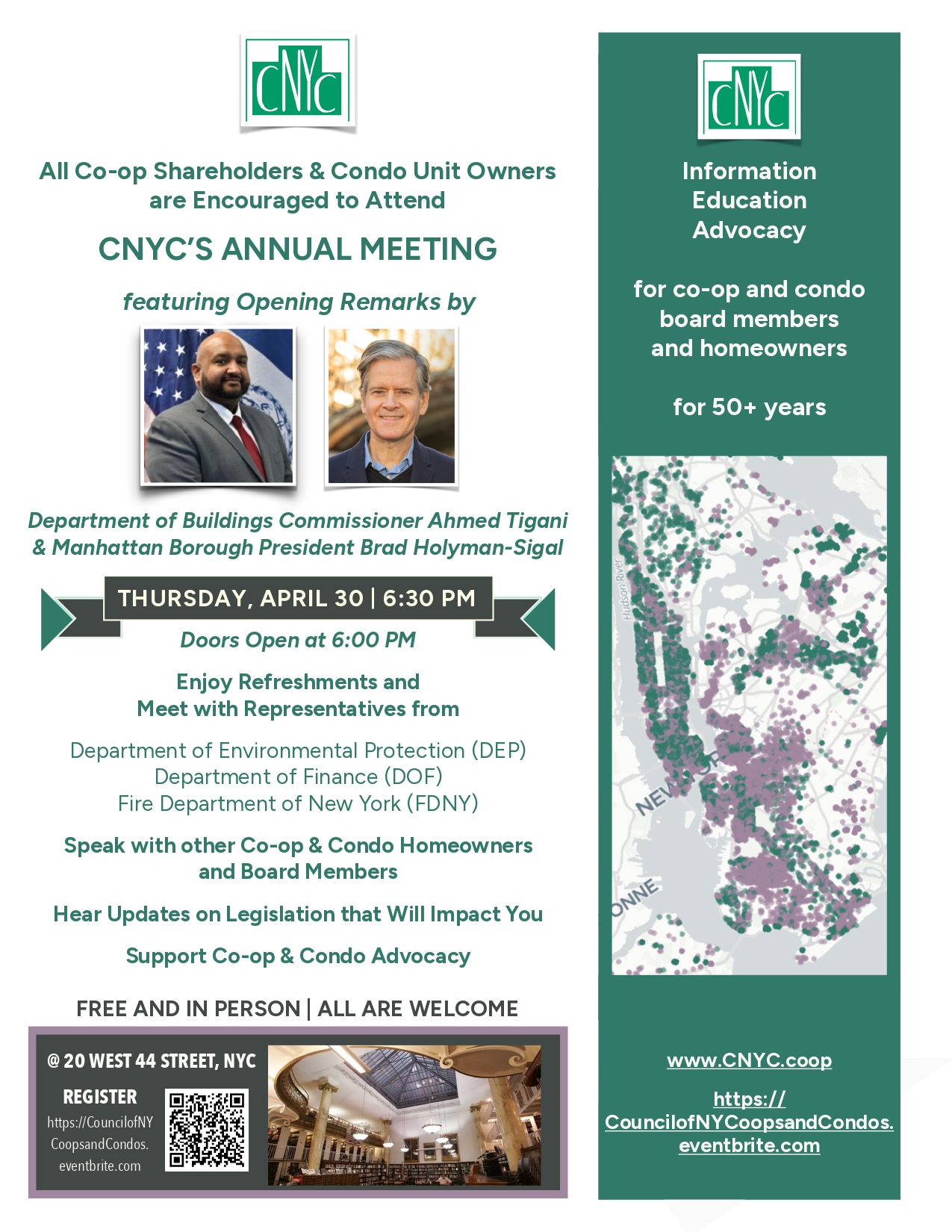
TOMORROW, THURSDAY, APRIL 30TH
At 20 West 44 Street in Manhattan
AS WE CELEBRATE MEMBERSHIP!
Come to CNYC’s Annual Meeting tomorrow evening for the launch of our new member platform, which will bring CNYC’s vast resources and community access to your fingertips! And a demonstration of our new data dashboard which gives you easy access to information on the number of impacted co-ops and condos in your district when you need to advocate for your co-op or condo.
You’ll hear highlights of the advocacy successes we achieved with your
partnership and you’ll witness the rollout of our 2026 Co-op/Condo Legislative Scorecard, which CNYC will use to help protect your co-op or condo from additional costs.
Doors open at 6 PM for networking and for those participating in the election of directors to get their ballots. There will be light refreshments, tabling by the Department of Finance, FDNY, and the Department of Environmental Protection and an opportunity to network with fellow co-op and condo board members as well as CNYC Professional Subscribers.
The formal meeting will be called to order at 6:30 PM and Commissioner Ahmed Tigani of the NYC Department of Buildings will be our first guest speaker.
We are pleased to announce that Peter E. Blond, Esq. of Brandt, Steinberg, Lewis & Blond LLP will provide an overview real estate tax trends and concerns, and Beth M. Gazes, Esq. of Gallet Dreyer & Berkey LLP will review the new administrative requirements for Co-op Admissions.
All co-op and condo homeowners are welcome at the Annual Meeting, which will provide an insight into the issues facing co-op and condo boards, as well as an overview of the resources that are available. Please feel free to circulate the attached flyer via building link or email, and/or post it in your lobby. Click HERE to register to attend.
PROPOSED RULES
FOR MAINTAINING SIDEWALK SHEDS
The Department of Buildings (DOB) held a hearing on April 27 for the proposed rules to implement Local Law 48 (LL48) and Local Law 51 (LL51) which became effective January 12, 2026.
Under the proposed rules, buildings:
- have five months to file construction plans commencing when a shed is installed
- have eight months to apply for permits
- have two years to complete all required repairs
Missing any of these deadlines results in penalties. While there are options to apply for extensions, the reports that must accompany the requests will be costly, and there are fees involved.
Buildings will also have increased obligations for documenting and maintaining proof of progress throughout the entire project, starting when the sidewalk shed is installed.
In order to obtain a sidewalk shed renewal permit - which is now required every 90-days starting 180-days after the shed is installed - buildings must:
- Contract with your engineer/architect to provide reports detailing the work completed, the work in progress, and the timeline to finish the project for every 90-day shed permit. The reports filed with the permit renewals must include photographs and require inspections.
- Ensure your contractor or project manager keeps a weekly log onsite that is available to the DOB and your engineer/architect showing what work was done, where the work was done, what % of work was completed and what is scheduled to be done next.
It will be important to remain vigilant and follow up with your professionals weekly. If your building does not meet filing requirements, penalties will range from $2,500 to $20,000+ depending on the deadlines missed.
CNYC provided testimony pointing out the cost of the permit renewals to the average homeowner, and the difficulty boards will face meeting the 5-month and 8-month deadlines, but boards should be prepared for the rules to be adopted.
Posted: April 28, 2026
Posted: April 24, 2026
CNYC TO TESTIFY AT HEARING
FOR PROPOSED SIDEWALK SHED RULES
The Department of Buildings is holding a hearing on Monday, April 27 on the proposed rules for
sidewalk shed permit renewal requirements. CNYC will testify and submit written comments on
the regulations, which add to the administrative work required of contractors, registered design
professionals, and shed installers in an effort to expedite facade projects.
The proposed rules can be found here:
https://rules.cityofnewyork.us/wp-content/uploads/2026/03/Proposed-Rules-Amendment-of-
Rules-relating-to-Sidewalk-Sheds.pdf
DON’T MISS CNYC’S ANNUAL MEETING
THURSDAY, APRIL 30th AT 6 PM
IN PERSON AT
20 WEST 44 STREET IN MANHATTAN
In addition to opening remarks by DOB Commissioner Ahmed Tigani, attendees will have an
opportunity to hear important updates on proposed legislation, the city and state budgeting
process, property tax trends, local law 97 updates, what to consider as you prepare for the new
co-op admissions law (1120B) and more. REGISTER TODAY
Posted: April 23, 2026
BUILDINGS COMMISSIONER TIGANI TO ADDRESS
CO-OP AND CONDO HOMEOWNERS
AT CNYC’S ANNUAL MEETING
CNYC thanks the Commissioner of the NYC Department of Buildings (DOB),
Ahmed Tigani, for agreeing to address co-op and condo homeowners at CNYC’s
Annual Meeting on April 30, 2026, at 6:30 PM, at the General Society for the
Mechanics and Tradesmen at 20 West 44 Street in Manhattan.
As Commissioner, Mr. Tigani is striving to “foster collaboration, ensure operational and
programmatic alignment, and strengthen partnerships with external stakeholders in
order to ensure DOB is a thoughtful steward driving building safety, efficiency, and
innovation.” Advancing this type of partnership with city agencies has been a hallmark
of CNYC’s for many years. Open lines of communication are critical for addressing co-
op and condo concerns and enabling co-op and condo homeowners to contribute their
ideas and knowledge towards our shared goals of preservation, energy efficiency,
resiliency and financial sustainability.
CNYC’s annual meeting is open to all co-op and condo homeowners at no cost. Doors
open at 6 PM for registration, networking and talking with City Agencies, including DEP,
DOB and FDNY. Commissioner Tigani will address members as the formal portion of
the meeting is called to order at 6:30 PM. We hope you will attend and encourage other
shareholders and unit owners in your building to attend as well. Click HERE to register.
RECORDED DEBATE ON CO-OP CONDO ISSUES
AMONG COUNCIL DISTRICT 3 CANDIDATES
IN APRIL 28 th SPECIAL ELECTION
CNYC thanks Trevor Stewart and the Co-op/Condo Forum for moderating, and co-
hosting last night’s debate on co-op/condo issues, and candidates Leslie Boghosian
Murphy, Lindsey Boylan, Layle Law-Gisiko and Carl Wilson for spending their evening
with co-op and condo homeowners. Everyone eligible to vote in City Council District 3
should watch this video before casting their vote in the special election.
We urge co-op and condo homeowners throughout the city to watch the debate and
consider co-hosting one with CNYC during future contested elections. Events such as
the one last night add to the understanding of future elected officials and benefit the co-
op/condo community.
You can watch the event here: https://www.youtube.com/watch?v=Byc_Aq6fUr0
Posted: April 17, 2026
FAIR AND EQUITABLE AGREEMENT
REACHED WITH 32BJ
FOR NEW FOUR -YEAR CONTRACT
IN HARD FOUGHT NEGOTIATIONS
CONCLUDED BEFORE EXPIRATION
OF THE PRIOR CONTRACT
At 2:10 PM on Friday, April 17, 2026, Howard Rothschild, president and CEO of the
Realty Advisory Board on Labor Relations Inc. faced the large delegation of negotiators
for Local 32BJ of the Building Service Employees International Union and announced
“We accept your most recent offer.” signaling tentative agreement on a new four year
contract for 32BJ members who work in residential buildings in Brooklyn, Manhattan,
Queens and Staten Island. This brings to a successful conclusion many weeks of
negotiations—and does so with more than three days to spare before the expiration of
the current contract.
This contact includes wage increases for 32BJ workers of:
$40 per week effective April 21, 2026,
$40 per week effective April 21, 2027,
$50 per week effective April 21, 2028 and
$50 per week effective April 21, 2029.
Pension contributions continue at $4 per week; and retirees will experience a 15% increase in their retirement benefits at no additional expense to employers. Past contributions to the Legal and Training Funds continue, and the Health Plan requires only modest increases. In fact, the excellent condition of the Health Fund has made possible a one-time adjustment to employer payments, which brings the overall cost increase to employers over the life of this contract to slightly over 3%.
The tentative agreement is subject to ratification by the Board of Directors of the Realty Advisory Board and the membership of the Union. Once ratification occurs, full details of the agreement will be explained on the RAB website at rabolr.com and discussed in future CNYC updates.
This is a pattern agreement; all the residential members of the RAB will have the option of assenting to it once it has been ratified by the RAB and the Union. It will expire at midnight on April 23, 2030.
Posted: April 17, 2026
CNYC IS COMMITTED TO REMAINING AN INDEPENDENT VOICE ON BEHALF OF – AND FUNDED BY NEW YORK’S COOPERATIVE AND CONDOMINIUM HOMEOWNERS
The recent formation by the real estate industry of an advocacy entity that claims to speak for all cooperatives and condominiums has prompted us to explain what CNYC is and how it differs from any developer or sponsor group. CNYC is a member-funded not-for-profit organization. Its mission is to represent and advocate exclusively for the interests of co-op and condo homeowners. Our funding structure ensures that priorities, policy positions, information, education and advocacy efforts remain fully aligned with the community we are striving to empower—without competing developer, sponsor or industry pressures. While CNYC has a track record of successfully partnering with the real estate industry on areas of mutual interest, and intends to continue along those lines, maintaining our independence is more important now than ever given the changing political dynamics of New York City. CNYC must not lose focus; at a time when the issue of affordability for co-op and condo homeowners is coming to the forefront, it is imperative that we remain unhindered by the separate issues facing other real estate interests, including developers.
For over 50 years CNYC has been able to speak with credibility on issues such as regulatory burdens, incentives, abatements, real estate taxes, co-op admissions and building-level financial sustainability. All positions taken by CNYC are derived from the lived experiences of co-op and condo homeowners and promote the long-term viability and affordability of co-op and condo homes. In an environment where many organizations rely on developer or industry funding, our structure provides a distinct and trusted voice. Like all homeowners, co-op and condo homeowners are not part of the developer industry; they are homeowners living in multi-family buildings in self-governing communities.
CNYC is entering an exciting moment. We are being heard at all levels of government. Co-op and condo board members from CNYC member buildings reached out to officials and testified at hearings last year in great numbers, resulting in multiple legislative and regulatory victories and increased visibility. This work has also helped bring the issue of affordability for co-op and condo homeowners into focus. Our advocacy at the state level aided in efforts to stop numerous harmful pieces of legislation from being passed while also ensuring the recognition of co-op and condo homeowners in budget appropriations. CNYC’s Town Halls, free Roundtables and LL97 Classes increased the outreach that is essential for success. The 2025 Co-op/Condo Legislative Scorecard for City Council Members led to exemptions from two bills intended for rental buildings. CNYC will roll out the 2026 Co-op/Condo Legislative Scorecard for City Council Members at our April 30 Annual Meeting. Our Reasonable Recommendations for the Mamdani Administration and New York City Council will soon be released.
As CNYC moves forward into its next 50 years, we are seeking motivated board members who are committed to co-op and condo homeownership and CNYC’s member-funded model to join the board or committees. Register your interest in running for the Board HERE or register your interest in serving on a committee HERE. CNYC will be in touch shortly with those who register regarding an optional informational session and Q&A on Zoom prior to the Annual Meeting.
Please attend our April 30th meeting to support this year’s Co-op/Condo Legislative Scorecard, hear our legislative and regulatory updates, network with other CNYC members, and increase visibility for our affordability campaign. We look forward to seeing you there!
GOVERNOR HOCHUL’S PROPOSED “PIED-A-TERRE TAX”
As part of ongoing budget negotiations, Governor Hochul proposed a “pied-à-terre tax” in an effort to fill part of New York City’s budget gap.
The proposed tax would be levied against non-resident owners of second homes in New York City valued at $5 million or more. According to the Governor’s press release, the tax would raise approximately $500 million a year for New York City. The tax is not meant to close the budget gap by itself but would help provide additional revenue for years to come.
The Governor has projected that approximately 13,000 homes out of the approximately 1,999,000 homes in New York City, or around 0.65% (under 1%), meet the criteria that would trigger this surcharge. The homes under consideration include single family homes, 1-4 family homes and co-op homes and condo homes. Only a percentage of those subject to the proposed surcharge would be in co-ops and condos.
CNYC is waiting for the details, including:
• How the proposed tax surcharge will be calculated
• How non-residents will be identified
• How the value of the co-op/condo homes will be calculated
• How the surcharge will be assessed, particularly in co-ops
• The number, location and size of impacted co-ops and condos
The surcharge would not impact 98%+ of New York co-ops and condos, hence CNYC is NOT taking an opposition stance at this time.
The Governor’s proposal could benefit the majority of co-ops and condos by providing a means of raising revenue without a general tax increase or additional transference of city costs onto co-op and condo homeowners. If residency status is determined based on whether the individual homeowner pays New York City or New York State income tax, this surcharge could be seen as a modern replacement for the long-lost commuter tax.
The main financial concerns followed by CNYC will (1) involve the actual cost to individual homeowners, and (2) the impact on co-ops and condos should units become harder to sell, as sellers might stop paying maintenance/common charges presenting challenges to the co-ops and condos in question. In smaller co-ops and condos with one or two oversized units owned by non-resident shareholders/unit owners this is more problematic. If your co-op or condo contains apartments owned by non-resident homeowners that are valued at over $5 million, please feel free to reach out to us at [email protected].
Lastly, it is important to note that if the legislation becomes part of the budget, ongoing advocacy would be required to monitor attempts to decrease the floor for the surcharge to include apartments valued at less than $5 Million, and if the value is calculated based on assessed value as opposed to sales value, how the city will account for non-updated apartments in gentrified neighborhoods.
CNYC will provide updates as they become available. The state legislature just voted to extend their contingency budget through April 20, when they will consider additional extenders until they reach final agreement, likely not until closer to May.
CNYC offers educational events throughout the year:
DISCUSSION GROUP for SMALL COOPERATIVES & CONDOMINIUMS
Tuesday, April 21, 2026
6:00 – 7:30 PM
Zoom details to be provided
Small buildings (30 units and fewer) face most of the same issues as
larger buildings, but they have a much smaller
resource of shareholders or unit owners to take on all necessary tasks and
to make difficult decisions. Rebecca Poole,
CNYC’s Director of Membership and Communications, has a background
in property management and a history of providing
educational programs to help small, self-managed buildings understand
and meet their responsibilities. This Discussion
Group meets regularly to examine topics raised by participants. There is
no fee for representatives of CNYC members to
attend. Others are welcome at a fee of $50. Advance reservation is
required for each Discussion Group meeting. Future
sessions of the Discussion Group for Small Cooperatives and
Condominiums will meet on June 9, 2026.
Click here to register online for this event
CANDIDATE DEBATE ON COOP/CONDO ISSUES - City Council District 3 Special Election
Wednesday, April 22, 2026
6:45 PM
via Zoom
Join CNYC and the Co-op/Condo Forum to
hear from candidates Leslie
Boghosian
Murphy, Lindsey Boylan, Layla Law-Gisiko
and Carl Wilson, who are
competing in the
April 28 th special election for the City
Council seat formerly held by Eric
Bottcher. Trevor
Stewart, founder of the Co-op/Condo Forum,
will moderate this debate
which will focus
on issues important to co-op and condo
homeowners. Register HERE and
submit
questions or comments for consideration.
COOPERATOR EXPO AT THE HILTON HOTEL
Wednesday, April 22, 2026
9:00 AM to 4:30 PM
Ave. of Americas at 53 rd Street
The Cooperator EXPO includes three floors
with hundreds of exhibits of products and
services for the real
estate market, plus advice booths,
informative presentations, door prizes and a
Directory of Products &
Services. Click HERE
to register in advance for free and avoid fees
for at the door registration. Plan to say
hello to CNYC in booth 907 at the back of
the second floor.
DISCUSSION GROUP for MEDIUM AND LARGER CO-OPS & CONDOS
Tuesday, April 28, 2026
6:00 - 7:30
Zoom details to be provided
This discussion series is for board members, shareholders and unit owners of buildings larger
than 35 units interested in
discussing issues and sharing successful strategies. Registrants are expected to participate
actively in this discussion,
which is facilitated by Rebecca Poole, CNYC’s Director of Membership and Communications,
who has a background in
property management and a history of providing educational programs. There is no fee for
representatives of CNYC
members to attend. Others are welcome at a fee of $50. Advance reservation is required for
each Discussion Group
meeting. Future Discussion Groups for Medium and Large Co-ops & Condos will meet on
June 16th, 2026.
Click here to register online for this event
CNYC’s ANNUAL MEETING & ELECTION OF DIRECTORS
Thursday, April 30, 2026
6 PM - Registration & Networking
6:30 PM – Updates and Election
20 West 44 Street - Lower Level
Everyone is welcome at CNYC’s Annual Meeting, which will feature updates on issues of importance, exhibit tables
where City Agencies can explain their programs, and an election of 6 directors to 2-year terms on the CNYC Board
and 1 Director to a one-year Board term. Every 2026 CNYC member cooperative and condominium represented at
this meeting will receive a ballot and can vote in the election. Make sure your cooperative or condominium is
represented at this important meeting. Light refreshments will be served.All are welcome but advance
registration is required.
Click here to register online for this event
BOARD BASICS CLASS #4:
UNDERSTANDING AND MANAGING YOUR PHYSICAL PLANT
Monday, May 11, 2026
6:00 PM
via Zoom
From routine maintenance to major capital
repairs, the nature of the care given to your
physical plant will impact the quality of life,
potential liability, and financial security of
your co-op/condo. Gain insights into the
roles played by the board, your property
manager, your staff and your
architect/engineer. Learn what is involved in
engaging
proactively, how to follow best practices, and
how to develop plans that free you to meet
your priorities. This class – and the full Board
Basics Series-- is free to CNYC members,
but advance registration is required for each
class. Registration is limited to 40 people,
to facilitate discussion. Non-affiliates are
welcome at a fee of $50 per class.
Click here to register online for this event
Posted: April 9, 2026
HELP LEAD THE CHARGE FOR CHANGE
THROUGH CNYC BOARD SERVICE
Are you engaged in your building and your community?
Do you believe in the merits of co-op and condo homeownership?
Could CNYC benefit from your talents, drive, connections, knowledge or
dedication?
If so, please consider running for the CNYC Board.
If you’ve ever wanted to have an impact on the costs and legislation that are
affecting your building and your fellow co-op and condo homeowners, now
is a perfect time to act. As a CNYC Board Member you’ll have an
opportunity to work alongside people who are equally dedicated to the
success of co-op and condo homeownership under the sound stewardship
of CNYC’s professional advocates and strategists.
Submit your name (and a brief bio) NOW to be a candidate for election at
CNYC ‘s Annual Meeting on Thursday, April 30th ; help fill the seats vacated by
the tragic death of one board member and the decision of another board
member not to run again. You don’t need to have everything figured out or
be an “expert.” What matters most is you are willing to contribute and want
to help the organization grow and succeed.
Not yet ready to run for the board this year? Join us at CNYC’s in person
Annual Meeting on April 30th to learn more about CNYC, its goals and its
leaders and other opportunities to participate.
Don’t forget to arrive when doors open at 6:00 PM for registration, an
opportunity to speak with DEP, DOF and FDNY, and networking.
RADIATOR INSPECTION REQUIREMENTS
TAKE EFFECT NEXT MONTH
OWNER-OCCUPIED UNITS ARE EXEMPTED
Local Law 151/2025, which requires the biennial inspection of steam
radiators in non-owner-occupied apartments occupied by a child under the
age of 6, is scheduled to take effect May 7, 2026. Please note that thanks to
an amendment issued by the bill’s sponsor following engagement with CNYC
and CNYC member buildings:
-
Owner-occupied apartments in co-ops and condos are NOT subject to this
law
- For non-owner-occupied units, responsibility is determined by the building’s governing documents.
The law reads:
“Notwithstanding any other provision of this article, nothing herein shall be
construed to alter existing or future agreements which allocate responsibility for
compliance with the provisions of this article between a tenant shareholder and a
cooperative corporation or between the owner of a condominium unit and the
board of managers of such condominium.”
“The provisions of this article shall not apply to a covered dwelling unit in a
covered multiple dwelling where (i) title to such multiple dwelling is held by a
cooperative housing corporation or such dwelling unit is owned as a
condominium unit, and (ii) such dwelling unit is occupied by the shareholder of
record on the proprietary lease for such dwelling unit or the owner of record of
such condominium unit, as is applicable, or the shareholder’s or record owner’s family.”
The Department of Buildings has not yet promulgated rules to establish
specific requirements and procedures for building superintendents
conducting steam radiator inspections pursuant to this new law. CNYC
anticipates that those rules being released shortly, and will provide an
additional update at that time.
In the meantime, co-ops and condos with rental/sublet/leased units should
note the following:
- Radiator inspections will be required biennially in apartments subject to
the law (non-owner occupied) and in the building’s common areas if any
apartments are subject to the law
- Inspectors will be required to inspect each component of the steam
radiator to determine if it is in safe operating condition and look for leaking
water, browning floors or walls, signs of corrosion on the steam radiator or
its surrounding surfaces, or any other evidence of water damage.
- If a defect is found, the inspector must notify the tenant, the owner, and
the Department of Buildings within 48 hours; the owner will have 14 days to
correct the defect.
- In the event the defect is considered likely to be hazardous to life or
safety, the owner must take the steam radiator out of service within 24
hours of the inspection and repair or replace the steam radiator within 7
days.
- Inspections may be done by master plumbers, boiler mechanics, their
assistants in their employ and building superintendents, among other
individuals.
- Owners are required to maintain a record of the required inspections and
repairs/replacements, subject to a penalty of $500.
- A rider must be added to all leases/subleases advising tenants of the
obligation of the owner of the covered multiple dwelling to inspect steam
radiators in dwelling units where a child under the age of 6 resides.
- In alternating years from the years in which inspections are completed,
owners must forward a notice inquiring as to whether a child under the age
of 6 resides in the non-owner-occupied unit according to the law by January
15, and notify the department if a response is not received by March 1.
Failure to provide notice is also subject to a penalty of up to $500.
Posted: April 7, 2026 IMPORTANT FILING DEADLINES APPROACH
FOR NYC CLIMATE LAWS
This year’s climate law filings are quickly approaching. Mark your calendars andreview your reports with your Registered Design Professionals (RDPs) to ensurethat your data is correct. It is also advised that you compare your 2026 filing toprior years to check for aberrations in advance of the submission.
May 1, 2026
LL97 Filing time OPENS for 2026 Reports
LL84 (Benchmarking) filing deadline
LL88 (Lighting and Submetering) filing deadlines for buildings not yet in compliance
June 30, 2026
End of grace period for LL97 (Climate Mobilization Act) filings
Deadline to apply for an extension through August 29
August 29, 2026
LL97 filing deadline for buildings that submitted an application for an extension
October 31, 2026
Deadline to post LL33 (Energy Grade) labels
December 31, 2026
LL87 (Retro-commissioning) filing deadline for the 2026 filing year
In March the Department of Buildings published an updated Covered Budlings List forLocal Law 97, which is available HERE and a new Rules Guide for LL97, which detailshow corporations/associations with multiple buildings (BINs) and/or tax lots (BBLs)should file.
Posted: March 31, 2026
CNYC HELPS FOCUS
DISTRICT 3 SPECIAL ELECTION CANDIDATES
ON CO-OP/CONDO ISSUES
Wednesday Evening, April 22nd
On ZOOM
The Council of New York Cooperatives & Condominiums (CNYC Inc) joins the Co-
op/Condo Forum in sponsoring a debate on Wednesday, April 22 at 6:30 PM among
the candidates in the special election for City Council District 3 seat previously held
by Eric Bottcher via Zoom.
Moderated by Trevor Stewart, founder of the Co-op/Condo Forum, this debate will
bring together Lindsey Boylan, Layla Law-Gisiko, Leslie Boghosian Murphy and Carl
Wilson to focus on issues important to the 36,000+ co-op and condo homeowners
in District 3.
Please join us for this unique opportunity to hear the candidates' positions and
express your concerns as a homeowner. The special election will be held on April
28th. While early voting begins on April 18 th , we hope you will wait to hear from the
candidates on coop/condo issues before casting your vote.
Register and submit questions or comments for consideration.
https://us02web.zoom.us/webinar/register/9017746245690/WN_nis2Ft-cTWOwjVzLR_Ayyw#/registration
Kindly share this email with the shareholders / unit owners in your building and
print and post the attached flyer to encourage attendance.
This is an opportunity for all co-op and condo homeowners to increase the visibility
of our issues and make our voices heard.
We look forward to seeing you online! While this event is intended for co-op and
condo homeowners in District 3, all co-op and condo homeowners are invited to
watch, and reach out if you would like to host a similar debate with CNYC in your
district for future elections.
Check your Council District HERE.

Posted: March 26, 2026
NOTICE OF CNYC ANNUAL MEETING
& ELECTION OF DIRECTORS
THURSDAY, APRIL 30th – IN PERSON
The Council of New York Cooperatives & Condominiums will hold its 2026 Annual Meeting on Thursday evening, April 30 at the General Society of Mechanics and Tradesmen at 20 West 44th Street in Manhattan. All are welcome, but advance registration is appreciated. Come at 6:00 PM for voter registration, light refreshments, and the opportunity to visit tables staffed by representatives of City Agencies and to network with fellow board members.
At 6:30 the meeting will be called to order with updates from CNYC leaders and the election of Directors. Each 2026 CNYC member cooperative or condominium present at the meeting will receive a ballot to cast its vote in this election. 2026 members can also nominate from among their shareholders or unit owners candidates to run for CNYC's 2026 Board. * Candidates must have served at least five years on a co-op or condo board and must commit to active participation in CNYC board meetings and activities.
Send nominations for the 2026 CNYC Board to [email protected]. Include the name, address and e-mail of your candidate, a brief biography and a statement of their reasons for wanting to serve. Candidate information received by April 28th will be distributed to voters at the meeting.
*If you are uncertain if your cooperative or condominium has renewed its membership for 2026, please email [email protected].
THREE LL97 WEBINARS OF INTEREST
The NYC Department of Buildings is speaking in two upcoming ASHRAE webinars to help building owners, managers, and industry professionals prepare for Local Law 97 compliance in 2026. CNYC encourages impacted members to attend and learn more about LL97 compliance and reporting requirements.
Friday, March 27, 10 a.m. to noon (Virtual)
Navigating the 2026 Covered Buildings List (CBL) for LL97
This session will provide an overview of the 2026 Covered Buildings List, including key updates to the format, how to review and verify building information, common data issues, the dispute process, and compliance path changes.
Register here: https://register.gotowebinar.com/register/770188558199373141
Monday, March 30, 10 a.m. to noon (Virtual)
Overview of the 2026 LL97 Reporting Process
This webinar will cover the 2026 BEAM Platform, the 2026 LL97/LL88 DOB NOW Filing Fee Platform, and Energy Star Portfolio Manager.
Register here: https://register.gotowebinar.com/#register/6228643665549379421
Wednesday, April 15, 9 a.m. to 11 a.m. (Hybrid)
Join CNYC, Building Energy Exchange, the Mayor's Office of Climate and Environmental Justice (MOCEJ) and REBNY on April 15th (9–11 AM, hybrid) for the launch of new tools designed to help co-op and condo boards and property managers navigate LL97 compliance and plan ahead.
Learn how to apply Strategic Decarbonization Planning (SDP) to your building, hear a real-world success story from CNYC Board Member Derek K. Jone's Bronx co-op, and engage directly with experts during a live Q&A!
RSVP: https://be-exchange.org/cma-co-ops-and-condos-new-tools/
Posted: March 25, 2026
CONTRACT NEGOTIATIONS CONTINUE
FOR A SUCCESSOR CONTRACT WITH LOCAL 32 BJ
Is Your Building Prepared for All Eventualities?
The contract between building service employees and residential buildings in Brooklyn, Manhattan, Queens and Staten Island will expire at midnight on Monday, April 20, 2026. Contract negotiations are in progress.
While a successor contract is usually reached before the deadline, there have been
occasions when negotiations broke down and employees went out on strike. It is
important that buildings plan in advance how they will manage their building if a strike occurs in April. CNYC’s booklet on strike preparation provides guidelines and advice.
UPDATE FROM MANAGEMENT NEGOTIATION LEADERS
TONIGHT AT 6 ON ZOOM
Tonight at 6:00 PM, CNYC will host a Zoom discussion on contract negotiations and
strike preparation with Howard Rothschild and Robert Schwartz, of the Realty Advisory Board on Labor Relations, Inc. (the RAB), which spearheads these negotiations for the residential buildings. Register to join us tonight with your questions about contract negotiations, strike preparation and other labor issues.
CNYC’S NEW CO-OP/CONDO DASHBOARD
LAUNCHED DURING OPEN DATA WEEK
CNYC encourages members to explore the CNYC Co-op & Condo Dashboard, which enables elected officials and members of the public to explore the geographic, regulatory, and financial world of co-ops and condos through enriched open data. Co-op and condo properties can be filtered by borough, city council district, state assembly district, state senate district, or US congressional district with all visualizations and statistics updating dynamically.
This project was made possible thanks to CNYC Board member Nathan J.
Lichtenstein’s work creating a data lake with the assistance of CNYC’s Director of Membership and Communication, Rebecca Poole, who helped determine what analytics
to pursue.
The dashboard can be accessed from CNYC’s website, or through use of this LINK. To
return to CNYC’s website, simply click on the CNYC logo at the top of the Dashboard.
Please view the site and provide feedback, questions and comments by email to
[email protected].
Posted: March 20, 2026
CNYC’S NEW CO-OP/CONDO DASHBOARD
TO LAUNCH DURING OPEN DATA WEEK
CNYC is pleased to launch the CNYC Co-op & Condo Dashboard in the lead up to NYC
Open Data Week. CNYC members are invited to explore the Dashboard, which will
enable elected officials and members of the public to explore the geographic, regulatory,
and financial world of co-ops and condos through enriched open data. Co-op and condo
properties can be filtered by borough, city council district, state assembly district, state
senate district, or US congressional district with all visualizations and statistics updating
dynamically.
This project was made possible thanks to CNYC Board member Nathan J.
Lichtenstein’s work creating a data lake with the assistance of CNYC’s Director of
Membership and Communication, Rebecca Poole, who helped determine what analytics
to pursue.
The dashboard can be accessed from CNYC’s website, or through use of this LINK. To
return to CNYC’s website, simply click on the CNYC logo at the top of the Dashboard.
Please view the site and provide feedback, questions and comments by email to
[email protected].
CONTRACT NEGOTIATIONS ARE IN PROGRESS
FOR A SUCCESSOR CONTRACT WITH LOCAL 32 BJ
Is Your Building Prepared for All Eventualities?
The four year contract between residential buildings in Brooklyn, Manhattan, Queens
and Staten Island will expire at midnight on Monday, April 20, 2026. It is hoped that a
successor contract will have been agreed upon by that time. Local 32BJ has a long
history of working cooperatively with management to provide and maintain good
salaries and exceptional benefits for 32BJ members. At contract time, they present
strong arguments and negotiate fiercely. In the past there have been occasions when
negotiations broke down and employees went out on strike. It is important that
buildings plan in advance how they will manage their building if a strike occurs. CNYC’s booklet on strike preparation provides guidelines.
On Wednesday, March 25 th at 6:00 PM, CNYC will host a Zoom discussion on contract
negotiations and strike preparation with Howard Rothschild and Rob Schwartz,
President and Executive Vice President of the Realty Advisory Board on Labor
Relations, Inc. (the RAB). The RAB is a membership organization providing virtually all
possible labor related services to its members. They spearhead the negotiations of
many labor contracts every year, and oversee arbitration services related to many
contracts. And they are available to advise members -- and your building is most likely
a member – on day-to-day labor issues. Register here to join us with your questions
Posted: March 10, 2026
SENATOR KAVANAGH AMENDS J-51 LEGISLATION
INCLUDING CHANGES SUGGESTED BY CNYC
HIS PROPOSAL IS INCLUDED
IN THE SENATE BUDGET PROPOSAL
Yesterday, Senator Brian Kavanaugh, chair of the State Senate Committee on Housing
introduced an amended version of the J-51 legislation that he and Senator Toby
Stavisky are sponsoring. S. 8170-A, if passed, will increase the assessed value cap for
J-51 eligibility to $ 75,000 per unit with CPI escalations, require Certified Reasonable
Costs to be reviewed every two years, and modify the fee structure to $75 per unit
capped at $20,000. The language in the legislation clearly indicates that this legislation applies to qualifying cooperatives and condominiums as well as to rental properties.
Today we have learned that this proposal will be included in the Senate’s Budget. As
the final budget is hammered out over the next three or four weeks, CNYC encourages
its members to ask Governor Hochul and their representatives in Senate and Assembly
to push their leadership to include the S.8170- A provisions in the final State budget.
Our thanks to Senators Kavanagh and Stavisky for their clear understanding of the
urgent need to adjust the J-51 program so that it better meets the needs of modest
cooperative and condominium homeowners struggling to comply with the laws that
protect the safety and sustainability of their homes.
Posted: March 6, 2026
32BJ CONTRACT EXPIRES APRIL 20TH
NEGOTIATIONS ARE IN PROGRESS
FOR A SUCCESSOR CONTRACT
The contract between Local 32BJ of the Service Employees International Union and
residential buildings in Brooklyn, Manhattan, Queens and Staten Island expires at
midnight on Monday, April 20, 2026. The Realty Advisory Board on Labor Relations Inc. (the RAB) has begun negotiations with the Union for a pattern successor contract which all RAB members will have the opportunity to join. CNYC participates in the RAB negotiating team, working with many other representatives of the residential real estate industry for a contract that will treat our employees fairly and that will also be affordable to building owners including resident-owned cooperatives and condominiums.
Local 32BJ is led by strong professionals, skilled in the use of negotiating tactics
including strikes. The RAB negotiators are also experienced and determined. We are
confident that negotiations will be conducted in good faith, and that a fair and
reasonable agreement will be reached.
As the RAB negotiators work to protect your interests, they need to know that they have your strong support. All buildings with 32B-32J employees need to prepare for the worst while hoping for the best as the contract expiration approaches. This means starting now to prepare your cooperative or condominium to cope effectively with a possible strike by building service employees.
To help buildings prepare, the RAB is mailing to all its member its extensive
Preparedness Manual. Click HERE for CNYC’s booklet which focused specifically on
ways housing cooperatives and condominiums can prepare their building and residents
for a possible strike by building service employees.
On Thursday, March 25th, at 6 PM on ZOOM, Howard Rothschild, president of the RAB
and Rob Schwartz, RAB Executive Vice President, will discuss preparedness and
contract negotiation issues specifically focused on cooperatives and condominiums. All are welcome at this event, but advance registration is required. See below for
registration information. As negotiations proceed, CNYC will provide further updates.
EXPECT TO PARTICIPATE ACTIVELY
IN THE BOARD BASICS CLASS THIS MONDAY
WHERE CO-OP POLICIES & PROCEDURES WILL BE DISCUSSED
Attorney Ingrid Manevitz and property manager Jim Goldstick will outline best practices
for coop boards dealing with admissions, alterations and sublets. They will then invite a
lively discussion with participants to ensure everyone’s questions are answered. See
events page for details and registration information.
Posted: February 26, 2026
CONDO BOARD MEMBERS
CAN HAVE THEIR GOVERNANCE QUESTIONS ANSWERED
AT CNYC’S NEXT BOARD BASICS CLASS
ON MONDAY, MARCH 2ND ON ZOOM
Attorney Peter Massa and Property Manager Christine Forbes will present CNYC’s Class on “Introduction to Condo Board Responsibilities, Policies and Procedures” this coming Monday on Zoom at 6pm. New and experienced condo board members with questions about by-laws, responsibilities, house rules, and more, all stand to benefit from this class. There will be ample time for questions. REGISTER HERE
STRENGTHEN AND ENFORCE CO-OP POLICIES AND PROCEDURES
AT THIS CO-OP SPECIFIC BOARD BASICS CLASS
ON MONDAY, MARCH 3rd ON ZOOM
CNYC’s Board Basics series was successfully launched last Monday with a well attended class introducing co-op board members to their responsibilities under the law and their governing documents. Now attorney Ingrid Manevitz and Property Manager Jim Goldstick will review how co-op board members can best implement policies and procedures governing purchases, sublets, refinances, alterations and more. If you are considering reviewing your purchase policies and procedures to comply with Intro 1120-B that the City Council passed in December, make sure you attend. REGISTER HERE
CNYC HAS SUBMITTED TESTIMONY
ON THE GOVERNOR’S EXECUTIVE BUDGET
CNYC brought co-op and condo interests and concerns to the forefront for State legislators once again through testimony on the NYS Executive Budget. As one part of our comments, CNYC addressed the Governor’s proposed J-51-R bill, and our ongoing request for money from the Sustainable Future Fund.
Applauding Proposed Enhancements to the J-51-R Program
CNYC Urged That It Be More Broadly Available to Co-ops & Condos
The Governor’s proposal for J-51-R, a program that provides qualifying co-ops and condos with a tax abatement spread over time for some building-wide work, would:
Extend the program through 2036. CNYC supports this ten (10) year time frame. It will enable co-ops/condos to plan ahead and consider how to use potential J-51-R benefits when evaluating capital projects. A ten-year period is broad enough to encompass refinancing cycles for underlying mortgages, FISP (Facade Inspection Safety Program (FISP) work, elevator compliance, energy efficiency needs, and end of useful life cycles for mechanical and structural systems.
Require HPD to review certified costs every three years. CNYC agrees this clause is necessary given the ten-year time frame. Costs change with time, and this will ensure that the benefits buildings can receive for work reflect current conditions.
• Increase the benefit cap to 100% of certified costs from 70% in previous iterations. Being able to receive up to 100% of the certified cost enhances the value of the J-51-R program.
• Increase the cap for qualifying co-ops and condos from an assessed value of $45,000 per unit to an assessed value of $60,000 per unit. CNYC fully supports increasing the cap, as the current program is of use to a limited subset of co-ops and condos. However, CNYC had requested an increase to $70,000-$75,000 per unit, along with an escalator to ensure buildings remain eligible for the program over the ten-year time period. As CNYC pointed out in its testimony, based on historical increases in AV from 2016-2026, ~90%+ of the buildings that would be added through this cap increase would no longer be eligible for the program by 2036. Instead, CNYC suggested that buildings qualify for the full ten-years if they meet the cap on the date of commencement of the program. CNYC will also continue to push for a higher cap to ensure that more middle-income co-ops and condos qualify for this program.
• Not include a reduction in filing fees. The current filing fees for J-51-R benefits are $1,000 plus $75 per unit. For larger buildings, this fee becomes untenable, as it must be paid upfront and is non-refundable if the application is denied. CNYC requested that there be a reasonable cap to the filing fee.
• Not serve as a stand-alone incentive program for co-ops and condos required to comply with Section 320 of Local Law 97. J-51-R is a fantastic program. It can help qualifying co-ops and condos that undertake major capital work to replenish reserve funds over time and/or pay down required financing without overtaxing homeowners. However, J-51 does require co-ops and condos to fund and perform the work BEFORE applying for and receiving the benefit. For many LL97 projects this mitigates the usefulness of the program.
Posted: February 20, 2026
REAL ESTATE TAX REFORM
The Council of New York Cooperatives & Condominiums (CNYC Inc.) is deeply
concerned by Mayor Mamdani’s proposal to raise property taxes, potentially
placing a significant burden on co-op and condo homeowners who already
shoulder some of the highest housing costs in the country. Any increase in taxes
will push more middle-class families and senior and disabled homeowners to the
brink and accelerate the erosion of long-term co-op and condo homeownership in
an increasingly unaffordable city.
Since 1990 when CNYC was instrumental in founding the Action Committee for
Reasonable Real Estate Taxes, CNYC has worked for property tax reform to
treat all NYC taxpayers equitably, resulting in origination of the Coop/Condo
Abatement Program. CNYC has testified at all hearings held by the Dinkins
Property Tax Commission and the De Blasio Property Tax Commission, has
commented on their recommendations, and has worked to ensure multiple
extensions of the Co-op/Condo Abatement Program while waiting for a long-term
plan to be introduced. CNYC looks forward to seeing specific tax reform
proposals from the administration and to working with them towards a taxation
plan that will deal fairly with all taxpayers.
Being funded almost entirely by membership dues from cooperatives and
condominiums enables CNYC to take a thoughtful, co-op and condo focused
goal-oriented approach to real estate tax reform that clearly promotes the needs
and concerns of co-op and condo homeowners. Please stay tuned for advocacy
and outreach opportunities that will enable you to participate in the process as it
develops.
INSURANCE UPDATE
CNYC continues to advocate on behalf of the many, many cooperatives and
condominiums that have seen repeated escalation in their insurance premiums
and/or have received non-renewal notices. In addition to our testimony at the
November 2025 NYS Senate’s hearing on insurance issues, CNYC is actively
advocating for legislation and rules that would protect co-ops and condos from
unintended consequences while they are seeking to maintain their buildings
through facade repairs.
Governor Hochul has signed into law the Consumer Litigation Funding Act
(S.1104A/A.804), a legislative priority of the Professional Insurance Agents of
New York State (PIANY). This new law begins to address some of the issues inherent in New York State’s Labor Law by regulating the involvement of third
party lenders who offer cash advances to plaintiffs in exchange for profits from
potential settlements. These funders have a financial incentive to push for
maximum settlements regardless of the best interests of the plaintiffs, resulting in
increased costs to insurance carriers and to policy holders.
This new law is a first step and CNYC will continue to alert lawmakers to the
adverse impact New York State’s insurance market is having on our members
through its testimony and meetings.
Posted: February 13, 2026
ONE WEEK EXTENSION
OF CO-OP/CONDO ABATEMENT FILING DEADLINE
GRANTED BY THE DEPARTMENT OF FINANCE
The Department of Finance (DOF) is extending the co-op/condo tax abatement deadline for one
week due to issues with the portal. The new deadline will be 5PM on February 23, 2026.
If you are a self-managed property and are still having issues with the DOF portal, please let us
know.
THE ALLIANCE FOR CLEAN ENERGY NEW YORK (ACE NY)
TO HOST IMPORT WEBINAR ON
DECARBONIZING NYC BUILDINGS: INNOVATIVE FINANCING IDEAS
CNYC’S Director of Membership and Communication, Rebecca Poole, will join a panel at ACE
NY’s webinar to address potential solutions to the financing challenges faced by co-ops and
condos seeking to comply with Local Law 97. The webinar will be held Wednesday, February 25
from 12pm-1pm and all are welcome to attend. If you are interested in learning more about
proposed policy initiatives REGISTER HERE.
Posted: February 11, 2026
MAMDANI ADMINISTRATION
CONSIDERS REAL ESTATE TAX REFORM
At budget hearings held in Albany today, Sherif Solomon, the budget director for Mayor
Mamdani’s administration, stated that the Mayor will seek to present the state with legislation
aimed at changing New York City’s property tax system. At the current time the indication is
that this legislation will seek to build on the recommendations issued by Mayor DeBlasio’s
property tax reform commission. CNYC and the Action Committee for Reasonable Real Estate
Taxes will monitor this situation closely and will keep members advised of opportunities to
comment on proposals as they are put forward.
LOFT BOARD PROPOSES NEW RULES
The loft board has proposed rules to guide (a) how it will determine occupancy protections, and
(b) how building owners can prove they are in compliance with required fire and safety
standards. Comments on these proposed rules are due by March 23.
DEP HAS ADOPTED A NEW RULE
FOR NOISE MITIGATION
AT CONSTRUCTION SITES
In response to the large number of 311 calls related to after-hour noise coming from
construction sites, the DEP has adopted a new rule requiring contractors to monitor the noise
levels produced during after-hour work for buildings with a gross floor area larger than 200,000
square feet, that are within 50 feet of a residential building. Noise levels exceeding acceptable
standards may be taken into account when future permits for after-hours work are requested.
Construction of buildings with 100% affordable housing are exempted from the requirements,
as are buildings undergoing emergency work.
Posted: February 6, 2026
CNYC OFFERS THREE INFORMATIVE SERIES
FOR YOU TO ATTEND VIRTUALLY IN 2026
MARK YOUR CALENDARS
CNYC is pleased to introduce two new Series for 2026, Board Basics and CNYC in Conversation.
CNYC in Conversation…
Held Bi-Monthly on Wednesdays at 6pm on Zoom
Led by CNYC Chair Stuart Saft and facilitated by Rebecca Poole, elected officials and agency representatives will share their ideas for co-op/condo focused legislation and solutions with an audience of engaged co-op and condo homeowners, and then answer questions provided to Mr. Saft from the virtual floor. Conversations will explore topics such as innovative ideas to support economically diverse buildings, legislation to lessen compliance burdens, public-private partnerships to build resiliency and reduce flooding risks, and more.
Wednesdays at 6pm Mar 18, May 20, Jul 15, Sep 23, Nov 18
Guests to be announced shortly
Board Basics
Held on set Mondays at 6pm on Zoom
New and experienced board members will benefit from CNYC’s new Board Basics Series covering essential board functions. The comprehensive classes can be taken as standalone classes for board members that want to gain insight into a specific topic, or as a series for board members interested in a general overview that will enable them to get the most out of their board service and improve the overall functioning of their co-op/condo.
See events for the full list of classes and dates and to register for the first class or the full series
CNYC’s Roundtables
In addition to the two new series, CNYC’s popular Roundtable Series will continue into its third year. This bi-monthly series brings together a panel of top professionals to answer questions submitted by board members. If you have a pressing issue at your co-op or condo, register and hear your question considered from every angle by accountants, engineers, property managers, insurance brokers and attorneys. Or, join to listen in and gain practical knowledge and solutions to apply proactively. The hour and half passes quickly.
Wednesdays at 6pm Mar 4, Apr 8, Jun 3, Aug 5, Oct 7, Dec 2
Posted: February 2, 2026
CITY COUNCIL OVERRIDES MAYOR ADAMS’ VETO
ON THREE BILLS OF INTEREST TO CO-OPS AND CONDOS
In the final days of his term, Mayor Adams had vetoed 19 City Council bills. Last week the City Council voted to override 17 of these vetoes, three of which will affect co-ops and condos, Int 1120-B, Int 994 and 1391-A.
1120-B Co-op Admissions Timing Bill
Int 1120-B requires co-op boards to respond to prospective purchasers as follows:
- Within 15 days of receipt: Alert the prospective purchaser if he/she/they have/have not submitted all documents required as part of the co-op’s standard purchase application.
- Within 45 days of receipt of all documents: Alert the prospective purchaser that the board has approved the sale, approved the sale with conditions, or denied the sale.
The bill allows for an extension to this time frame over the summer provided the board does not meet regularly during the summer, as indicated in the co-op’s minutes.
Other items to note:
- The bill requires the co-op to have a standard application for all prospective purchasers.
- The co-op may still request additional documentation from the prospective purchaser at any time during the process to substantiate and/or supplement information provided in the original purchase application.
- The prospective purchaser may request the deadline(s) be extended.
In response to CNYC’s request for additional time for co-ops to develop appropriate procedures and policies, this bill takes effect in six months.
Int 994- Installation of Cooling Mechanisms Upon Request of Tenants
Int 994 requires the owner of a “covered dwelling unit” that is a tenant-occupied unit to install cooling devices in the primary sleeping places in that unit upon the request of the tenant(s), or ensure sufficient cooling is available to the tenant in an apartment with centralized cooling.
To implement the carve out for co-ops and condos requested by CNYC, lawmakers defined the owner of a “covered dwelling unit” as the condominium unit owner or the shareholder of record named on the proprietary lease. This change was made instead of utilizing the language employed in LL1/204 and LL151/2025.
In theory, this definition of an owner of a covered dwelling unit will insulate the co-op/condo from obligations meant to pertain to landlords, including notification, installation and inspection requirements. The “opt-in” nature of the law ensures owner-occupied units are exempted.
In units that are sublet, leased or rented, the law requires that the owner of the covered dwelling unit provide cooling equipment sufficient to maintain an indoor air temperature less than 78 degrees Fahrenheit between June 15 and September 15 of each year if requested by the tenant. The rooms that must be cooled vary based on whether the building is cooled by a central system or individual cooling units.
The requirement to provide a requested cooling unit will go into effect on June 1, 2030. Notification requirements go into effect on March 30, 2028.
CNYC notes that the law requires the Department of Buildings to adopt rules establishing minimum technical specifications for cooling systems with the goals of limiting the cost of operating such units for tenants and may seek to address concerns over the impact increased electrical usage will have on the grid and carbon emissions. Further, the Office of Management and Budgeting (OMB) has alluded to the use of heat pumps as a solution.
While the impact on most co-ops and condos will likely be minimal due to the exemption of owner-occupied units and the “opt-in” nature of the law, CNYC will closely follow rule development and provide comments or testimony as necessary.
Int 1391-A - Establishment of Compensation Standards for Security Guards
Int 1391-A requires all who employ one or more security guards to provide the security guards with prevailing wages, including wages that meet or exceed specific wage requirements (commencing by January 2027), paid time off (commencing by January 2028), and supplemental benefits (commencing by January 2029).
In the cases where security guards are subject to either a collective bargaining agreement or a designated agreement that was signed prior to October 2025 and has a termination date, the starting date for implementing the new prevailing wages will start at the termination date of the contract.
The applicable minimum wage, paid time off, and supplemental benefits will be posted by the city no later than September 1, 2026.
Security guard employers in violation of the law may face civil penalties per occurrence and per guard, as well as civil action.
Co-ops/condos should review pertinent contracts and employment agreements with their professionals to ensure compliance and that appropriate language exists in any contracts signed with security guard employers.
FDNY - Red Cross Partnership Provides
FREE Smoke Detectors and Carbon Monoxide Detectors
CNYC’s board member Derek Jones recently discovered a program that enabled his cooperative, Sherman Terrace, to replace smoke detectors and carbon monoxide detectors with updated versions for free. Shareholders in 47 of the 66 apartments took advantage of this opportunity, and reported that installation required about ten minutes, and that the installers would install multiple smoke detectors in the apartment if requested.
To participate in the program, simply visit https://www.fdnysmart.org, select “Get Alarmed NYC” and in the “NOTES” section of the form state that you are submitting the application on behalf of entire building. The Red Cross will contact the individual that completes the form to confirm the specific request and will then forward that request to the Fire Department for scheduling. You may note that you heard about the program through CNYC.
Con Edison Rate Case for Gas and Electric Concluded
On January 22, 2026, the New York State Public Service Commission (PSC) agreed to a three-year gas and electric rate plan for Con Edison. The adopted plan represents an 87% reduction from Con Edison’s initial requested increases. Residential electric rates are anticipated to increase approximately 3.9% in 2026, 3.3% in 2027 and 3.2% in 2028, while average gas bills are expected to increase around 2.4% in 2026, 7.8% in 2027 and 5.6% in 2028 according to PSC spokespeople.
CNYC applauds the New York Energy Consumers Council (NYECC), where CNYC takes membership, for their role in successfully advocating for lower rates for all New York consumers.
Con Edison Rate Case for Steam is Progressing
Con Edison filed a steam rate case with the New York State Public Service Commission on November 26, 2025 proposing steam service rate increases effective November 1, 2026 with an average 11.5% rise in delivery charges, and an overall 8.91% bill increase for Rate Year 1, with a three-year compounded total bill increase of 22.4%.
The New York Energy Consumer Council will provide advocacy for steam consumers as the case proceeds, and CNYC will keep you updated on the progress of the case and advise you if there are opportunities to submit testimony.
Posted: January 26, 2026
LL97 Compliance: Information and Updates
The first filing period for LL97 is complete, and it has underscored the
importance of reviewing LL84 (Benchmarking) data for accuracy.
LL84 data feeds directly into LL97 reports, impacting compliance, penalties and
prospective decarbonization plans. If the benchmarking data is incorrect, your
outlook will be incorrect and your LL97 report will be incorrect. CNYC has
received reports from member buildings that indicate some reports are
inaccurate. This can occur due to errors in data entry, lack of billing
information, and/or issues with Con Edison accounts.
Steps to Take
- Check your benchmarking data and ensure it is accurate. The most recent
benchmarking reports are based on calendar year 2024 energy and water use.
This information can now be found on NYC’s Open Data website, and the be-ex
calculator has been updated to include 2025 reports. In addition to
consumption data and the gross floor area measurements, it is important to
check that your BBL(s) and BIN(s) identifying numbers are correct.
- If you have not submitted your 2024 benchmarking data, make sure you file
your report by February 1 to avoid additional violations. If you’re not sure if
you have to file a LL84 report, check the 2025 NYC LL84 Covered Buildings List.
- If the data submitted by Con Edison does not appear accurate, consider
attending Con Edison BEUP Support Office Hours WEDNESDAY, JANUARY 28 from 3pm-4pm. You - or your professionals - will be able to request assistance and
ask questions related to Con Edison’s consumption data. Please note that these
support hours will recommence in March for 2025 data / 2026 filing questions.
- Register to attend CNYC’s 2/29 Class on the Momentum platform which
accesses benchmarking and other NYC data and have your data analyzed by
Cadence OneFive’s Marc Zuluaga.
FILING LL97 IN 2026
The Department of Buildings has released the Covered Building Lists by borough
for 2026. Check to confirm (1) if your co-op/condo is on the list, and (2) if your
co-op’s/condo’s BBL(s) and BIN(s) are accurate. This information must be
correct in LL84 reports, Con Edison reports, the Energy Star Portfolio Manager,
LL97 reports and on Covered Building Lists for your data to flow correctly.
LL87 2025 DEADLINE EXTENDED
The Department of Buildings has extended the filing date for LL87 (Energy
Audit and Retro-Commissioning) reports from December 31, 2025 until March
31, 2026 for those that are required to file.
ESTATE SALES AND FEDERAL ESTATE TAX LIENS
CNYC received a letter from the IRS requesting that we alert members and
shareholders seeking to transfer apartments held by estates, that estates do
not need to obtain approval from the IRS to conclude a transfer as long as the
estate does not require a form 706 filing. The IRS recommends utilizing an
affidavit from the selling estate stating that no federal estate tax is due.
Because of staffing reductions, the IRS anticipates that responses to estates
will take 30-45 days going forward - or that no response may be forthcoming,
potentially causing unnecessary delay of estate sales.
REMINDER — BOARD LISTS REQUIRED FOR CNYC’S NEW PLATFORM
Thank you to all members that have forwarded board lists in response to prior
emails. There is still time to forward yours, if you have not already done so —
Having a current board list – including names, addresses with apartment
numbers and e-mails - will enable CNYC to set up membership accounts on our
new membership platform before we launch next month - enhanching your
ability to utilize all of CNYC’s resources.
DEPARTMENT OF FINANCE RELEASED ITS NOTICES OF PROPERTY VALUE
The Department of Finance published its tentative tax rolls for Fiscal Year
2026/2027 on January 15th . Be sure to review your building’s notice of property
value to ensure accuracy and to determine changes from last year. If you have
questions about how your property value was determined, or if you seek
guidance about protesting your assessed value, please attend CNYC’s upcoming
class of the Action Committee for Reasonable Real Estate Taxes, tomorrow,
January 27 th on Zoom at 6PM. Everyone is welcome, but you must register to
receive the zoom link.
Posted: January 16, 2026
NEW ENERGY CODE WILL GO INTO EFFECT THIS SPRING
The New York City Council voted to adopt changes to the New York City Energy Conservation Code. The new code will update the 2020 NYC Energy Code and ensure that all changes made to the Energy Conservation Construction Code of New York State
(ECCCNYS) have been incorporated into the City’s code. It is anticipated that enforcement will begin in March 2026.
If you are contemplating roof, window or facade replacement, it is possible that changes to the code could impact your project due to increased insulation and efficiency
requirements. CNYC suggests that you confer with your design professionals to ensure that you do not end up with unexpected change orders.
INTRO 1120-B WAS ONE OF 19 BILLS VETOED
BY MAYOR ADAMS
Mayor Adams vetoed 19 bills on December 31, including Intros 1120-B (co-op admission
timing), 994 (air conditioner installation), and 1391-A (increased minimum wages for
security guards). The City Council has 30-days to override the Mayor’s vetoes. CNYC will
provide an update once City Council acts.
BUILDING ON LAST YEAR’S SUCCESS
CNYC implemented new advocacy initiatives during 2025 to stem the influx of legislation that
increased the complexity and cost of operating co-op and condo buildings.
The participation of board members and homeowners from CNYC member buildings like yours
was noted by elected officials and helped CNYC achieve the following:
A potentially harmful state bill, S.7541/A.8337, that would have placed onerous reporting
requirements on co-ops and condos and threatened offering plans, was pulled by its sponsor in
the Assembly.
Two city bills, Int 925 and Int 994, that require inspection of radiators and the installation of air
conditioner units were amended to exempt owner occupied co-op and condo units.
Int 407 and Int 438, two bills that would have substantially increased insurance and legal costs
and liability for co-ops by imposing unreasonable restrictions on the co-op admissions process
were not moved forward despite intense lobbying efforts.
The Department of Buildings extended filing deadlines for the first submission of Local Law 97
reports.
A state bill that would have increased the difficulty and cost of utilizing advanced “virtual
doorman” intercom and security systems, S.966/A.156, did not move forward.
Funding was set aside in the Sustainable Future Fund for individual income qualifying co-op and
condo homeowners whose buildings undertake energy efficiency, pre-electrification and/or
electrification projects.
Several state lawmakers are considering the need to increase the assessed value cap of $45,000
per unit before voting on a J-51-R Extender bill.
City council members have openly and publicly recognized the need for co-ops and condos to
be involved in the implementation of changes to trash, recycling and composting collection
procedures. They have also acknowledged the inequity in charging co-op and condo
homeowners for services that are free for single-family homeowners.
New York State legislators are studying the specific impact the hardening of the insurance
market has had, and is having on co-ops and condos as part of their ongoing investigation.
As 2026 progresses, CNYC will push for proactive legislation that
- streamlines compliance requirements,
- attempts to focus legislators on the cost of implementing the laws they propose to
enact,
- recognizes the stability and growth that co-op and condo homeowners have brought
to New York City, and
- formally considers the differences between landlord-tenant
UPDATE YOUR BOARD LIST
CNYC is in the process of changing to a new web platform. This will bring members access to
greater information that is specifically targeted to their buildings or their interests. Members
who wish to participate will need to sign in to the platform using their email address. Please
reply with e-mail contacts for all current board members to ensure that CNYC is able to set up
an account for each board member at your building.
Posted: December 16, 2025
PROPOSED FISP RECOMMENDATIONS
OFFER LITTLE RELIEF
FOR MOST CO-OPS AND CONDOS
This morning the Department of Buildings hosted Thornton-Tomasetti for a webinar reviewing the recommendations stemming from their year-long study of the Facade Inspection Safety Program (FISP).
The recommendations would change the current five-year inspection cycle as follows:
-
Extend baseline inspection frequency from 5-Years to 6-Years.
-
Allow an “Abbreviated Filing” program for buildings with a “SAFE” status that are
less than 40-Years old.
Hands-on inspections would be moved to a twelve (12) year cycle. These inspections would be supplemented by triennial
visual-only inspections and a short form report. These inspections would likely be done by drones for qualifying buildings greater than 10 stories.
-
Allow a “Reduced Hands-On” option for buildings with a “SAFE” or “SWARMP” status that are
20-stories or less,
that do not have terra cotta, stone, balconies, or “concrete” eye-brows.
This would allow for 100 feet between drops instead of 60 feet between drops. The inspection cycle would be set at a six-year interval.
-
Require an “Enhanced Inspection” option for buildings
with facade materials, construction, and maintenance history that reveal patterns of chronic deterioration.
This would require additional visual inspections at the midpoint of every six-year hands-on inspection. It is important to note that the report also stated that
“brittle materials such as masonry, terra cotta, and stone tend to have more “UNSAFE” conditions.”
The report also recommended a change in how SWARMP (Safe With A Repair or Maintenance Program) conditions are identified and classified. SWARMP conditions would include any condition that may become unsafe regardless of timeframe. Currently the timeframe runs through five years, the length of the cycle.
SWARMP conditions that are not addressed during a cycle would either be classified as “Actual UNSAFE” or “Administrative UNSAFE” based on examination by a QEWI. “Administrative UNSAFE” conditions would not require the immediate installation of sidewalk shedding.
The report did not take into account full facade replacement or cladding when evaluating the length of time required between inspections and the probes required for buildings with cavity walls. The only factors considered were the age of the building and the materials used in construction.
Any changes to FISP will take effect for the 11th FISP Cycle, so they do not impact ongoing or planned FISP work.
CNYC will push forward with requests to engage with both the Department of Buildings and the Landmarks Preservation Commission prior to rule-making.
INT 994 HAS BEEN AMENDED
TO EXEMPT OWNER OCCUPIED CO-OPS AND CONDOS
FROM COOLING REQUIREMENTS
AND LIMIT THE ADMINISTRATIVE BURDEN
FOR CO-OPS AND CONDOS
Int 994, which would require landlords to provide air-conditioning and dehumidifying units to tenants upon request if passed, has been amended to reflect the unique homeownership status of cooperative shareholders and condominium unit owners. All owner-occupied units would be exempted from the law, and sponsors, holders of unsold units, shareholders who are subleasing their units, and unit owners who are leasing their units would be held directly responsible for meeting compliance requirements for their units if their tenants request air-conditioners.
CNYC is grateful for the consideration extended by Council Member Restler’s office on this bill and looks forward to continuing the discussion on how to protect cooperatives and condominiums from the unintended ramifications presented by legislation meant to regulate landlord-tenant relationships.
If Int 994 is passed, CNYC will engage as rules are developed for this bill to ensure co-ops and condos are protected.
PLEASE ENSURE ALL BOARD MEMBERS
AND YOUR PROPERTY MANAGER ARE ON CNYC’S EMAIL DISTRIBUTION LIST
This will help ensure you receive important notices and updates and will enable us to convert smoothly to our new membership platform, which will launch early next year.
We are excited to be making the transition, which will allow us to send you information that specifically impacts your building and increase member benefits.
More information will be coming soon. For now, please respond to this email with the names, apartment numbers, and email addresses of all current board members.
Posted: December 12, 2025
EFFORTS BY CNYC MEMBERS LEAD TO
A FAIR OUTCOME ON ADMISSION BILLS
Around 40 volunteer board members from CNYC member buildings delivered carefully considered, knowledgeable testimony on the admissions process and how Int 407, Int 438 and Int 1120-A – while well intentioned -- would negatively impact the cooperative housing model and all co-op homeowners. Thanks to the overwhelming evidence that Int 407 and Int 438 would add to the personal and corporate liability and costs faced by individual board members and housing cooperatives, neither bill was aged, and they will not be brought up for a vote.
Instead, City Council members focused on reworking Int 1120-A to ensure it addressed the needs and concerns of housing cooperatives and volunteer board members, while still facilitating the timely consideration of purchase applications in all cases. Thanks to Council Member Farias’ leadership on this bill, and her team’s willingness to consider CNYC’s input, the clauses (1) deeming potential purchasers “admitted” due to missed deadlines, and (2) encouraging lawsuits against cooperatives performing due diligencewere removed from the bill. The aggregated 74-day timeline, while tight, will help purchasers maintain rate-locks without requiring extensions, and can be extended by mutual consent of the parties to ensure all portions of the purchaser application can be carefully considered. Importantly, co-op boards will retain the right to request additional back-up documentation throughout the process. To enable co-ops to develop appropriate policies, the effective date of the bill was also extended at CNYC’s request. It is anticipated the revised bill, Int 1120-B will pass. CNYC will engage with HPD during the rule-making process to protect the interests of co-op homeowners. Once the rules are developed, CNYC will offer classes and recommendations on compliance and best practices.
CNYC thanks all of its members who made calls to their City Council representatives, submitted written testimony opposing the three bills, attended the December 2nd hearing, presented testimony in opposition and forwarded CNYC’s e-blasts on this issue to friends in other cooperatives. Together we’re a strong force.
Posted: December 5, 2025
PROGRAMMING ERROR AT DEPARTMENT OF FINANCE
IMPACTS ONLINE BALANCES
STAY ALERT FOR POTENTIAL MORTGAGE ESCROW
AND INSURANCE RENEWAL ISSUES
A programming error at the Department of Finance made it appear that co-op/condo
tax abatement credits had been revoked for many co-ops for the period from
2020/2021-2024/2025. This resulted in inaccurate online tax balances. Printed bills are
correct and the Department of Finance is working to correct the online error.
Unfortunately, CNYC has learned this impacted a building that was in the process of
refinancing their underlying mortgage. While we have reached out to the Department of
Finance to enquire what steps can be taken to protect co-ops from unintended
consequences until online accounts are corrected, we suggest you remain alert for
issues with mortgage escrow demands, refinancings, closings for share loans, and
insurance renewals. If you run into a problem, please reach out to CNYC. We will keep
you posted on actions you can take.
The announcement from the Department of Finance can be found HERE.
JOIN THE CONVERSATION
ON DSNY’S SOLID WASTE MANAGEMENT PLAN
FOR 2026-2036
AS PART OF A CNYC GROUP
ATTEND MSWAB’S PRESENTATION ON DECEMBER 10
The Manhattan Solid Waste Advisory Board (MSWAB) is hosting a presentation on the
NYC Department of Sanitation’s (DSNY) 2026 draft Solid Waste Management Plan
(SWMP26) on Wednesday December 10, 2025, at 6:00 PM in person and over Zoom.
New York City’s SWMP26 outlines a 10-year strategy to reduce waste, expand organics
collection, improve recycling, and build a more circular and climate-aligned system. The
plan spans eight focus areas: waste prevention, organics, recycling, residential and
commercial waste, construction and demolition debris, special waste, and education. It
advances major initiatives, including citywide composting, trash containerization, and
commercial waste zones.
If you are interested in engaging on rules for trash and organics containerization as part
of a CNYC group and would like to attend this event in person or over zoom, please let
us know by emailing Rebecca Poole at [email protected].
CONTINUING EFFORTS TO PREVENT PASSAGE
OF BILLS TO CONTROL ADMISSIONS
ARE NECESSARY
CNYC thanks the 125 co-op board members who attended the December 2 hearing of
the Committee on Housing and Buildings. The hearing ran for just over six hours,
starting at 10 AM and concluding shortly after 4 PM. A large number of board members
stayed the full time to testify, both in person and on zoom, a fact that will be noted by
City Council members.
Unfortunately, our efforts cannot stop here! The following bills are still under
consideration by city council:
Intro 407-A which would introduce personal criminal liability for individual board
members, open co-operatives to increased legal liability risk, increase insurance costs
and increase legal costs.
Intro 438 which in its current form would increase legal liability for board members and
cooperatives and likely increase administrative and legal costs.
These drastic bills are being considered to catch a few “bad actors” without any
consideration of the devastating impact they would have on all existing homeowners
and the vast majority of cooperatives and board members who do not discriminate.
CNYC NEEDS YOUR HELP.
If your council member has sponsored Int 407, please encourage all shareholders in your
building to reach out to them and ask them to withdraw their sponsorship. A sample
letter you can forward to shareholders can be found HERE.
If you are in any of the following districts, this action is particularly urgent:
- District 1: Christopher Marte - 12,504 co-op homes - Lower Manhattan
- District 3: Eric Bottcher - 18,128 co-op homes - Chelsea and West Side
- *District 5: Julie Menin – 36,770 co-op homes - East Side
- District 7: Shaun Abreu - 15,641 co-op homes - Morningside Heights and Harlem
- **District 14: Pierina Ana Sanchez – 3,172 co-op homes - Fordham Heights, Kingsbridge and Marble Hill
- District 25: Shekar Krishnan - 14,441 co-op homes - Jackson Heights, Elmhurst and Woodside
- District 47: Justin Brannan - 11,991 co-op homes - Bayridge and Coney Island
*Please note CM Menin is not a sponsor of the bill, but as future speaker can help influence the outcome.
**CM Sanchez is the chair of the Committee on Housing and Buildings and is a sponsor of the bill.
You can check your council district and obtain your council member’s contact details HERE.
INTRO 407 Co-Sponsors
Public Advocate Jumaane Williams,
Pierina Ana P. Sanchez,
Lincoln Restler,
Julie Won,
Shekar Krishnan,
Mercedes Narcisse,
Diana I. Ayala,
Shaun Abreu,
Nantasha M. Williams,
Alexa Avilés,
Christopher Marte,
Erik D. Bottcher,
Shahana K. Hanif,
Tiffany L. Cabán,
Oswald J. Feliz,
Amanda C. Farías,
Chi A. Ossé,
Sandy Nurse,
Crystal Hudson,
Selvena N. Brooks-Powers,
Jennifer Gutiérrez,
Yusef Salaam,
Althea V. Stevens,
Rita C. Joseph,
Carmen N. De La Rosa,
Farah N. Louis,
Kamillah Hanks,
Chris Banks,
Francisco P. Moya,
Justin L. Brannan
(in conjunction with the Brooklyn Borough President)
The hearing itself should have led council members to withdraw their support for the bills, as:
- The Commission on Human Rights attested to finding only 2 cases of potential discrimination in co-op sales, and in one case determined the applicant was rejected due to blatant fraud found in the purchase application
- No agency or organization could site any proof of systemic discrimination in co-op sales
- The advocates requesting the introduction of 407 could not justify their position when read the line from Int 407 that clearly threatens individual board members with the “penalty of perjury” — a criminal offense
- Attorneys testified that the bills would increase legal liability and legal costs for cooperatives
- Testimony showed that Int 407 would likely result in increased insurance costs and non-renewals
- The board members who attended were applauded for being the “good guys”, yet no consideration was given for the damage these bills will do to their cooperatives
- Multiple board members pointed out the precarious condition of co-op homeownership due to the unintended consequences of local laws
You can watch the full hearing on YouTube HERE.
Posted: December 1, 2025
CITY COUNCIL HEARING TOMORROW:
COME VOICE YOUR OPPOSITION
TO THREE CITY COUNCIL BILLS
ATTACKING THE CO-OP ADMISSIONS PROCESS
We hope to see you tomorrow at 250 Broadway at 10AM for the hearing held by Committee on Housing and Buildings on three co-op admissions bills.
This will be an opportunity for all stakeholders to have their views formally heard.
You are welcome to testify in person, online, or submit written testimony at this link.
If you plan to attend in person, please let CNYC know that you’ll be there and feel free to share your testimony with us.
PLEASE NOTE THE FOLLOWING:
- The hearing is scheduled to be held at 250 Broadway on the 8th Floor in Hearing Room 1.
- We expect that there will be a large turnout.
- Please arrange to arrive early (between 9:30 and 9:45) to get your “COOPERATOR” pin and pose for quick pictures outside.
- Bring ID and plan on waiting to go upstairs - there is airport style security
- If you choose to testify you will need to fill out a slip when you get to the hearing room and hand it to the Sargeant-at-Arms, who is usually stationed by the door. (If you registered with CNYC we provided your name to the Committee, but you will still need to register with the Sargeant-at-Arms)
- If you have not sent your testimony to CNYC or Cozen O’Connor please bring 10-20 copies for distribution to Council Members.
Please remember that oral testimony is limited to two minutes, but your written testimony may be as long as you wish.
Posted: November 26, 2025
CNYC WISHES ALL ITS MEMBERS, SUBSCRIBERS AND FRIENDS A WONDERFUL THANKSGIVING HOLIDAY
WE ALSO URGE YOU TO JOIN US ON
TUESDAY, DECEMBER 2nd TO OPPOSE
THREE DANGEROUS BILLS
ATTACKING THE CO-OP ADMISSIONS PROCESS AND SHOW THE COMMITTEE ON HOUSING AND BUILDINGS CO-OP HOMEOWNERS COUNT
THE HEARING BEGINS AT 10AM IN HEARING ROOM 1
ON THE 8TH FLOOR AT 250 BROADWAY
ACROSS FROM CITY HALL
Please plan to attend this hearing and consider testifying to state your opposition -- verbally or in writing to these three bills that seek to impose controls on the Admissions process. Consult CNYC’s website for analysis and arguments to use.
Consider printing and posting the flyer located on our advocacy page to encourage others in your building/neighborhood to attend with you.
Posted: November 20, 2025
LOCAL LAW 11 REPORT TO BE RELEASED IN DECEMBER
INCLUDES POTENTIALLY HELPFUL RECOMMENDATIONS
CNYC met with the Department of Buildings (DOB) yesterday to discuss the Local Law 11/FISP study performed by Thornton Tomasetti, the roll out of the City’s six new sidewalk shed designs, and Local Law 48 (LL48), which changes the length of time for sidewalk shed permits to 90-days.
It is expected that the Thornton Tomasetti Report will be released in December. Key recommendations include:
- Adjusting inspection frequencies for all buildings to six years
- Clarifying definitions of unsafe conditions
- Only requiring a sidewalk shed at a building for truly hazardous conditions
- Introducing specific requirements for lower-risk buildings, including less frequent hands-on inspections; reducing the number of hands-on inspections required for each inspection
- Creating an option for stricter standards for specific buildings with a history of chronic deterioration
- Exploring ways to expand the use of drone technology for façade inspections
- Providing inspection guides, which may include improved definitions of DOB specific terminology
CNYC will continue to work to present and protect the interests of co-op and condo homeowners as the new recommendations are rolled out and considered by the new administration next year. Many thanks to the Department of Buildings for the helpful meeting. You can see depictions of the new sidewalk shed options HERE.
CNYC TESTIFIED AT THE NOVEMBER 18TH STATE SENATE HEARING ON INSURANCE AVAILABILITY AND AFFORDABILITY
CNYC thanks Senators Kavanagh, Bailey and Skoufis for holding a joint hearing on insurance — an issue which is of primary concern to all cooperatives and condominiums. CNYC’s initial testimony focused on the following items which need to be addressed to stabilize costs and coverage:
- The hardening of the NYS insurance market
- The impact of new underwriting guidelines beginning in 2021 that include the transition costs of new energy laws
- Risk exposure due to flooding, inadequate municipal infrastructure and local law 97
- Risk exposure and aggressive risk subrogation due to New York State’s labor laws (240/241) and litigation model
- Risk exposure due to aging mechanical and structural systems, which has been exacerbated as the cost of compliance projects has increased
- Payouts and fraudulent claims, which are driving non-renewals and premium increases
Many thanks to Orsid Realty, Metro Management and Wallack Management for providing feedback and assistance, and to the many co-op and condo board members who contributed information for CNYC’s initial testimony.
CNYC will continue its advocacy efforts throughout this state legislative session. If you have not already done so, please contribute your data so that we can present as strong a case as possible. You can complete this FORM and forward any questions to Rebecca Poole at [email protected].
WHEN CO-OPS AND CONDOS UNITE, WE THRIVE!
PLEASE JOIN CNYC AT THE CITY COUNCIL HEARING ON THREE BILLS
AIMED AT CONTROLLING CO-OP ADMISSIONS
AT 10 AM ON TUESDAY, DECEMBER 2ND at 250 BROADWAY, 8th FLOOR
TO SHOW OUR STRONG OPPOSITION TO THESE BILLS
Encourage Your Shareholders to Attend as Well
For details scroll through our website
Click HERE to Register
Posted: November 13, 2025
CITY COUNCIL MEMBERS VOICE CONCERNS
FOR CO-OP AND CONDO HOMEOWNERS
DURING VOTE ON ON-STREET TRASH AND ORGANICS CONTAINERS
Intro 1123-B has passed the City Council and, once signed into law by Mayor Adams, it will authorize DSNY to
develop rules and implement fees of up to $55/unit/year for on-street containers for trash and
organics collection.
However, Council Members
Brewer, Holden, Mealy, Paladino and Schulman
all specifically mentioned the need to protect co-op and condo homeowners
from additional fees when explaining their votes, and Council Members
Ariola, Banks, Carr, Dinowitz, Felder,
Lee, Louis, Marmorato, Morano, Vernikov
and Zhuang abstained or voted against this legislation.
If you reached out to any of these council members, please thank them for their partnership, and ask them to
ensure co-ops and condos are involved in the rule making process. Your effort made a difference, and CNYC will
now pursue stakeholder meetings with DSNY before rules are developed.
A CHANCE TO ADDRESS ESCALATING INSURANCE PREMIUMS
& NON-RENEWALS
CNYC has been invited to present testimony at a New York State Senate hearing on insurance costs and availability
on Tuesday, November 18 at 250th Broadway.
We would like to give voice to your issues. Please email Director of Membership and Communication, Rebecca Poole,
at [email protected] if you have:
-
Received a notice of non-renewal within the past five years (any known details would be helpful)
-
Seen an increase in your insurance premiums over the past five years above the rate of inflation
-
Accepted policies with decreased coverage and/or increased deductibles during the past five years
-
Been asked to comply with new requirements (ban e-bikes, explain compliance issues, agree to contractor policy
review, install mitigation measures to deal with back-ups and/or flooding, etc.)
-
Had difficulty finding acceptable and reasonable contractors to work in your building
-
Had to delay capital projects or hiring professionals to deal with risk subrogation
Your information will help direct and fortify CNYC’s requests for legislation and support.
When complete, CNYC’s
testimony will be made available on our website to help drive legislative and regulatory changes.
CITY COUNCIL HEARING ON CO-OP ADMISSIONS BILLS:
VISIBILITY IS CRITICAL: PLEASE CONTINUE TO REGISTER TO JOIN CNYC AT THE DECEMBER 2 HEARING
AT 10 AM AT 250 BROADWAY
Co-ops and condos citywide provide the first homeownership opportunity for many New Yorkers as well as an affordable home for well over a million existing New York homeowners and residents. Therefore, each co-op’s
admissions process must be equitable, transparent and protective.
CNYC regularly provides education to help co-op board members understand their obligations under the law and arm
them with the tools they need to implement Best Practices. The three bills being heard on December 2 would
severely damage the ability of co-op board members to protect the affordability of existing homes for more than a
million current co-op homeowners and would provide little to no help to prospective homeowners.
Intro 407 would impose difficult to impossible constraints on the admissions process, and would discourage the
time-consuming volunteer board service that is a basic part of cooperative living. Any rejection would require a
detailed listing of reasons that could open the co-op and individual board members to excessive liability and/or
extensive legal fees.
Intro 438 would require boards to open their co-op to liability for trying to plan ahead by mandating the release
of unverified working documents and unaudited or unreviewed financial statements to prospective purchasers who
have no legal relationship with, or obligation to, the cooperative.
Intro 1120-A tries to impose a one-size-fits-all time frame on the very diverse co-op universe of New York City.
It would reduce the effectiveness of co-op admissions and damage best practices by requiring boards to state that
purchase applications are complete before board members have sufficient time to review documents for
inaccuracies, inconsistencies, missing back-up and possible fraud. The penalty for failure to meet the proposed
timeline is the acceptance of a potentially irresponsible or dangerous individual.
Please register to attend the hearing on December 2, and consider testifying or providing written comments. If a
substantial number of co-op board members from all five boroughs do not stand up now, there is a likelihood that
all co-ops will be subject to some form of devastating legislation.
By attending in person, co-op shareholders and board members can make a visible statement about the importance
of the ongoing affordability of their home.
CNYC thanks the Association of Riverside Cooperatives (ARC), the Coordinating Council of Cooperatives (CCC),
Orsid Realty Corp, and Smith Buss & Jacobs LLP for helping spread the word of this important hearing.
Posted: November 11, 2025
ADMISSIONS HEARING POSTPONED
FROM THIS WEEK
TO TUESDAY, DECEMBER 2 AT 10 AM
PLEASE RESERVE THIS NEW DATE
SHARE IT WITH OTHERS
AND COME IN LARGE NUMBERS
TO TESTIFY AGAINST THESE OPPRESSIVE BILLS
REGISTER HERE IF YOU HAVEN’T ALREADY!
Posted: November 7, 2025
JOIN CNYC IN PROTECTING
COOPERATIVE HOMEOWNERSHIP
IT’S TIME TO STAND UP AND BE COUNTED
ATTEND A CITY COUNCIL HEARING
ON NOVEMBER 13 AT 10AM
REGISTER to attend the hearing at 250 Broadway, Hearing Room 1 on the 8th Floor.
Three misguided bills under consideration by the Committee on Housing and Buildings seek to dismantle the Admissions process in New York City cooperatives -- but their passage will do far more.
Int 407 threatens the very heart of cooperative living, whereby volunteer board members assume the responsibility of protecting the safety, finances and the quality of life of all shareholders in part through a careful, thoughtful admissions process. The bill penalizes board members with the threat of perjury of carrying out their fiduciary responsibility and exposes them to unnecessary liability and frivolous lawsuits, undermining their ability to act in the best interest of the cooperative and all its shareholders.
Int 438 requires cooperatives to provide potential purchasers with unverified financial information regarding operating expenses and potential and ongoing capital expenses, attempting to protect potential purchasers at the expense of exposing the cooperative and its current shareholders to unnecessary liability.
Int 1120-A seeks to impose a one-size fits-all structure on the vast diversity of housing cooperatives in our city.
Come stand with CNYC and many fellow cooperators at the Committee meeting at 10 AM at 250 Broadway in Hearing Room 1 on the 8 th floor. In addition to attending we hope you will consider testifying and/or and providing written testimony.
STEP UP AND SHOW UP
NOW is the time to defend cooperative (and condominium!) home ownership in our city. Show that you are a homeowner. Show that city council needs to stop introducing legislation that has a negative impact on your home. Come to this hearing – as a committed co-op observer to bear witness, or as an engaged co-op representative to provide two-minute oral testimony. (See below for more information on what this entails.)
WHAT IS IT LIKE TO GIVE TESTIMONY IN A CITY COUNCIL HEARING?
There are typically many people registered to give testimony, so once City Agencies have had a chance to testify, a clock is set allowing 2-minute testimony from others. People are usually called forward in panels of four, alternating between panels favoring the proposed legislation and those opposed. Occasionally the committee members may ask questions of people presenting testimony, but for the most part, they allow things to proceed briskly.
Likely the statement you would like to make will be longer than 2 minutes, so prepare written testimony (see sample here) with all you want to say and then reduce it to highlights that will make up your oral testimony at this hearing. You will want to begin with a brief description of your cooperative and then make some of the following suggested points.
CONTACT YOUR CITY COUNCIL REPRESENTATIVE
Contact your City Council representative: if they support any of these bills, ask that they consider the harm they are doing to cooperative living and ask that they remove their support. If they are not on any of the bills, thank them and urge them to vocally oppose passage.
Register HERE to be part of CNYC’s delegation at this important hearing.
Posted: November 5, 2025
HEARING ON ADMISSIONS LEGISLATION
SCHEDULED FOR NOVEMBER 13TH AT 10 AM
JOIN CNYC IN OPPOSING THIS LEGISLATION
The City Council Committee on Housing and Buildings has scheduled a hearing on three bills designed to control the Co-op Admissions Process in cooperatives that contain 10 or more apartments. The hearing is scheduled on the 8th floor at 250 Broadway in Hearing Room 1.
CNYC strongly opposes all three bills: Int. 407, 438, and 1120-A. More information on each bill is below.
If you would like to testify, or to attend the hearing, please complete this short form. If you share our view that cooperatives are better off without these laws, please contact your City Council Representative and ask that they oppose passage.
Once a hearing is held, the City Council can age and pass the legislation without further notice or discussion by the end of 2025 before the new session begins. That is how the Criminal Background Check legislation was passed.
Int. 407-2024 (Public Advocate Williams)
Impacts Co-ops w/ 10 or more apartments
Should a cooperative withhold consent for a sale, Intro 407 would require the board to provide prospective purchasers with a written statement detailing the rationale for each and all reasons for not consenting to the sale, certified by a member of the board.
Under Int 407:
- The cooperative would be required to: (1) identify each element of the purchase application that the board found to be deficient, (2) explain how the application failed to meet specific policies, standards, or requirements of the cooperative, and (3) specify any negative sources that the board used in forming the conclusions that led to each reason listed.
- Each explanation would need to be structured to enable the prospective purchaser to attempt to remedy the cited deficiencies.
- An individual board member would be required to affirm and certify under penalty of perjury that no members of the board considered reasons other than those provided.
- The board would be limited solely to the information provided in the written explanation if the decision is challenged in court.
- Stiff penalties would be imposed on cooperatives whose boards fail to comply, and the certifying board member could be charged with perjury.
CNYC fully supports New York City’s strong anti-discrimination laws, and offers classes on Admissions Policies and Procedures as well as Corporate Best Practices. We are pleased to say that we are unaware of any actions brought by the Human Rights Commission in the last decade for discrimination in co-op admissions, indicating the success of education.
CNYC strongly opposes this legislation, which would severely hamper the ability of volunteer board members to act on their fiduciary responsibility, limit the cooperative’s ability to defend itself in court, and place undue liability on the individual certifying board member, who is an unpaid volunteer working for the benefit of all shareholders in their cooperative.
This bill is highly unlikely to have any impact on discrimination in admissions given the already small number of rejections. On the other hand, the acceptance of even one shareholder who does not regularly pay their bills, is disruptive, is unwilling to participate in a small building, and/or does not follow established policies and laws, can have an outsized impact on every other shareholder in a cooperative. This is a major concern as it is virtually impossible - and very costly - to evict uncooperative shareholders once admitted.
Int. 438-2024 (Sanchez) - Financial Disclosure Bill
Would apply to ALL co-ops
Intro 438 would authorize any prospective buyer with an accepted offer to request multiple financial documents and private information from the cooperative corporation, including unaudited reports, information that is subject to change for reasons beyond the control of the cooperative, and working documents that are only available to board members who are held to a fiduciary responsibility.
CNYC encourages sellers and their agents to share audited financial statements with prospective purchasers as part of best practices.
However, this bill does not require the sharing of audited data, and CNYC strongly opposes the legislation. Much of the information this bill would require boards to distribute is only found in confidential working documents, shared only with board members who have a fiduciary responsibility to preserve its confidentiality. Boards are currently unable to accurately predict the cost of capital work. Change orders, changes in cost and supply availability, changes in laws and regulations, actions of neighboring buildings, and the insurance and mortgage markets, all impact the cost of ongoing and planned capital projects. Cash flow situations are variable and depend on timing.
Requiring cooperatives to disclose such information will increase costs, and place an additional strain and possible liability on boards, their management companies and individual board members. Finally, prospective purchasers do not have standing to request documents from a cooperative and should instead address their requests to the seller or the seller’s agents.
Int. 1120-A-2024 (Farias) - Timing bill
Would apply to Co-ops w/ 10 or more apartments
Intro 1120-A would set timelines for the admissions process in cooperatives, including smaller, self-managed buildings. It requires cooperatives to provide written acknowledgement of receipt of a purchase application within ten calendar days, along with a statement as to whether the application is complete or what other information is required. Within 45 days (with some exceptions and provisions for extensions) of the acknowledgement of receipt of a complete application the cooperative must advise the prospective purchaser whether it consents to the sale unconditionally, whether consent is granted conditionally or whether consent is denied. Failure to comply with the deadlines will be deemed an approval of the purchase.
CNYC acknowledges the effort at evenhandedness in Intro 1120-A, but still opposes its passage. We believe that better education for boards in their responsibilities in the Admissions Process will succeed far better than trying to impose a one-size-fits-all timeframe on the very diverse cooperative universe in New York City. CNYC is also very concerned about the issue of stating that an application is ‘complete’ just days after it is received. Review of an application regularly turns up questions that require applicants to submit additional materials to substantiate information that was provided.
We would greatly appreciate your participation in this hearing. We want to make our voices heard to the City Council!
——-
You can check if your City Council member has sponsored any of the bills discussed by viewing the bill. Int 407 - Int 438 - Int 1120-A. IF they have not sponsored the bill, please thank them for their support. If they have sponsored the bill, please explain your issues and ask them to drop off the bill.
PLEASE ALSO REACH OUT TO Pierina Sanchez, Jumanne Williams and Amanda Farias, who are the main sponsors on the bills.
HOUSING CHAIR: Pierina Ana Sanchez (District 14)
2065 Morris Ave
Bronx, New York 10453
Phone: 347-590-2874
[email protected]
PUBLIC ADVOCATE: Jumaane D. WIlliams
David N. Dinkins Municipal Building
1 Centre Street 15th Floor North
New York, NY 10007
Email: [email protected]
Hotline: (212) 669-7250
MAJORITY LEADER: Amanda Farias
778 Castle Hill Avenue
Bronx, NY 10473
Phone: 718 792-1140
[email protected]
Posted: October 28, 2025
CNYC UPDATE AND ADVOCACY ALERT
OCTOBER 28, 2025
OUR THANKS TO ALL WHO ATTENDED OUR 45th ANNUAL CONFERENCE ON SUNDAY
Your presence, your questions, and your support helped make our Conference a success. Special thanks to all the wonderful speakers who shared their time and expertise with CNYC members. This year’s innovation of Policy Panels further enhanced our Conference with stimulating discussions among industry experts, board representatives, and elected officials. We thank you all and look forward to seeing you at CNYC events throughout the year and at next year’s 46th Annual Conference.
ADVOCACY ALERT: Intro 1123-A Stationary On-Street Containers
Expected to Pass on October 29, 2025
Legislation Will Shift Liability and Expenses from DSNY
to Co-op and Condo Buildings with 10 and More Units
PLEASE REACH OUT TO YOUR CITY COUNCIL MEMBER ASAP
Explain the impact of additional costs on your co-op or condo
Request equal treatment to single-family homeowners
Ask for co-op and condo participation in the rule development process
CNYC appreciates City Council’s goal of improving quality of life in New York City through on-street containers for trash and organics collection and thanks council members and staff for meeting with us on this bill.
However, Intro 1123-A will authorize DSNY (1) to charge residential buildings with more than 10 units up to $55 per unit per year for procurement and maintenance of on-street containers and (2) to develop rules that govern exemptions and the placement and use of containers without community input.
Note: Note: The original bill gave buildings between 10 and 30 units the ability to “opt-in.” This clause has been removed from the amended bill, leaving a final determination to DSNY’s rule-making.
As written, Intro 1123-A shifts the cost and liability of containerization onto already cost and compliance burdened co-op and condo homeowners and leaves many decisions to rulemaking. The bill will:
- Require an additional increase in maintenance / common charges to cover the annual per unit fee of
containerization, employee training, protective gear and potential changes in workers compensation
premiums
- Widen the gap between consideration given resident single-family homeowners (who are eligible for
a $59.30 rebate for their containerization program) and co-op/condo homeowners who are (1) not
eligible for a rebate if they own a home in a 3-9 unit building and (2) expected to pay up to
$55/unit/year if they own a home in buildings with 10 or more units
- Have unintended consequences as containers may be placed in front of building entrances, may alter
neighborhood character and impact curb appeal, and may impede pedestrian safety — all areas
where community input, environmental review, and extensive pilot studies are essential.
ASK —> Your City Council member to require DSNY to meet with the co-op and condo community,
reinstate the “opt-in” language for 10-30 family co-ops and condos, create a fee exemption for
eligible co-op and condo homeowners, and address bin design and placement, workers
compensation, and employee issues before rules are developed.
SHARE —> Please encourage your shareholders/unit owners to reach out to your council member as
well and share this alert with neighboring buildings.
FIND MY COUNCIL MEMBER: https://council.nyc.gov/districts/

NYC ELECTION IS NOVEMBER 4th
EARLY VOTING BEGINS ON OCTOBER 25th
STUDY THE 6 PROPOSITIONS ON THE BALLOT
This year’s ballot submits six propositions to the voters. Be sure to familiarize yourself with these propositions, particularly those that will impact community involvement in approving future developments.
Posted: October 10, 2025
OWNER OCCUPIED CO-OP AND CONDO UNITS ARE EXEMPTED
FROM RADIATOR INSPECTION LEGISLATION
Thanks to the efforts of CNYC’s advocacy and CNYC members who contacted their City Council members, the homeownership status of co-ops and condos has been recognized in Intro 925-A, which requires property owners to annually engage licensed plumbers to inspect every radiator in units in which a child under six (6) lives. Owner-occupied co-op and condo units are exempted from the requirements of the legislation. The implementation in rental units (sublet, leased, or sponsor held) will be determined based on the governing documents of the co-op/condo. The full amended bill has not yet been published on the city council’s website, but it will be located HERE.
ADVOCACY ALERT FOR CONDOMINIUM BOARDS
AND UNIT OWNERS
ASK GOVERNOR HOCHUL TO VETO A.3470/S.7413
A.3470/S.7413, an act to amend notification requirements for the foreclosure of liens for unpaid assessments, would require condominium boards to provide at least 90 days' notice before commencing foreclosure proceedings on liens for unpaid assessments, fees, or fines. This requirement would decrease the ability of Condominium Associations to be made whole when banks foreclose on condominium units – and, by extension, would negatively impact the remaining unit owners. The bill was delivered to the Governor on October 9 and she has until October 21 to sign or veto it. CONTACT GOVERNOR HOCHUL TODAY and request she VETO the bill.
CNYC THANKS ELECTED OFFICIALS WHO WILL PARTICIPATE
IN OUR OCTOBER 26TH ANNUAL CONFERENCE
CNYC extends thanks to the following elected officials, who are taking time during the run-up to elections, to help co-op and condo homeowners by participating in our 45th Annual Housing Conference on Policy Panels. If you are in their districts, please reach out and thank them for engaging and expressing a willingness to understand and address your concerns as a co-op/condo homeowner.
City Council:
Eric Dinowitz, District 11 Bronx
Lincoln Restler, District 33 Brooklyn
New York State Assembly:
Edward C. Braunstein, Assembly District 26 Queens
New York State Senate:
Cordell Cleare, 30th Senate District Manhattan
Liz Krueger, 28th Senate District Manhattan
Don’t forget to register for the 45th Annual Housing Conference. Encouraging all board members to attend the conference is a great way to increase participation, knowledge, connection and our advocacy successes.
CNYC TOWN HALL IN BROOKLYN ON OCTOBER 16TH
CNYC’s Town Hall Series continues with a Town Hall in the Brooklyn Height’s Branch of the Public Library on October 16. Please spread the word to all Brooklyn co-op and condo homeowners. It is great opportunity to connect, engage and act. REGISTER HERE.
NYECC (New York Energy Consumers Council) GALA ON OCTOBER 29TH
CNYC is pleased to be an active member of the New York Energy Consumers Council (NYECC) which supports New York State energy consumers – including co-ops, condos, and co-op/condo homeowners - through its advocacy for reliable and affordable energy. With increasing rates for gas, electricity and steam, NYECC’s work dovetails with CNYC’s efforts to ensure the long-term affordability of co-op/condo homeownership. Their rate case advocacy on behalf of their members has led to the avoidance of over $6 billion in electric, steam and gas costs for consumers in the last decade.
NYECC is holding its fundraising gala, the 2025 Energy New York Awards (ENYA) on Wednesday, October 29th at 6:00pm in support of their mission to protect the interests of energy consumers and foster innovation and leadership in the community. The event will honor a diverse array of individuals and organizations that exemplify excellence in energy innovation, sustainability, and community impact. The 2025 Keynote Speaker will be Rich Dewey, President & CEO, New York Independent System Operator, and the event will feature networking over hors d’oeuvres and drinks, the awards ceremony, and coffee and dessert. Tickets cost $225.
For more information, and to register please visit NYECC’s site.
Posted: October 6, 2025
EARLY BIRD RATES EXTENDED THRU OCT 7TH
for
CNYC’s 45th ANNUAL CONFERENCE
ALL DAY SUNDAY, OCTOBER 26th
ON ZOOM
42 Classes 8 Policy Panels
Download the brochure that describes the 50 sessions at CNYC’s 45th Annual Housing Conference, which takes place in just three weeks. Quickly list of the sessions your board, committee members and residents want to cover and then decide who will attend each one. Register by October 7th to enjoy the early rates that expire on that date. The first registrant from every CNYC 2025 member cooperative and condominium is FREE.
CNYC’s new Policy Panels address issues crucial to New York cooperatives and condominiums and the homeowners living there. 42 classes help with compliance requirements, financial soundness, building structure, legal decisions, lobby décor, communication, recycling, best practices and more!
Registration closes at midnight on Thursday, October 23rd and links and materials are distributed to registrants on Friday, October 24th.
HEAT PUMP EXPO AND PROGRAMMING
October 15 - at Building Energy Exchange, 31 Chambers Street
Expo from 1 pm - 4 pm, Programming from 4pm - 5 pm, Networking from 5 pm - 7 pm
CNYC is partnering with Be-Exchange, NESEA and REBNY to bring you a Heat Pump Expo, sponsored by NYSERDA, which will allow you to see heat pumps manufactured by: Airform, Ephoca, Friedrich, GE, Gradient, Gree, Ice Air, Islandaire, Midea, MIMiC and Olimpia Splendid. The heat pumps on display are for installation in apartments; They can be placed in windows, in through-the-wall A/C sleeves, or in place of existing PTACs.
If you are interested in attending, please register with CNYC and we will sign you up with Building Energy Exchange.
REGISTER HERE!
DECARBONIZATION PLANNING FOR NYC'S LARGE CO-OPS
October 23 - at Building Energy Exchange, 31 Chambers Street
From 9:30 am - 11:00 am: In Person and Online
CNYC is pleased to announce that Rebecca Poole, Director of Membership and Communication, will serve as a presenter and panelist on October 23, as the Mayor’s Office of Climate & Environmental Justice (MOCEJ) presents findings from a Technical Assistance Panel (TAP) they requested to address barriers to decarbonization in NYC's large co-op buildings.
The TAP, organized by the Urban Land Institute (ULI), considered the significant financial, legal, and technical challenges faced by large co-ops, and particularly those applicable to limited-equity co-ops that have cogeneration facilities. The solutions resulting from the study could also be applied to all co-ops and condos subject to Section 320 of LL97.
We encourage you to attend the launch of the NYC Co-ops and Local Law 97 report. If you have any questions, please reach out to Rebecca at [email protected].
Seating will be limited, so please respond quickly.
If you are interested in attending, please register with CNYC and we will sign you up with Building Energy Exchange.
REGISTER HERE.
NYSERDA OPPORTUNITY - NO COST PILOT PTHP PROGRAM
Applications close 10/30
If your boiler is approaching end of life, you have 5+ units, and you have building-wide through-the-wall A/C's, standard PTACs, or PTAC's in hydronic cabinets, NYSERDA is running a pilot program that may be of interest.
NYSERDA's Goal is to provide Qualified Demonstration Sites with:
- PTHP (Heat pump) equipment, installation, and ongoing performance monitoring at no-cost (subject to funding availability and caps)
- High-efficiency heating and cooling, increased temperature control, and improved indoor air quality in dwelling units.
- Potential emissions reduction, which can help larger buildings reach their LL97 targets.
The benefit of installing the type of heat pumps available through this demonstration project (as opposed to mini-split systems) are:
- Simplified installation in existing through-wall openings or hydronic cabinets
- Compatible with the existing building electrical service
- Individual zonal control for improved comfort and energy efficiency
- Improved indoor air quality by delivering outdoor air with energy recovery capability
In exchange for your participation in the demonstration pilot project, NYSERDA will get real-world performance data on PTHP equipment to inform future implementation decisions.
Limited demonstration sites will be selected, but there is no cost to applying and no obligation to proceeding, and if you meet the above criteria, it may well be worth it.
If you are offered an opportunity to proceed, it may be important to note that unless your building is sub-metered and master-metered, shareholders/unit owners/residents will be paying for the electricity directly.
You can apply here: https://nyserda.jotform.com/team/operations/clean-heat-for-all (The application takes around 20 minutes to complete and must be done in one sitting).
More information on the program can be found here.
Please let CNYC know if you apply to be considered as a demonstration site, and we will help you follow up on your application if needed.
Posted: September 16, 2025

Posted: September 5, 2025
SENATOR KAVANAGH TO LEAD STATE SENATE INQUIRY INTO RESIDENTIAL PROPERTY INSURANCE MARKET
If your building – like so many others -- has experienced escalating insurance
premiums or your existing carrier has refused to renew your policy — there are
rumblings of an understanding that help is needed.
The NYS Senate is launching an inquiry into the residential property insurance
market, led by Senator Brian Kavanagh. The inquiry plans to address:
- The increasing insurance rates for single-family homes and multi-family co-op/condo buildings
- The difficulty in obtaining homeowners insurance
- The link between insurance and mortgage requirements
- How recent climate events are placing pressure on the insurance industry and impacting local policies and premiums
Senator Kavanagh has indicated a willingness to hear ideas that would make the
market more affordable, and will explore:
- Formalizing and expanding captive insurance options
- Requiring insurance companies to offer basic policies that meet certain standards, similar to those required for auto insurance
Along the same lines, Assembly Member Torres of the Bronx has introduced a bill
to establish an insurance and housing task force to ensure the availability of
affordable housing and affordable housing insurance.
As the process moves forward CNYC will work to ensure that the interests and
needs of co-ops and condos are well representation.
If this is an issue that interests you, please be sure to attend the Insurance Policy
Panel at our Annual Housing Conference (#408) on Sunday, October 26th, and
reach out to contribute your comments, ideas, and experiences.
Posted: August 13, 2025
NEW WINDOW GUARD RULES TAKE EFFECT JANUARY 2026
On July 23, 2025, the Department of Health and Mental Health (DOHMH) adopted new rules regarding window guard selection, installation, inspection and notification to:
- Provide
uniform, easy to enforce regulations delineating the design, construction,
installation and operation of “opening limiting devices” that are commonly used
in tilt and sliding windows.
- Eliminate
the process by which new window fall prevention devices were reviewed and
approved by the DOHMH’s Window Guard Policy and Acceptance Board, instead
relying on new specifications and affidavits from professional
engineers/architects.
- Regulate the
proper installation and removal of window air conditioner units to prevent
falls.
- Require the
installation of window fall protection devices on windows that open onto
balconies or terraces above the first/ground floor.
- Require the
registration of all new window fall prevention devices.
The new rules include new notification and inspection procedures. We recommend that boards reach out to their managing agents to ensure they are in compliance and ready for January 1, 2026.
The adopted rule can be found HERE.
Posted: August 13, 2025
AN OPPORTUNITY FOR YOUR TRUSTED VENDORS TO EXPAND THEIR BUSINESS (AND GET YOU INCENTIVES)
On August 5 and August 12, CNYC held a two-part class with
Willdan, the organization that runs Con Edison’s incentive programs, in an
effort to increase the number of co-ops and condos benefiting from Con Edison
and National Grid incentives. Our goal in co-hosting this program is to address
two complaints that we hear fairly regularly: (1) the vendor who reached out to
me marked up the cost of the job to incorporate the incentive, so there was a
limited benefit, and (2) the vendors I reached out to will not handle my
building, because it is too small. CNYC discussed these issues with Willdan and
they decided to attempt to expand their contractor network to include trusted
co-op/condo vendors, including: plumbers, boiler mechanics, electricians, pump
and motor companies, elevator companies, window companies, and general
contractors. Now you can suggest to your trusted vendors that they join
Willdan’s network
Having your vendors register to join Willdan’s network
could provide benefits to your building and to your vendor, including:
- Your
building can receive incentives for work you have already decided to undertake,
or complete regularly (boiler tune-ups, pipe insulation, window replacement,
elevator upgrades, pump or roof fan motor replacements, etc.).
- Your vendor
likely has a better understanding of your building systems than someone you
might hire just to qualify for incentives. Once your trusted vendor - who
knows you and your building -is registered with Willdan, you can use that
vendor in whom you have confidence and still qualify for incentives.
- If your
vendor signs up for the network they will receive information on limited time
offers, new incentives, and sunsetting measures, which could benefit you.
- Your vendor
can expand their business through leads from being included in Willdan’s
“Multi-family Participating Contractor List.” Those that are interested can
also participate in Con Edison’s co-branding option.
It is easy for your vendors to apply and join, and there is
no cost to them. If they are interested, please have them email Rebecca Poole
at [email protected], who will connect them with an onboarding expert at Willdan.
They will also be able to find the recording of the class on CNYC’s YouTube channel in a few days.
Posted: July 17, 2025
LEAD BASED PAINT TESTING MUST BE DONE BY AUGUST 9
Bear in Mind that Superintendent/Resident Manager Apartments are NOT Owner Occupied
All NYC cooperatives and condominiums with more than three residential units are subject to Local Law 31, which requires XRF testing in common areas and non-owner occupied units. The test results do not need to be filed, but you must retain the records onsite for 10 years. Failure to complete the tests on time may result in a Class “C” violation which carried a penalty of $1500 per unit and/or for the common area.
If your co-op/condo has leased/sublet/rented units, make sure that your governing documents clearly delineate responsibility for this testing, and that you obtain copies of the testing and/or documentation that multiple attempts were made to perform the testing.
If your co-op/condo has an apartment for your superintendent/resident manager, make sure that you test their unit. If the superintendent has a child under the age of 6, follow the same procedures re: peeling paint and high friction surfaces that are required in a rental unit.
If your co-op/condo is completely owner-occupied AND children under the age of six live in the units you must test the common areas according to the published rules and FAQs. If your co-op/condo is completely owner-occupied and no children under the age of six live in any of the units, conflicting information has been released on the need to test the common areas, but the linked FAQ state you must also test. For small (4-8) unit co-ops, the testing charge appears to be in the range of $350-$500
If you already tested at 1.0 mg/cm2 you do not need to re-test to be in compliance. However, if you want to apply for an exemption you must retest at the lower level.
These rules apply to buildings built before 1960, and those built between 1960 and 1978 if the board is aware of the presence of lead-based paint in the building.
Please refer to HPD’s FAQ for detailed information, and HPD’s video for a full explanation of the inspection process and where inspections must occur in common areas: https://youtu.be/Tt0jb4loU5Y?si=XpfeAmU4BV8x1xeD. Co-ops/condos are discussed at 43:53 and again at 1:28:10.
CNYC's ADVOCACY CONTINUES
CNYC continues to build on recent grass roots success advocating for the rights of shareholders and unit owners as homeowners and underscoring the costs of compliance.
Within the past few months, we’ve accomplished the following:
- Expressed concern and encouraged advocacy over A.8337, a bill that would have potentially threatened the offering plans of buildings for the administrative failure to notify shareholders/unit owners each time an inspection was completed. The bill was pulled and deleted by its sponsor in the Assembly and is unlikely to resurface.
- Supported S.3799/A.357, a bill which will help buildings negotiate and obtain fair access agreements from their neighbors when undertaking mandated façade work. The bill passed with many helpful amendments and CNYC has asked for the Governor to expedite signing the bill.
- Testified in favor of, and supported Intro 1281-A, a bill to extend the deadline for the installation of natural gas leak detectors in each until such time as there are four battery operated options. The bill passed the City Council unanimously.
CNYC is striving to capitalize on the current momentum to drive our three major advocacy goals: obtaining recognition for shareholders/unit owners as homeowners, streamlining compliance requirements to reduce costs, and ensuring the ongoing affordability and viability of our homes. We invite you to join us at our Town Hall this evening in Hell’s Kitchen to learn more about what actions you can take to further amplify our advocacy.
HELP THE MANHATTAN SOLID WASTE ADVISORY BOARD (MSWAB)
BY COMPLETING A SURVEY
ON YOUR ORGANICS COLLECTION EFFORTS
The Manhattan Solid Waste Advisory Board (MSWAB) is studying public participation in NYC’s mandatory curbside organics collection (aka composting) program. Whether your building is located in Manhattan or another NYC borough, the MSWAB is interested in learning more about how the program is working so far for your building staff and its residents. If you have concerns and/or frustrations about curbside organics collection, or ideas about how the program could operate more smoothly in your building and/or citywide, the MSWAB wants to hear from you! Your feedback and ideas will help inform its outreach efforts as well as the recommendations it will be relaying to the City’s Department of Sanitation – MSWAB wants your input to help shape the future of curbside organics collection in NYC.
If you are willing to help, please follow the link below to a brief survey, which should only take a few minutes of your time. If you choose to complete the entire survey and give provide MSWAB your contact information at the end, you will be entered into a drawing for a $50 Amazon gift card that will be sent to a randomly-selected participant in this survey.
MSWAB would greatly appreciate hearing from you!
Link to Participate: https://nyu.qualtrics.com/jfe/form/SV_6gmKIDixwFcfOBg
Posted: July 2, 2025
COMPLIANCE DEADLINE EXTENDED FOR LOCAL LAW 157 (LL157)
REQUIRING THE INSTALLATION
OF NATURAL GAS LEAK DETECTORS
Thanks to legislation proposed by Council Member Eric Dinowitz in response to requests from Riverdale cooperatives and condominiums, the deadline for installing natural gas leak detectors will be extended as follows (pending the Mayor’s signature):
- If by July 1, 2026 the Department of Buildings provides documentation showing that at least four distinct manufacturers are producing code-compliant battery operated device, buildings will need to be in compliance by January 1, 2027.
- If such devices are not available by July 1, 2026, then the compliance date will be pushed back to January 1, 2029.
CNYC included the letter that Council Member Dinowitz drafted to the Department of Buildings prior to introducing the legislation as one of the items on the 2024/25 co-op/condo legislative scorecards, and provided testimony in support of Intro 1281 at the June 3, 2025 hearing. We are pleased that the legislation passed unanimously. It is now awaiting the Mayor’s signature.
The Department of Buildings did not express concern that safety would be impacted as a result of the delayed implementation of Local Law 157. A representative from the Department of Buildings provided the following testimony at the June 3 hearing, (at 44:43) “The Department does not object to extending the compliance deadline. Since the enactment of LL157, other related laws have been implemented, such as LL152 of 2016 which requires the periodic inspection of gas piping systems. The inspections required by LL152 promote a safer environment by allowing any issues with gas piping systems to be timely identified and addressed.”
If your council member is on the list below, please thank them for co-sponsoring the legislation.
Eric Dinowitz, Erik D. Bottcher, Robert F. Holden, Farah N. Louis, Chris Banks, Nantasha M. Williams, Amanda Farías, Kevin C. Riley, Linda Lee, Sandra Ung, Oswald Feliz, Julie Menin, Lincoln Restler, Francisco P. Moya, Diana I. Ayala, Althea V. Stevens, Lynn C. Schulman, Carlina Rivera , David M. Carr, Inna Vernikov, Joann Ariola, Frank Morano, Vickie Paladino
CNYC also thanks those board members that provided feedback for council members on difficulties with compliance, which we included anonymously in our testimony.
Posted: June 18, 2025
LL97 and LL88 Grace Periods EXTENDED
The Department of Buildings has issued a Service Update for LL84, LL88 and LL97 – available HERE and on our LL97 tab.
If you must file your LL97 report this year:
AND your Registered Design Professional (RDP) requests an extension to file before August 29, 2025, you will be given until December 31, 2025 to file your LL97 and your LL88 reports.
If you are only required to file your LL88 (Lighting and Submetering) report this year:
Your LL88 report is still due by June 30, 2025
However, if you have not completed the work required for LL88 compliance by June 30, you may file a ticket with a compliance plan to avoid penalties. The work must be done this year.
All buildings are required to file LL84 (Benchmarking) reports by June 30 (unless you file for and receive a LL97 extension – in which case you can file through August 29). The deadline cannot be extended further than August as the Energy Star Portfolio Manager Platform is provided by the Federal government, and funding for the program may be withdrawn.
CNYC thanks the following members of the City Council who signed on to the letter initiated by Eric Dinowitz requesting that the Department of Buildings extend the filing deadlines and that that filing fees be substantially reduced.
|
Diana Ayala - District 8
Eric Dinowitz - District 11
Kevin Riley - District 12
Oswald Feliz - District 15
Althea Stevens - District 16
Amanda Faruas - District 18
Vicki Paladino - District 19
Sandra Ung - District 20
Francisco Moya - District 21
|
Linda Lee - District 23
Robert Holden - District 30
Joann Ariola - District 32
Chris Banks - District 42
Susan Zhuang - District 43
Mercedes Narcisse - District 46
Inna Vernikov - District 48
Kamillah Hanks - District 49
|
PLEASE let CNYC know if you have any questions or if you are having difficulty with the filings. The Department of Buildings will work with co-ops/condos that are showing an effort to comply.
HPD PROPOSED RULES
OPEN THE DOOR FOR DIGITAL SIGNAGE
HPD’s proposed rules for the signage required for Local Law 157 (Natural Gas Leak Detection Devices) allows for digital signage in lobbies. CNYC is reviewing the rules and will submit testimony to ensure future-looking rules that consider all signage requirements.
We have not had an update on the legislation introduced by City Council Member Eric Dinowitz to extend to at least January 1, 2027 the deadline for installation of gas leak detection devices in acknowledgement of the availability challenges currently preventing buildings from acquiring these products.
This digital signage proposal gives hope to CNYC’s campaign for streamlined compliance requirements, which will form the basis for one of the Policy Panels at our 45th Annual Housing Conference. STAY TUNED!
Posted: June 16, 2025
SWIFT SUCCESS -- A.8337 HAS BEEN WITHDRAWN
Great news! Assembly Member Rosenthal “struck the enacting clause” of this bill today, removing her support, and in essence deleting the bill. We accomplished this TOGETHER! Thank-you to everyone who reached out to their elected officials and spread the word to others. Our voices were heard! Let’s continue standing up for our rights as homeowners.. Stay tuned for our end of session update next week.
Posted: June 9, 2025
LOCAL LAW 31: Lead Paint Testing in Apartments and Common Areas
New lead paint laws and rules require XRF testing of non-owner-occupied apartments and the common areas in co-op and condo buildings in which children under the age of 6 reside. The tests must be completed by August 9, 2025, and must be kept and accessible for 10-years.
If a co-op/condo building is completely owner-occupied and no children under the age of 6 reside in the building, then the co-op/condo does not have to perform the testing.
Buildings should keep records listing which units are owner-occupied and which unit are not owner-occupied in conjunction with the lead paint laws.
If a unit is not owner-occupied, the residents are required to return a form indicating whether a child under the age of 6 resides in the unit. Regardless of whether the notice is sent by the shareholder/unit owner or the board, the board must retain a record of the notice.
Performing Tests and Retaining Records:
All non-owner-occupied units in which a child under the age of 6 resides must undergo new XRF testing by August 9, 2025 and the results must be kept on hand at the building. If there is peeling paint, it is considered a hazard, and it must be repaired. Specifics regarding the testing and required work can be found on HPD’s website. In all cases, the responsibility for in-unit testing and work follows the responsibility laid out in the building’s governing documents.
Common areas in co-ops/condos built before 1960 with non-owner-occupied units must be tested using an XRF machine. In this case, “common areas” refers to any area which tends to be accessed by everyone (lobbies, public hallways, stair wells, etc.) – “Common areas” do not include rooms, such as gyms and laundry rooms.
For public hallways on upper floors, testing is to be done based on historical statistical sampling – you do not have to test every wall/window/door on every floor, but you must perform tests on a large enough sample size, as determined by your consultant. Each component of a public stairwell must be tested (ie handrail, tread, baluster, risers, posts and caps) on each floor.
Metal, ceramics and vinyl surfaces many be tested via paint chips to resolve questions.
Please refer to this HPD video if you have questions: https://youtu.be/Tt0jb4loU5Y?si=XpfeAmU4BV8x1xeD
Co-ops/condos are discussed at 43:53 and again at 1:28:10.
Key Info from the HPD Website :
FAQ are available at www.nyc.gov/hpd if you search for Lead-Based Paint.
How do I get lead-based paint testing done?
Certified Lead paint Inspectors can be found at Environmental Protection Agency (EPA)
Posted: May 29, 2025
LOCAL LAW 97 SURVEY / COMPARATIVE STUDY
CNYC is conducting a survey of co-ops and condos that must comply with Local Law 97. We will be utilizing the JB&B tool to find commonalities in available decarbonization pathways based on building typology. We will then bring the aggregated information into a report that can be shared with legislators. All information will be anonymized.
CNYC members that participate in the survey will receive a LL97 Comparative Study (similar to our Annual Comparative Study of Operating Costs) and several potential resource efficient decarbonization pathways as generated by the JB&B tool.
In order to participate, you simply need to forward an energy audit for your building. If you have any questions, please email Rebecca Poole at [email protected]. Please also email Rebecca if you would like to join a CNYC Working Group on Local Law 97.
Finally, DOB Sustainability is collecting information on the success buildings have had filing their Local Law 97 reports. If your building has successfully filed (or is having issues filing) LL84, LL88 and/or LL97 reports, please contact our office.
Posted: May 19, 2025
ACT NOW TO ENSURE BENEFICIAL HOMEOWNERSHIP STATUS
FOR CO-OP SHAREHOLDERS AND CONDO UNIT OWNERS
Ensuring that co-op shareholders and condo unit owners are treated as homeowners is an essential component of CNYC’s advocacy efforts. Homeownership status can confer preferable incentives to help cover compliance costs based on individual financial needs, like those given to single-family homeowners. It can ensure co-ops and condos are automatically exempted from in-unit compliance mandates and legislation intended to dictate landlord-tenant relationships. CNYC is at the cusp of success on both of the above items, and with your help, we may be able to get meaningful legislation over the line, ensure programming is developed to help distribute incentives to fixed-income and middle-class shareholders and unit owners, and finally secure reductions in Local Law 97’s draconian late filing fees.
CNYC'S EFFORTS TO OBTAIN INCENTIVES FOR
INDIVIDUAL CO-OP/CONDO HOMEOWNERS RECEIVE A MASSIVE BOOST IN NYS BUDGET
CNYC has successfully secured language in the Sustainable Future Fund attached to the State's 2026 budget for incentives for "purchase and installation of energy efficient equipment..." in "residential apartments owned as a residential cooperative apartment or a condominium unit."
This budget line marks the initial success of CNYC's push to obtain incentives for income-qualifying shareholders and unit owners to help offset the cost of building-wide decarbonization work performed by their co-op/condo. The importance of the State's acknowledgement that co-op shareholders and condo unit owners are individual homeowners with unique economic needs and means is tremendous! CNYC is grateful to the legislators who agreed to provide funding to help seniors on fixed incomes and other LMI shareholders and unit owners remain in their homes while their co-ops and condos take on Local Law 97's legislatively mandated work.
CNYC is now working to develop programming to ensure that these funds help as many qualifying shareholders and unit owners as possible.
HOW YOU CAN HELP: Contact your local assembly member, state senator, and the governor’s office and thank them for setting aside funds in the Sustainable Future Fund for individual co-op and condo homeowners living in buildings tasked with LL97 compliance. Let them know that these incentives can help you, and/or your neighbors, remain in your/their homes, while ensuring the viability of your co-op/condo, which requires prompt payment from all shareholders/unit owners.
CNYC URGES YOU TO EXPRESS SUPPORT FOR
ASSEMBLY MEMBER BRAUNSTEIN’S AND SENATOR STAVISKY’S BILLS (A.1701/S.1745)
TO OMIT CO-OPS/CONDOS FROM LANDLORD-TENANT BASED LEGISLATION
This carve-out bill, discussed by Assembly Member Braunstein at CNYC’s 2020 Annual Housing Conference, would proactively protect co-ops from inadvertent inclusion in legislation meant to speak to landlord-tenant relationships due to terminology issues. The bill will significantly reduce the need for amendments to legislation just to enable co-ops to successfully govern and finance their buildings on behalf of their shareholders, according to co-op/condo best practices. It simply states that legislation addressing ‘landlords’ cannot be applied to ‘cooperative entities’ unless specifically so stated in the legislation itself.
HOW YOU CAN HELP: Contact your NYS Assembly Member and sign on to the NYS Senate website and indicate your support for the bills. Then, email your assembly member and state senator and request that they co-sponsor and vote for the bills, which will help protect your building’s finances and operation.
Posted: May 8, 2025
CNYC's Efforts to Ensure That
Co-op Shareholders and Condo Unit Owners
Are Recognized as Homeowners
Receive Massive Boost in NYS Budget
Last night New York State passed its budget for fiscal year 2026, which includes funding specifically for the "purchase and installation of energy efficient equipment...'' in "residential apartments owned as a residential cooperative apartment or a condominium unit.''
This budget line marks the success of the first part of CNYC's long term push to obtain incentives for qualifying shareholders and unit owners that are equal to those offered to qualifying single-family homeowners. The importance of the State's willingness to recognize that co-op shareholders and condo unit owners are individual homeowners with unique economic needs and means is tremendous! The funding this budget sets aside for shareholders and unit owners will help seniors on fixed incomes and other LMI shareholders and unit owners remain in their homes while their co-ops and condos take on legislatively mandated energy efficiency work.
CNYC now looks forward to working with NYSERDA to develop the specific programming to ensure that these funds help as many qualifying shareholders and unit owners as possible.
Posted: March 18, 2025

Posted: May 2, 2025
ANNUAL MEETING AND ELECTION OF DIRECTORS
At its in-person Annual Meeting on Wednesday, April 30th, CNYC welcomed representatives of many member cooperatives and condominiums as well as interested guests, friends and subscribers and guests. CNYC board members provided updates
on the many issues that CNYC follows on behalf of its members, and CNYC’s new Legislative Scorecard was introduced, currently noting the records of all City Council members on 17 bills, 2 resolutions and 2 letters of importance to New York City
cooperatives and condominiums. Click HERE to see the Scorecard, which is now posted in the Advocacy section of CNYC’s website. It will be regularly updated.
Annual meeting participants were able to visit tables staffed by representatives of the Department of Environmental Protection, DSNY Recycling and Con Edison to ask questions and collect information (and water bottles for NYC water).
Five people were elected to two-year terms on the CNYC board:
Corinne Arnold
Kevin Cruickshank
Nathan Lichtenstein
Peter Varsalona
Elyse Waldinger
To form the 2025 CNYC Executive Board, they are joined by incumbents
Mary Maggio Fischer
Derek Jones
Robert Pollack
Stuart Saft
Michael Wolfe
Arthur Weinstein
And Board Member Emeritus Marc Luxemburg. The Board will convene later this month to elect officers and set its meeting agenda.
Posted: April 22, 2025
EARTH DAY - SUNSHINE AND FLOWERS
As nature gives us sunshine and flowers on this 55th Earth Day Celebration, CNYC wishes members a day of positive thoughts and actions for our homes, our city and our planet.
DOB HAS MODIFIED 2025 BENCHMARKING REQUIREMENTS (LL84)
The Department of Buildings announced yesterday that it is extending to June 30th the 2025 Benchmarking (LL84) deadline for all property owners required to submit energy and water use data for the calendar year 2024. The deadline was previously set for May 1. This will enable co-ops and condos that must also submit LL97 reports this year to further review their benchmarking data and ensure it is accurate, and the change is appreciated.
In a previous bulletin issued last week, the Department of Buildings also announced that it will accept estimated reporting which are frequently transmitted by Con Edison (updating reports as actual numbers replace estimates) for the purpose of considering benchmarking reports to be complete.
Finally, for those buildings that must file a LL97 report this year, requesting an extension for LL97’s deadline through August 29, 2025, will also trigger a similar extension for LL84. Please note that there is not a similar procedure for LL88.
ORGANICS RECYCLING FINES SUSPENDED FOR SMALL BUILDINGS
Mayor Adams has suspended fines for buildings of 30 units or less where organics are found in the trash. But organics recycling continues to be compulsory and fines continue in larger buildings that receive more than four warnings. If you have questions about compliance – including issues about how to fit the necessary bins in your building – please attend our Annual Meeting and visit our YouTube channel, where we have a webinar posted.
ATTEND CNYC TOWN HALLS AND OUR ANNUAL MEETING
TO PROMOTE ESSENTIAL ADVOCACY EFFORTS
Tonight, CNYC is holding a Town Hall at 6:30 PM at the Calvary Church Parish House at 61 Gramercy Park North in City Council District 2 in Manhattan. These Town Halls provide guidance on advocacy tactics that can be implemented by co-op and condo homeowners and board members seeking to amplify the message that:
- shareholders and unit owners are homeowners and should be treated as such,
- compliance costs and requirements are impeding the ability of co-ops and condos to function and must be streamlined, and
- co-ops and condos cannot sustain additional financial burdens – our homes must remain affordable over time.
All are welcome, but advance registration is required. Click HERE to register.
CNYC’S IN PERSON ANNUAL MEETING ON APRIL 30th
CO-OP/CONDO LEGISLATIVE SCORECORDS TO BE REVEALED
In addition to our annual update, networking and community building opportunities, tabling by City Agencies, and the board election, CNYC will introduce the first Co-op and Condo Legislative Scorecards for council members at this year's Annual Meeting. Your support for this new initiative will help drive its success. To help ensure that council members consider the impact legislation is having on co-op and condo homeowners PLEASE ATTEND – Register below.
Posted: April 15, 2025
MAY 1 DEADLINES LOOM FOR - LL84, LL88, LL97
Buildings of 25,000 square feet and larger must (1) file their benchmarking report (LL84) detailing water and energy use for 2024 and (2) file their lighting and submetering report (LL88) this year --- this is true even for buildings that do not have to file their LL97 report until 2027 or 2035.
LOCAL LAW 84
Although benchmarking reports have been required for many years, both the submission and review process will be different this year. Please make certain that your RDP (registered design professional) is prepared to file and request a status report. Currently LL84 reports are due May 1, and no grace period exists – CNYC is advocating for an extension alongside other organizations, but do not count on it. If you’re not sure what questions to ask, stay tuned - CNYC will post a list shortly.
LOCAL LAW 88
Confirm that you have complied with all of LL88’s requirements, and your RDP is prepared to file your attestation. Note that the law requires lighting controls for lights in common areas in addition to the use of LED lights and sub-metering for large commercial spaces. If lights in your common spaces, including basement areas and utility rooms, are not on motion detectors, timers, or other such controls, it is especially important that you check in with your RDP and managing agent now. While the filing for LL88 is due by May 1, there is grace period through June 30 for this filing.
LOCAL LAW 97
Many co-ops and condos 25,000 square feet and larger must this year file their Local Law 97 decarbonization report using the City’s new BEAM portal. A grace period exists which extends this deadline to June 30th, and RDPs can request a further extension to August 29th , if they deem it necessary. Despite the extensions, it is advantageous to ensure your RDP is working on file your report as soon as possible. Many questions exist regarding the filing process, and some may require board feedback.
ORGANICS RECYCLING NOW MANDATORY THROUGHOUT NYC
The Department of Sanitation required organics recycling throughout the city beginning November 1 and implemented a grace period for violations and fines. That grace period is over. Despite the fact that a bill has now been introduced in city council that would make organics collection voluntary, co-ops and condos should take the existing requirements seriously – fines are currently being assessed. If you have questions about compliance – including issues about how to fit the necessary bins in your building – please attend our Annual Meeting and visit our YouTube channel, where we have a webinar posted.
CNYC EXPANDS ITS ADVOCACY EFFORTS
On April 10th, led by CNYC board member Kevin Cruickshank, CNYC held its first Town Hall in Council District 7, to help provide guidance on advocacy tactics that can be implemented by co-op and condo homeowners and board members seeking to amplify the message that (1) shareholders and unit owners are homeowners and should be treated as such, (2) compliance costs and requirements are impeding the ability of co-ops and condos to function and must be streamlined, and (3) co-ops and condos cannot sustain additional financial burdens – our homes must remain affordable over time. Co-op and condo board members in that district are now organizing – If you are interested in participating, but did not attend the Town Hall, please email Rebecca Poole at [email protected].
The next Town Hall will be held in Council District 2 on April 22 at 6:30 PM at the Calvary Church Parish House at 61 Gramercy Park North. All are welcome, but advance registration is required. Click HERE to register.
YOUR PRESENCE AT OUR ANNUAL MEETING IS IMPORTANT!
In addition to our annual update, networking and community building opportunities, and tabling by City Agencies, and the board election, this year CNYC will introduce the first Co-op and Condo Legislative Scorecards for council members at our Annual Meeting. Your support for this new initiative will help drive its success and potentially ensure that council members consider the impact future legislation will have on co-op and condo homeowners before they introduce it. PLEASE ATTEND – Register below.
Posted: March 11, 2025
CTA COMPLIANCE NO LONGER REQUIRED
FinCEN PROMISES A STUDY AND NEW RULES
FOCUSED ON FOREIGN COMPANIES
On February 27th the Treasury Department’s Financial Crimes Enforcement Network suspended compliance requirements for the Corporate Transparency Act and promised a careful study and a future focus on foreign companies in its efforts to control racketeering and money laundering. This comes as a great relief to the many small companies throughout the nation that were facing compliance requirements. CNYC continues to monitor developments and will keep members advised of any new developments that could affect them.
Posted: March 5, 2025
CNYC IS PLEASED TO OFFER CO-OPS, CONDOS
AND THEIR PROPERTY MANAGERS
A FREE LOCAL LAW 97 PLANNING TOOL!
CNYC is pleased to announce the launch of a free, user-friendly Local Law 97 (LL97) Compliance Planning Tool, developed by Jaros, Baum & Bolles (JB&B) Consulting Engineers LLP to assist New York City’s co-op and condo boards, along with their property managers, in planning a decarbonization pathway for their building. This dynamic Excel-based tool will enable boards to assess and visualize how various energy and carbon reduction projects will impact their building over time. The tool will be launched immediately following the first of two scheduled training sessions, which will familiarize board members and property managers with the benefits of the tool, how to use it effectively and the key concepts it introduces. The tool will then be available to download off the CNYC website.
REGISTER FOR TRAINING ON THIS TOOL
Register now to join us for a training session with JB&B on March 13 at 6pm on Zoom or March 20 at 6pm on Zoom.
CNYC thanks JB&B for this significant contribution in support of the co-op and condo sector.
Posted: February 10, 2025
URGENT REMINDER!
THE ‘FAIR CHANCE FOR HOUSING ACT’ IS HERE.
REVIEW AND UPDATE YOUR PURCHASE APPLICATION BEFORE DISTRIBUTION
The Fair Chance for Housing Act took effect on January 1, 2025. It requires that housing entities - including co-ops – review applications for housing and provide a preliminary answer on acceptance, BEFORE running a limited criminal background check. What does this mean for your board? First, in consultation with your attorney, remove all questions regarding criminal activity from your purchase application and supporting documents before distribution. CNYC has received anecdotal comments that boards are still sending out old forms with these questions, so make sure you check in with your managing agents, and package services if you use one. Then register to attend CNYC’s class with Arthur I. Weinstein, Esq on Wednesday, March 12, to learn more.
FLASH CALL! AN “ENGAGE NOW” EVENT!
ASSERT YOUR NEEDS AS A HOMEOWNER TO LAWMAKERS
WEDNESDAY, FEB 12th ON ZOOM AT 6PM
In response to recent city legislation and regulations, and a growing call from shareholders, unit owners, and board members to address the increasing costs of homeownership, CNYC will host an advocacy event this Wednesday, February 12th at 6 PM on Zoom. Please attend..
As the city’s budgetary needs have increased, so too have the fines and fees the city is imposing on co-op and condo homeowners on top of compliance mandates. How have YOUR building and its shareholders/ unit owners been affected?
Join us on Wednesday and share your building’s hot button issues!
Together we can turn the trend and ignite positive change in our City – but we need to hear from you. Find out how to engage. Amplify your voice by joining with other shareholders, unit owners and board members. And learn more about the legislative picture as we approach June’s primaries.
REGISTER: https://us02web.zoom.us/webinar/register/6417385875200/WN_Z0vKabZbS3WcgRAPB-IAWA
Posted: February 3, 2025
URGENT ACTION ITEM: PROTECT YOUR BUILDING FROM
PUNITIVE - AND POTENTIALLY DISASTROUS -- LATE FILING FEES!
This year, many NYC buildings of 25,000 square feet or larger are required to file the first report confirming their progress toward Local Law 97’s carbon reduction goals. The law is well-intentioned and will improve the quality of life for New Yorkers and help our planet. But the portal where these reports are to be filed is new; the rules governing implementation are not always perfectly clear and many have only recently been promulgated. LL97’s five-year carbon reduction milestones are challenging, the penalties that some buildings will face this year and that many more are likely to face in 2030 are costly. But NOTHING even approaches the magnitude of the monthly late filing fees that the City seeks to collect from anyone that file late.
The City has opted for the maximum late filing fee allowed by LL97. It is FIFTY CENTS per square foot per month.
- That’s $500+ per month for a 1,000 square-foot two bedroom apartment.
- Or $50,000+ per month for a 100-unit, 100,000 square-foot building.
- Or $100,000+ per month for a 200-unit, 200,000 square-foot building.
The magnitude of these late filing fees is unprecedented! For almost all cooperatives and condominiums, the potential late fee far exceeds their estimated annual carbon emissions penalty based on 2023 benchmarking data. This would also be true in most cases for 2030.
With late filing fees so inordinately high, the pressure and potential for legal liability is tremendous. Mistakes happen. Forms get filed late. However, when the late fee is $600,000 for filing a form three months late, the mistakes can have severe repercussions. Identifying the responsible party becomes important – Is it the registered design professional (RDP)? -- the property manager? -- the Board? Completely unnecessary lawsuits could ensue. And what will this do to insurance costs?
CNYC has sought to have the late filing fees brought in line with other NYC fees ever since the rule was first proposed in the fall of 2023. With time running out, we urgently need your help to achieve this change.
Please check your coop/condo’s potential monthly late fee; compare this with your projected penalty – if any – for 2025. You can look up the information by typing your address into the Accelerator's energy snapshot.
Visit https://accelerator.nyc/building-energy-snapshot.
Then multiply your “Total Square Feet” number by $.5 to find your late fee. You can then compare that to your “Projected LL97 Penalty” for 2024-2029 listed right below.
Once you have found the information, please share it with CNYC by email, or preferably on our CNYC Facebook page: https://www.facebook.com/share/p/15h7L6rsw2/ as a comment.
Ask your board and neighbors to do the same and join you in contacting your City Council representative to ask that they introduce legislation today to moderate the late filing fees in accordance with the suggestions proposed by CNYC, the Association of Riverdale Cooperatives (ARC) the Coordinating Council of Cooperatives (CCC) the Presidents’ Co-op and Condo Council (PCCC) and the Western Queens Coalition of Cooperatives.
Find your city council member: https://council.nyc.gov/districts/
Even you are not required to file until 2027 or 2035, please protest these fees by sharing your information and contacting your City Council member.
PLEASE SEE A SAMPLE BUILDING:

Posted: January 27, 2025
LOCAL LAW 97 DEADLINES LOOM
Many NYC buildings of 25000 square feet and larger are subject to Section 320 of Local Law 97, which sets decarbonization goals for these buildings.
-
Check the Covered Building List to see if your building must comply by filing its first LL 97 Report this May.
-
If you must file, then check that the Gross Floor Area of your building has been properly measured (it is different – usually greater—than the Gross Square Footage numbers of the Department of Finance) and that you have current drawings to confirm these measurements or original condominium documents with measurements. These measurements are performed by a Registered Design Professional (RDP) who generally will also be submitting your LL97 Report in May. Note that the Department of Buildings will not accept requests for more time from any building that didn’t have a signed contract with an RDP by January 31, 2025.
-
Review the guidelines that follow to help prepare for a successful LL97 Report and the CNYC vides that provide more information.


Posted: January 10, 2025
URGENT ALERT FOR ALL NYC BUILDINGS OF 25,000 SQUARE FEET OR MORE
THAT MUST COMPLY WITH SECTION 320 of LL97
Have you signed a contract with an RDP (Registered Design Professional) to (1) file your LL97 report? and (2) measure/confirm the Gross Floor Area (GFA) of your building?
CNYC has just become aware that a building that is unable to file a buildings emissions report within 60 days of the May 1, 2025 deadline, will NOT be able to request an extension of time to file UNLESS 1) they had executed a contract with an RDP BEFORE February 1, 2025, and 2) the RDP is willing to sign an affidavit stating that they were unable to complete the report on time.
This requirement was documented by the Department of Buildings on December 23, 2024 in their Article 320 Info Guide – Version 1.1.
RDPs are also requiring that boards contract with them this month to measure/confirm the GFA of their building to ensure that their report – which requires the GFA – can be completed in a timely fashion.
Fees for late filing will be assessed at $.50 per square foot per month if reports are NOT turned in within sixty days of May 1. For a 25,000 square foot building, late fees will be $12,500 per month! Late fees will be charged retroactively from May 1 for any building that fails to meet this deadline.
A building’s Gross Floor Area (GFA) is not the same as the Gross Square Footage (GSF) number provided by the Department of Finance, and which many buildings used in prior benchmarking (LL84) filings. It is urgent that you confirm that an RDP has verified your building’s GFA. If that has not been done, you must sign a contract for this work NOW!
Posted: January 7, 2025
THE ROLLERCOASTER OF THE CORPORATE TRANSPARENCY ACT CONTINUES
The on again – off again beneficial owner information (BOI) filing requirements set by the Corporate Transparency Act continue to confuse. As of this writing, the requirement is suspended, and therefore filing by January 13 is not a necessity. CNYC continues to monitor this situation, as the Department of Justice, has sought a stay of the injunction pending the ongoing appeal in the Supreme Court. You can receive alerts directly from FinCEN by registering on their website.
CURRENT CHALLENGES TO CO-OP AND CONDO ADMISSIONS
The Fair Chance for Housing Act, which went into effect on January 1, 2025, limits the use of criminal background checks in housing including co-op and condo screenings for admissions and sublets/rentals. This will have a profound impact on all co-ops and condos. CNYC is disappointed that legislators did not take into account the long-term nature of homeownership and how it differs from a rental relationship. All boards are strongly advised to review their policies and procedures with their property managers and attorneys to ensure they are ready to comply with the law, while maximizing their ability to continue to protect the existing homeowners in their buildings. See below for more information.
Intro 407, which is currently up for consideration in city council, would drastically impact co-op admissions and the ability of boards to properly protect the financial well-being of existing co-op homeowners. It provides a legal head start and advantage to all rejected applicants – regardless of reason - while limiting the board’s ability to respond and protect itself from legal action. We need your help to ensure this bill does not pass.
INTRO 407 – URGENT CALL TO ACTION!
Some City Council members need our thanks! Council members Rivera, Powers, Menin, Brewer, and Schulman are standing firm in opposition to Intro 407 despite being labeled as being against civil rights enforcement and publicly shamed due to their support for - and protection of - co-op homeowners.
Why is opposition to Intro 407 necessary? Intro 407 would drastically alter the co-op admissions process and add tremendously to the legal liability faced by co-ops and individual board members every time an application is rejected – regardless of the validity or reason for the rejection.
As crafted, the legislation requires board members to provide rejected applicants with sworn testimony that cites the specific documents and sources used in the decision-making process, alongside a detailed explanation of how the resultant reasoning aligned with the policies, standards, and requirements of the co-op. The co-op must further provide a list of the number of applications the board received, rejected and “did not consider” for the three years prior to the rejection. All the above must be produced within five (5) days of the rejection and sworn to by a certifying board member under threat of perjury and fines of up to $25,000. Finally, the statement must be written in a way to “convey sufficient information to enable a prospective purchaser to take specific steps to remedy any specific deficiencies in the application,” while boards are limited to the details listed when providing a response to any legal action taken by the prospective purchaser or seller.
Our full review of the legislation and guidelines for how to share what this would mean for your building will follow in a separate e-blast. In the interim, you can read the proposed legislation HERE.
HOW DOES THE FAIR CHANCE HOUSING ACT IMPACT THE APPLICATION PROCESS
Effective January 1, 2025, Boards may not run a criminal background check until after reviewing and considering the rest of the purchase/sublet/rental application. Once a board has tentatively approved the application, they may provide a notice to the prospective residents/shareholders/unit owners explaining their rights and responsibilities and then run a limited criminal check, to check the following limited categories:
- convictions that require registration on a sex offense registry at the time of the background check
- felony convictions from 5 years following release, with some exceptions
- misdemeanor convictions from 3 years following release, with some exceptions
If a board determines it wishes to revoke its’ tentative approval following the receipt of a background check, it must first notify the applicant, and permit time to respond to the discovered items. Regardless of whether or not the applicant then responds with additional information, the board must provide detailed information on the reason for the rejection.
Purchase, sublet, and rental applications and policies should be reviewed and adjusted in light of this change, with assistance from your building’s professionals. CNYC will hold classes on this topic this spring.
Posted: December 20, 2024
BEST WISHES TO ALL CNYC MEMBERS & SUBSCRIBERS
FOR HAPPY HOLIDAYS & AND A HAPPY, HEALTHY NEW YEAR
In these interesting times new events, new challenges and new opportunities arise daily. CNYC does its best to keep members aware of issues affecting them and to provide guidance. Sometimes that guidance has to consist of exercising patience as events slowly unfold. The restorative pause that the holiday season provides reminds us of the importance of family and friends and the comfort that a bit of relaxation and celebration can bring to our busy lives. Let’s all cherish those moments and provision ourselves with them as we prepare to meet the challenges and opportunities that the New Year will bring.
MEANWHILE. . .
CORPORATE TRANSPARENCY ACT COMPLIANCE STILL IN FLUX
BUT NO FURTHER ACTION IS REQUIRED THIS YEAR
As Congress battles over a Continuing Resolution to fund the Government beyond tonight, the legislation to extend the CTA compliance deadline to 1/1/2026 was part of the first failed resolution, but not the subsequent failed versions. This leaves in place the current stay on filing, and the FinCEN website continues to confirm that there is no penalty for failing to file before 1/1/25. Therefore, CNYC currently advises members who haven’t filed to hold on to all compliance information that you have gathered, but to await further developments before proceeding with filing.
VIRTUAL VISIT TO THE NEW COOP/CONDO ABATEMENT PORTAL
CNYC brought many questions to the Department of Finance about its new portal where Coop/Condo Abatement information now must be entered; in response, the Department has scheduled a virtual walk-thru and explanation of the new site on January 15th at 10 AM. See details and registration information below and on the CNYC website. Self-managed buildings that enter their own information will want to attend; buildings whose management does this filing are encouraged to bring this meeting to the attention of your management firm.
CNYC LL97 CLASSES IN JANUARY & FEBRUARY WILL BRING PRACTICAL
ADVICE FOR BOARDS PREPARING TO FILE LL97 REPORTS IN MAY AND THOSE CONSIDERING DECARBONIZATION WORK
Thanks to CNYC’s inclusion and participation in LL97 working groups, CNYC has been able to connect with environmental experts that have been serving the commercial and public sectors for over fifty years. We have arranged for these experts to bring their knowledge and experience to boards, property managers and co-op/condo attorneys that must manage energy audits, contracts for energy efficiency, pre-electrification and electrification work, and the pressing nature of LL97. Don’t miss these important classes and a presentation on tools. Register below for the January classes, and stay tuned for two more classes in early February.
IT'S NOT TOO LATE TO ENSURE YOUR BUILDING IS INCLUDED IN THE COMPARATIVE STUDY FOR 2023
CNYC is in the process of putting the finishing touches on our 2023 Comparative Study of Operating Costs. Don’t lose out – either contact your accountant or property manager now to make sure they have forwarded your 2023 financials, or send them yourself. There is limited time left before we publish.
GET READY TO ADVOCATE!
With all 51 city council seats, the mayor’s office, the public advocate’s office, and the comptroller’s office up for election in New York City, and with many new and returning assembly members and state senators preparing for a new legislative year in Albany, 2025 presents a unique opportunity for co-op and condo homeowners to make their voices heard, and their concerns and needs known. Join CNYC in getting their word out. Encourage all shareholders and unit owners to sign our affordability petition, and stay tuned for Town Halls and Meet & Greets. If we want change, we must seize the moment.
RENEW YOUR CNYC MEMBERSHIP OR SUBSCRIPTION FOR 2025
Invoices for renewal of your CNYC affiliation will soon arrive in the mail with details about our projects and plans for the new year. Please be sure to send CNYC the names, apartments, and e-mail addresses for all current board members as you renew, so that you can all be aware of and engaged in CNYC meetings, advocacy efforts and educational programs.
Posted: December 13, 2024
CONFIRMING THAT CORPORATE TRANSPARANCY COMPLIANCE INFORMATION
DOES NOT -- REPEAT DOES NOT – HAVE TO BE FILED AT THIS TIME
BUT KEEP ANY INFORMATION YOU HAVE ALREADY PREPARED
AS MORE CHANGES COULD OCCUR
CNYC has previously advised you that, on Tuesday, December 3, 2024, in the case of Texas Top Cop Shop, Inc., et al. v. Garland, et al., No. 4:24-cv-00478 (E.D. Tex.), a federal district court in the Eastern District of Texas, Sherman Division, issued an order granting a nationwide preliminary injunction that: (1) enjoins the CTA, including enforcement of that statute and regulations implementing its beneficial ownership information reporting requirements, and, specifically, (2) stays all deadlines to comply with the CTA’s reporting requirements. The Department of Justice, on behalf of the Department of the Treasury, filed a Notice of Appeal on December 5, 2024.
Two days ago the US Department of Justice (DOJ) filed a motion with the District Court to stay the injunction to enable FinCEN to enforce its Regulations. The court gave the plaintiff in Texas Top Cop Shop Caser until Monday, December 16, 2024 to respond to the DOJ’s motion. We assume that the plaintiff will respond on Monday, the court will then review the papers submitted by both sides and probably schedule a Hearing to question the parties and then issue its decision. At that point, whichever side loses can appeal the decision to the Fifth Circuit.
Earlie this week, the following posting appeared FinCEN’s website. It certainly appears as if FinCEN expects a long slow fight through the courts and that the December 31, 2024 deadline is unlikely to be met.
Stay Informed.
Subscribe to FinCEN
Updates.

In light of a recent federal court order, reporting companies are not currently required to file beneficial ownership information with FinCEN and are not subject to liability if they fail to do so while the order remains in force. However, reporting companies may continue to voluntarily submit beneficial ownership information reports.
---
Further, FinCEN also posted
BOI e-Filing Alert: Please note that beneficial ownership information reporting requirements have been affected by a recent federal court order. The Department of the Treasury is appealing that order. In the meantime, reporting companies are not currently required to file a BOIR and are not subject to liability if they fail to do so while the applicable order remains in force.
However, reporting companies may still opt to file a BOIR.
More information is available on our website (https://www.fincen.gov/boi).
Finally, it appears that FinCEN is reducing the access to its portal by shutting it down for APIs (presumably the people with the most experience filing in response to the Texas Top Cop ruling), while permitting the direct filing by individuals or through a pdf.
As indicated above co-ops and condos can continue filing with FicCEN or can compile the required information and wait to see what happens in the litigation before filing. CNYC’s assumption is that the December 31, 2024 deadlines will be extended until the litigation is resolved.
Posted: December 4, 2024
TEMPORARY INJUCTION GRANTED
STOPPING THE US TREASURY FROM
ENFORCING THE CORPORATE TRANSPARENCY ACT
On December 3, 2024 the U.S. District Court for the Eastern District of Texas (Sherman Division) issued a preliminary injunction, which will stop the U.S. Department of Treasury from enforcing the Corporate Transparency Act’s (CTA) Beneficial Ownership Information (BOI) reporting requirements.
In his ruling granting the request for the injunction, the Judge wrote, that neither the CTA nor the Implementing Regulations may "be enforced, and reporting companies need not comply with the CTA's January 1, 2025 BOI reporting deadline pending further order of the Court."
This preliminary injunction is nationwide and covers all entities that are required to file, for the time being. However, CNYC anticipates that the ruling granting the injunction will be appealed, so it is possible that the January 1 deadline will be reimposed.
CNYC will continue follow this closely and keep you updated. As always, we will also use every avenue available to advocate for the full exemption of all co-ops and condos From the Corporate Transparency Act.
For safety’s sake, it is still prudent to continue to file as you have planned.
If you have any questions, please call us, or visit the FINCen website: https://www.fincen.gov/boi
Posted: November 8, 2024
CORPORATE TRANSPARENCY ACT COMPLIANCE
The Federal Government passed the Corporate Transparency Act (CTA) as part of a large legislative package. The CTA requires small businesses that have fewer than 20 employees and receipts of less than $5,000,000 to register their ‘Beneficial Ownership Information’ (BOI) in a protected database overseen by the Treasury’s Financial Crimes Enforcement Network (FinCEN). The stated purpose of requiring hundreds of thousands of small businesses nationwide to meet this requirement is to help FinCEN prevent and prosecute racketeering and money laundering.Â
Individuals owning more than a 25% interest in a small business, plus all members of the Boards that set policy for entities such as housing cooperatives and condominiums are ‘Beneficial Owners”.  By January 1, 2025, they are required to provide basic personal information plus a document such as a passport or a driver’s license to confirm identity.  Any time that there is a change in this information, the BOI must be updated within 30 days. The law includes stiff penalties for lateness and for non-compliance.Â
WE’VE TRIED TO EXEMPT COOPERATIVES AND CONDOMINIUMS
Many housing cooperatives, condominiums and homeowner associations meet CTA’s compliance criteria despite the fact that these forms of home ownership have never been known as sources of racketeering or money laundering. CNYC has been involved with a number of  efforts to exempt cooperatives, condominiums and homeowner associations from the requirements of the Corporate Transparency Act. At this point none of these has been successful. Â
A DELAY COULD GIVE MORE TIME TO WORK FOR EXEMPTION
In 2022 the House of Representatives passed H.R. 5112 to extend the deadline for CTA compliance to January 1, 2026.  The Senate has not moved the companion legislation, S.3625; CNYC encourages members to push for passage – contact Senators Schumer and Gillibrand AND and ask  friends in other states to also seek the support of their US Senators for passage of S.3625.Â
COMPLIANCE IS THE BEST STRATEGY RIGHT NOW
 With the January 1, 2025 deadline for filling now looming, CNYC is advising members to comply with the CTA.  The filling is not complicated; individuals can to it themselves on the FinCEN website; this will result in their own FinCEN number (to be used in all future dealings with FinCEN). Alternatively, there are compliance firms and individuals that will collect and file BOI information for a fee. Careful strategies should be established to ensure timely updating of these filings as changes occur.Â
CNYC WILL KEEP TRYING FOR EXEMPTION
CNYC and the National Association of Housing Cooperatives continue to work to exempt cooperatives, condominiums and homeowner associations from the requirements of the Corporate Transparency Act.
LEARN MORE ABOUT CTA IN THE PLENARY SESSION AT CNYC’ NOVENBER 17th CONFERENCE
CNYC Board Chair Stuart M. Saft, Esq. will discuss CTA compliance at CNYC’s 44th Annual Housing Conference during the Plenary Session which begins at 1:30 PM.
Posted: October 2, 2024
GROUNDS LEASE LEGISLATION SIGNED!
CNYC is pleased to announce that Governor Kathy Hochul has signed into law the grounds lease legislation enabling cooperatives built on land which they lease, to reopen lease negotiations before the expiration date of the lease.
LL97 REMINDERS
The first LL97 report will be due May 1, 2025, and will be based on your benchmarking report for the period ending December 31, 2024. We cannot stress strongly enough the importance of reviewing prior benchmarking reports with your professionals, ensuring your building is in compliance with LL88, and checking to see if you face any possible penalties in 2025. For buildings not in compliance – particularly if your building is under 50,000 square feet and not required to comply with LL87 – we also highly recommend checking the gross floor area (GFA) indicated on your prior benchmarking reports. If your GFA matches the gross square footage indicated in the Department of Finance’s records, it is likely that it is not accurate, and should be larger. The GFA considered for Local Law 97 includes ALL space in your building, including basement space. The Department of Finance does not take this space into account. A properly measured GFA may reduce your penalties.
For those co-ops and condos that are not on track for compliance with 2025 thresholds – and have confirmed their benchmarking data is correct - the Department of Buildings has recently introduced a rule that allows for the possibility of a one-year adjustment of emission thresholds based on a sustained increase in carrying charges over three years. Unfortunately, the metric used, which requires co-ops and condo in to prove that their carrying costs over a three-year period have increased more than 5% over the average cost of inflation during the same three-year period, will limit the usefulness of this opportunity. A hearing will be held on this and three other proposed rules on November 7 at 11 am. We encourage you to consult us regarding testimony.
CORPORATE TRANSPARENCY ACT
The Corporate Transparency Act, which was designed to control terrorism financing and money laundering, requires board members to provide detailed personal identifying information to the US Treasury through the Financial Crimes Enforcement Network. CNYC has been working with partner organizations, including the National Housing Association of Cooperatives (NAHC), the Community Associations Institute (CAI), and the Real Estate Board of New York (REBNY) to attempt to have cooperatives and condominiums exempted from the law. CAI filed a lawsuit on behalf of cooperatives, condominiums, and home owner associations, against the US Department of Treasury challenging their inclusion in the Act, given the burdensome requirements it places on volunteer boards and the lack of threat posed. As part of the lawsuit, CAI requested that co-ops, condos, and HOA be exempted from compliance until the matter is ruled on. There will be a hearing on October 11. In the interim, please be advised that accountants, property managers and attorneys are recommending their clients prepare to comply.
Posted: September 17, 2024
CNYC is Pleased to Offer Co-ops and Condos Subject to Section 320 of LL97
Two Programs in Conjunction with NYSERDA to Help Reduce the Burden of Compliance
CO-OP / CONDO DECARBONIZATION
DEMONSTRATION PROJECTS
A PROGRAM FOR CNYC MEMBERS ON NO 4 or NO 2 OIL
CNYC is pleased to announce a program providing funding, engineering assistance, and project management to enable the implementation of decarbonization projects at 20 co-ops and condos that are currently using oil as a fuel source. The program will assist these buildings as they seek compliance with Section 320 of LL97. Metro IAF will oversee the project, which will be sponsored by NYSERDA.
Over the course of the past year CNYC engaged in multiple discussions with NYSERDA regarding the need for meaningful support for NYC co-ops and condos that are struggling to reduce their carbon emissions and meet the requirements of Local Law 97. These discussions have resulted in a program geared to develop decarbonization projects for 20 CNYC members on oil. Not only will the program provide much needed financial assistance, but it also will equip participating vendors with scalable knowledge that will enable the development of best practices and recommendations for future cost-effective decarbonization projects in co-ops and condos.
Our hope is that with the success of this project CNYC will be able to obtain additional funding for similar programs next year. Please let us know if you would like to learn more and/or are interested in participating by emailing Rebecca Poole at [email protected].
Participating buildings can receive two types of support:
- Planning and technical support from consulting engineers
- Rebates for completed projects
Funding can be combined with support from the state's Clean Heat program.
To be eligible, projects must involve either (A) Electrification of space heating, domestic hot water, and/or cooking, OR (B) Upgrades that help buildings prepare for cost-effective electrification in the future, e.g. envelope improvements (roofing, window replacement, etc) and, in certain cases, electrical upgrades.
Many thanks go to Jessica Tusing, Head of Compliance at Argo, and Chris McGinnis, a board member at a CNYC member building, for the time, work, and knowledge they contributed to making this program happen.
CO-OP / CONDO DESIGN CHARETTES
A PROGRAM FOR CNYC MEMBERS SEEKING DECARBONIZATION PLANS
THAT FIT THEIR NEEDS AND THEIR BUDGETS
At CNYC’s request, NYSERDA has assigned a team to provide design charettes for CNYC members that are struggling to develop decarbonization plans to help them comply with Section 320 of LL97. The design charettes take into account each building’s granular needs and priorities, as well as the current state of green technology and future anticipated changes. To participate all you need is an energy audit, and a willingness to engage in the process to ensure you maximize your benefit. NYSERDA will provide the best experts for your situation and advice free of charge.
Any interested CNYC member should contact Rebecca Poole at [email protected] to be connected to the NYSERDA team.
Many thanks to the following board members from CNYC member buildings for their contributions to this, and other LL97 related efforts: Andrea Arnold, Alicia Fernandez, Isabel Taube and Elise Yablonski.
Posted: July 29, 2024
IMPORTANT DEADLINES LOOMING IN 2025
For NYC BUILDINGS GREATER THAN 25,000 SQUARE FEET
January 1, 2025 and May 1, 2025 Will Be Here Before You Know It
PREPARE NOW to Ensure you do NOT Face Fines and Penalties
CNYC urges co-ops and condos that must comply with Local Law 88 of 2009 (and subsequent amendments) and Local Law 97 of 2019 to prepare carefully now to protect themselves against any possible liability and hiccoughs.
As a reminder, Local Law 88 requires buildings in excess of 25,000 sqaure feet to have upgraded common area lighting according to building code, and to have installed submeters in commercial spaces in excess of 5,000 square feet. An attestation of compliance is due by January 1, 2025. Local Law 97 requires buildings in excess of 25,000 square feet to meet carbon emission thresholds, and the first filing will be due by May 1, 2025. The Department of Buildings’ Covered Building List (CBL) shows all buildings that must comply with these laws.Â
As you prepare to hire professionals to complete your LL88 and LL97 filings, consider the following:
LL88 COMPLIANCE AND ATTESTATION
(1) LIGHTING UPGRADES MUST CONFORM TO CODE IN PLACE WHEN THEY WERE PERFORMED
If you think you are in compliance with LL88 because you updated your lighting after 2010, please note: you will be required to submit an attestation from an RDP (Registered Design Professional) , Special Electrician, or Master Electrician confirming that your lighting complies with the Energy Code that was in effect when you performed the installation. While the rule promulgated by the Department of Buildings does not specify the type of documentation that the RDP, Special Electrician, or Master Electrician may require from your building, you can assume that you will need to provide some proof of: (a) the date of installation and (b) confirmation that the lighting power and controls meet the appropriate requirements. Some examples of documentation include: electrical permits, confirmation of any lighting incentive programs (through NYSERDA/ConEd/others), purchase orders, LL87 reports, etc. Be aware that each Energy Code upgrade from 2010 onward has different requirements not just for lighting, but also for lighting controls, therefore the date of installation will be important in determining if you will need to complete additional work. Check in with your professional now to see what proof they will accept, and what your standing is.
(2) START NOW IF YOU HAVEN’T YET UPGRADED YOUR LIGHTING
If you have not updated your lighting, or are uncertain of your standing, reach out to an RDP, Special Electrician, or Master Electrician NOW. There is just enough time to get work done if necessary. Fines for failure to comply start at $1,500 per building.
LL97 REPORTS AND FILINGS
(1) CAREFULLY REVIEW YOUR BENCHMARKING REPORTS
The City will be using LL84 Benchmarking reports to determine whether or not to flag your LL97 filing for closer review. Therefore, you should look at those reports as soon as possible – preferably with the RDP that will be filing your LL97 report. Flags may include: estimated utility amounts, vast changes in numbers year-to-year without work having been done, a lack of oil and/or gas usage data if you have not fully electrified, etc. As we have looked through LL84 numbers, we have noted many errors – these can happen without your knowledge – so, start checking now to make sure you’re aware of your standing and ensure your LL97 report will be correct. We have asked the Department of Buildings to provide a list of flags, and will notify you when it is posted.
(2) VERY SIGNIFICANT FINES FOR LATE LL97 FILING - ENSURE YOUR CONTRACT PROTECTS YOU
The Department of Buildings will impose fines of $.50/sq ft per month for LL97 reports that are filed late. All LL97 reports are due on May 1, 2025. You can only gain an excemption from late fines is if your RDP files an affidavit stating that they were unable to complete the report on time. Such language must be in your contract with your RDP, which you must be executed before February 1, 2025 for a late fee waiver to be considered. We suggest you consult your corporate counsel and ensure the protective clause described in the rules for filing is inserted.
(3) SQUARE FOOTAGE MEASUREMENTS
Some buildings have used the Department of Finance square footage information for their benchmarking (LL84) reports and have now discovered that the measurements prepared by their RDP for their an energy audit and/or in preparation for their LL97 filing is larger than the Department of Finance’s figures, as the RDP’s measurements appropriately include the building’s basement, cellar, and other areas. This properly increased square footage figure is beneficial in calculating LL97 carbon reduction compliance, as thresholds are based on square footage. In the rare instances where a building previously recognized as having fewer than 50,000 square feet finds that its new measurements take it over 50,000 square feet, the building is not required to now meet the energy audit and retro-commissioning requirements of LL87.
IF YOU HAVE QUESTIONS or are concerned about compliance, considering attending our upcoming Roundtable on August 7, where Darren Johnson will answer questions on LL88 and LL97 Compliance, and/or our upcoming LL97 Classes. Of course, members can also contact the CNYC office for help and direction.
Posted: July 10, 2024
GARBAGE COLLECTION CHANGES FOR SMALL BUILDINGS ARE IMMINENT
CHANGES FOR MEDIUM AND LARGER BUILDINGS WILL FOLLOW DURING 2025
FOR BUILDINGS UNDER 10 UNITS
On July 8, 2024, the New York City Department of Sanitation (DSNY) promulgated rules that mandate the use of specific garbage containers at buildings under ten (10) units. The hearing for the rule is scheduled for August 8. CNYC will submit testimony. However, the rules will likely be adopted as written. Here is what they will require:
- Starting November 12, 2024, buildings under 10 (ten) units will be required to all garbage brought to the curb is in rigid containers with tight-fitting lids.
- Starting June 1, 2026, buildings under 10 (ten) units will be required to use specific "NYC Bin" containers. You can purchase the containers online at https://www.bins.nyc/.
Please note:
- The rule does not apply to recycling and composting materials, just refuse, although you can purchase matching recycling and composting containers online at https://www.bins.nyc/
- To avoid a ticket, you will need to bring the containers back inside the building by 9 a.m. If you currently put out bags, note that this will require a change in procedure.
- According to the new rule, buildings with "logistic issues" can apply for a waiver. The specific "issues" are not detailed in the rules, and the process by which you would apply for the waiver is not specified.
- The largest "NYC Bin" available for sale ($53.01) has a capacity of 45 gallons and is said to hold four kitchen-sized garbage bags. The lids must be latched when the bin is left on the curb. Calculate the number of bins you need accordingly.
FOR LARGER BUILDINGS
DSNY plans to require buildings with 31 or more units to use stationary, on-street metal containers for their trash. The containers will be constructed so they can be emptied by new side-lifting garbage trucks. In theory, the containers will only be used by residents of the building for which they are assigned. We are following this development closely and will alert members once DSNY promulgates the new rule. DSNY plans to implement a pilot program in Community Board 9 in Manhattan in Spring 2025.
Buildings between 10 and 30 units will be able to choose between the proposed stationary containers required for buildings larger than 30 units and the smaller "NYC Bin" containers required for buildings under 10 units. We anticipate that the rule for these buildings will be released simultaneously with the rule for buildings with more than 31 units.Â
NEW PROPOSED CITY COUNCIL LEGISLATION REGARDING GARBAGE COLLECTION
INTRO 2024-0057 WOULD SET NEW FINES
If passed, Intro 2024-0057 would increase fines for failure to comply with garbage collection rules, including when you can put garbage out on the curb, what containers you must use, and the prompt removal of containers following pick-up. Under the new structure, fines would vary based on both the number of units within a building and the number of violations issued to the building within a 12-month period, as follows:
Building Size Amount of fine per occurrence/ticket (range)
5 units or less                         $100-$250 per occurrence
6-15 units                               $500-$650 per occurrence
16-20 units                             $1,000 - $2,500 per occurrence
21-50 units                             $1,500 - $3,000 per occurrence
51 or more units                     $2,000 - $3,500 per occurrence
INTRO 2024-0949 WOULD REQUIRE DUMPSTERS IN ADDITION TO OTHER CONTAINERS
If passed, Intro 2024-0949 would require buildings larger than 100 units to provide a dumpster at least 20 yards in length for the deposit of refuse. The legislation does not specify whether the dumpster would be for the exclusive use of residents of the building, where it would be placed, or how it would be emptied.
CNYC intends to testify at any hearings held for Intro 2024-0949 and 2024-0057.
LL97 and LL88 / 134 ALERTS AND REMINDERS
IMPORTANCE OF CHECKING YOUR BENCHMARKING REPORT
Buildings on New York City's Covered Buildings List (CBL) should consider checking their benchmarking (LL84) reports for 2022 and 2023 to ensure they are complete and accurate. The Department of Buildings is flagging benchmarking reports for inconsistencies and missing data year-to-year and may use that information to pull and examine LL97 filings next year. If your report is inaccurate or missing data, projected emissions and fines may be underestimated.
Additionally, please note that Con Edison is currently replacing estimated and incomplete benchmarking data uploads to many NYC Portfolio Manager accounts. If you received an email from Con Edison or believe this might apply to you, you should check your account and determine how it will impact projected emissions and fines.
If you have any doubts about your benchmarking reports, we recommend you reach out to your property managers and/or energy consultants this fall to ensure you are on track for next year's LL97 submission.
SHARING YOUR LL97 INFORMATION
CNYC is conducting a survey of the costs of LL97 compliance. If you have completed an energy audit (Flex Tech or LCCP), please share it with us. CNYC will preserve the confidentiality of any information received. We plan to use the data in the reports sent to us to gain a comprehensive view of the estimated costs of LL97 compliance to individual shareholders and unit owners to use as part of the advocacy we continue to do on your behalf.
For questions or to share your data, please email Rebecca Poole at [email protected].
DON'T FORGET YOUR BUILDING MUST CONFIRM COMPLIANCE
WITH LL88 OF 2009 (As amended by LL132 and LL134 of 2016)
Be aware that, in addition to LL97, covered buildings must comply with LL88 and amendments by January 1, 2025:
- Submetering: All commercial tenant spaces larger than 5,000 gross square feet require an electrical submeter.
- Lighting: All buildings or building complexes which exceed 25,000 gross square feet are required to upgrade all lighting to conform to the latest energy code. Resident apartment spaces are excluded. In practice, this generally means ensuring that all common/laundry/lobby/amenity spaces, closets, mechanical rooms, corridors, exteriors, and commercial areas are lit by LEDs, and feature control systems beyond just a switch (occupant or light sensors, dimmers, timers, etc). Exit stairways and passageways are exempt from the control requirements.
More information can be found at: https://www.nyc.gov/site/buildings/codes/ll88-faqs.page. If you are unsure if you are in compliance, check with your property manager, master electrician, or registered design professional (energy consultant / architect / engineer) to ensure they are prepared to submit your affidavit of compliance next year.
Posted: June 6, 2024
BREAKING NEWS! POTENTIAL TAX RELIEF FOR LL97
AND ACCESS AGREEMENT HELP
PLEASE ASK YOUR ALBANY LAW MAKERS
TO VOTE TO PASS THESE TWO IMPORTANT BILLS TODAY
Today is the final scheduled day for the New York State Legislature to meet in 2024, though they may stay on for a day or two to pass the heavy load of last-minute bills.  CNYC seeks your help to ensure that two of these bills become law. Â
POTENTIAL TAX RELIEF FOR ALL CO-OPS AND CONDOS REQUIRED TO COMPLY WITH LL97:
EXPRESS YOUR SUPPORT FOR A.10536 / S.09852
Your board and as many shareholders and unit owners as you can reach are urged to contact their assembly member and senator today to express their support of A.10536/S.09852, sponsored by Assembly Member Braunstein and Senator Parker.  If passed, this legislation would establish an abatement and exemption for all “covered buildings” as defined by Section 320.1 of New York City’s administrative code, that that undertake any of the following capital improvements between January 1, 2022 and December 31, 2029 to reduce carbon emissions:
- Full or partial building electrification
- Building envelope improvements
- The installation of onsite clean energy generation, storage or electric vehicle charging infrastructure
- Or other measures that reduce energy consumption as determined by local law.
Although this currently only applies to co-ops and condos of 25,000 square feet or larger, it is possible that smaller buildings, particularly those of 10,000 – 25,000 square feet, will be added to the covered buildings list before 2029. Therefore, we encourage shareholders and unit owners in smaller buildings to support this bill as well.
CNYC thanks Assembly Member Braunstein and Senator Parker for persisting in the fight to obtain financial relief for Co-ops and Condos
PLEASE SUPPORT A.1321 WHICHWILL HELP RESOLVE DELAYS
IN WORK HELD UP BY ACCESS ISSUES
CNYC thanks Assembly Member Rajkumar and Senator Comrie for introducing legislation designed to make it easier for buildings seeking to perform repairs or make improvements to the exterior of their buildings to gain access to adjoining buildings. Senator Comrie’s S.1305 has already passed the Senate.  Please ask your Assembly Member to vote to pass A.1321, explaining how this legislation will help your cooperative/condominium complete necessary building work expeditiously.
FIND YOUR ASSEMBLYPERSON TO EXPRESS SUPPORT FOR A.10536 and A.1321
https://nyassembly.gov/mem/search/
FIND YOUR SENATOR TO EXPRESS SUPPORT FOR S.09852
https://www.nysenate.gov/find-my-senator
For more information on this bill and our efforts to mitigate the costs of LL97 Compliance and what you can do to help, please visit our website, www.CNYC.coop.
Posted: June 3, 2024
Please Help CNYC Advance Practical Concerns About LL97 Requirements
Contribute to CNYC’s Survey on “The Economics of Retrofitting and Electrifying Co-ops and Condos to Meet LL97’s Statutory Goalsâ€
CNYC is working on multiple fronts to obtain incentives, rebates and mitigation of penalties (fines) for co-ops and condos that must comply with Section 320 of LL97.  This  law requires that NYC buildings of 25,000 square feet or more reduce their 2005 carbon footprint by 80% by the year 2050 to combat climate change and promote cleaner air in our City. At five year intervals, beginning with data from this year, buildings that don’t meet carbon reduction compliance requirements face steep fines.
CNYC has long advised affected members to consider LL97 in all of their planning for their building and to work incrementally to meet the 2050 goal and to avoid fines along the way.
HIGH COST OF ELECTRIFICATION
Based on our discussions with members, it appears a large percentage of co-ops and condos are being advised to retrofit and electrify at some point between 2030 and 2040, generally at a cost that well exceeds $1 million, and without an eye towards the remaining useful life of their existing space heating / cooling / domestic hot water heating equipment. This is particularly true of buildings that received LCCP audits.
CNYC is undertaking the development of a survey on “The Economics of Retrofitting and Electrifying Co-ops and Condos to Meet LL97’s Statutory Goals” to pinpoint the specific hardships and financial concerns faced by co-ops and condos required to comply with Section 320 of LL97. To contribute to our Survey, please forward your most recent LCCP or FlexTech Audit to Rebecca Poole at [email protected], OR submit your information through Survey Monkey: https://www.surveymonkey.com/r/6WPCNLG. All information provided will be presented in the aggregate and your building will be assigned a non-identifiable number, as CNYC does in the comparative study.
IMPORTANT CONSIDERATIONS
The Survey will be used to augment and strengthen CNYC’s position that the Department of Building’s rule making for Local Law 97 must consider all of the following points; failure to do so places an unfair and unreasonable burden on co-op and condo homeowners:Â
- the current (and projected) cost of electrification, including work needed to increase building-wide and unit capacity,
- current projected retrofit costs and their impact on individual shareholders and unit owners,
- the remaining useful life of existing equipment and systems replaced early to comply with statutory regulations,
- the unknown characteristic of the useful life and effectiveness of recently introduced products,
- the unknown aspect of the future capacity of the grid year to year, and
- the unknown aspect of how clean the grid will be from year to year
We will share information about the completed survey and possible pilot programs, incentives, rebates, and penalty mitigation as they become available. Thanks in advance for your assistance with this important survey.
STILL USING #4 OIL?   -- PLEASE TELL CNYC
Separately, if your building is still on #4 oil and you have not yet entered a contract to replace the boiler, please advise [email protected].
Please contact Rebecca Poole at [email protected] with any questions.
Posted: May 21, 2024
YOUR HELP IS NEEDED IN EFFORTS
TO EXEMPT COOPERATIVES & CONDOMINIUMS
FROM THE CORPORATE TRANSPARENCY ACT
Congress passed the Corporate Transparency Act (CTA) in 2021 for the stated purpose of curbing racketeering and money laundering. It requires that business entities that file with the Secretary of State, have fewer than 20 employees, and have budgets under $5 million  must register online reporting specific information about the Beneficial Owners of the entity and must update this filing within 30 days of any changes or face stiff penalties.  Existing businesses must file by January 1, 2025.
The ’Beneficial Owners’ of housing cooperatives, condominiums and homeowner associations would surely be the officers of the board -- and should probably include all board members.  Given the frequency of changes on boards, the compliance requirement becomes onerous.Â
WE ARE CURRENTLY REQUIRED TO FILE
Last fall, CNYC alerted members to this requirement as we tried – along with other organizations – to exempt cooperatives, condominiums and homeowner associations from the CTA filing requirements. There was already a list of exempted entities, and we believed it reasonable to include resident owned homes in that exemption list, but we were unsuccessful.  On April 18, 2024, the Treasury’s Financial Crimes Enforcement Network (FinCEN) issued a new FAQ stating that homeowner associations are required to file their Beneficial Owner Information (homeowner associations being the generic term that includes cooperatives and condominiums). With this setback, legislative action is now required if we are to secure this exemption.Â
PLEASE ASK YOUR LAW MAKERS FOR EXEMPTION LEGISLATION
We are calling on all New York housing cooperatives and condominiums to contact their U.S. Senators and Members of Congress today to ask lawmakers to introduce legislation to exempt housing cooperatives, condominiums and homeowner associations from  inclusion in the Corporate Transparency Act, and to support legislation that delays CTA compliance (in order to have the exemption legislation passed).
Please go to democracy.io, type in your name and address and you will be directed to links to e-mail your senators and representative. Send them your version of the following message:
"We are homeowners and do not engage in terrorist activity nor money laundering. Please introduce legislation to exempt housing cooperatives, condominiums and homeowner associations from the onerous reporting requirements of the Corporate Transparency Act and support legislation that delays the date of CTA compliance."
Please do this today and recruit similar messages from your friends and neighbors.
Posted: May 21, 2024

Posted: May 2, 2024
PROPERTY TAX REFORM EFFORTS FOR NYC
Assembly Member Edward Braunstein has introduced a bill in the NYS Assembly which would require NYC to consider property tax reform that “promotes fairness, clarity, and simplicity; that eliminates structural inequality and taxes similar properties similarly; that encourages the development and preservation of affordable and multifamily housing; that includes owner relief programs and an approach to transition that insures low-and moderate-income owners have affordable tax bills and that primary residents are not displaced from their homes; and that does not diminish revenue for the city of New York.” (A.9879) The structure of the bill calls for the establishment of a temporary state commission on New York city property tax reform. If passed, Mayor Adams would be required to present a plan for reform, that responds to the guidelines above, on or before August 31, 2024. The Mayor’s plan would need to follow the recommendations of the last New York City Advisory Commission on Property Tax Reform, and explain any deviations. CNYC will track this bill and intends to be an active voice throughout the process to ensure that cooperative and condominium homeowners are treated equitably, that our contribution to the City is noted, and that the financial viability of our homes is protected, ensuring that all shareholders and unit owners are able to continue to afford to remain in their homes.
CNYC has long crusaded for a property tax system that would be fair and equitable and easy to understand. CNYC testified on the 10 Recommendations of the Advisory Commission on Property Tax Reform at a City Council Hearing in November of 2022. A summary of our testimony follows. The full testimony is available by emailing our office at [email protected].
SUMMARY OF CNYC’s TESTIMONY ON THE RECOMMENDATIONS OF THE ADVISORY COMMISSION ON PROPERTY TAX REFORM
In 1990, CNYC formed the Action Committee for Reasonable Real Estate Taxes to crusade for fairness in New York City’s complicated property tax system. Since 1990 CNYC and the Action Committee have participated in every examination of the City’s property tax system, seeking fair taxation for all NYC taxpayers. The Action Committee advocates for a clear and simple property tax system, with two classes of property, one residential and one commercial. We suggest that the two classes be inextricably linked by a fixed ratio governing tax increases on the two property classes. We suggest that this ratio be 1:2.
Advisory Commission Recommendation ONE - One Residential Class for Home Owners
CNYC fully supports the creation of one residential class all home owners, those in 1-3 family homes as well as cooperatives and condominiums. We understand the situation of very small rental buildings that are often the homes of their owner and agree provisionally with their inclusion in this category, with the understanding that this issue should be tagged for future review.
Advisory Commission Recommendations TWO and THREE – Changing Methodology for Assessments
CNYC is intrigued at the suggestion of a sales-based methodology to value all properties, but we wonder how this can be accomplished. What will be the methodology for determining fair market value? Shall individual units in cooperatives and condominiums be evaluated based on improvements, etc.? If so, will that require individual block and lot numbers for cooperative apartments with the cooperative still responsible for the overall tax bill? Can the present resources of the Department of Finance accomplish this?
Advisory Commission Recommendation FOUR – Establishing a Plan to Phase in Changes
CNYC suggests a 10-year phase-in rather than five years as this seems more fair to the homes whose taxes would increase significantly. We agree that Assessed Value Growth Caps skew any system and should be eliminated.
Advisory Commission Recommendation FIVE – Establishing a Partial Homestead Exemption Based on Income Thresholds
Every New York City homeowner for whom their house, condominium or cooperative is their primary residence should receive a significant homestead exemption. Purchasing a home and paying taxes in New York City is a commitment to our city. We welcome discussion on gradations in the percentage of this exemption, similar to those instituted in the Coop-Condo Abatement program in 2013.
Advisory Commission Recommendation SIX – Establishing Circuit Breakers to lower the property tax burden on low-income primary resident owners
CNYC strongly supports circuit breakers. Once we have a uniform, clearly understandable assessment system in place, circuit breakers provide a means of leveling the playing field for long term New Yorkers who are ‘real estate rich’ but subsisting on fixed incomes or meager savings, for individuals with special needs or those providing special service. All the current circuit breakers should also remain in place. And more could be added to help low- and moderate- income individuals, families with small children, and to otherwise promote social justice.
Advisory Commission Recommendation SEVEN - Freeze the relationship of tax rates among the tax classes for five-year periods, then conduct a periodic review
CNYC respectfully suggests that the four-class system from S.7000-A has long since outlived its usefulness. We propose instead a two-class system, one residential and the other commercial, with a ratio of 1:2 governing increases in their taxes. We concur that a review five years into the implementation of this comprehensive property tax reform should help determine whether this ratio is the correct one. That review should also explore whether it has been effective and beneficial to include small rentals in the residential class.
Advisory Commission Recommendation EIGHT – Maintain Current Evaluation Methods for Commercial Properties
CNYC agrees that current evaluation methods are appropriate, but proposes that all commercial properties be grouped into one class as we have described.
Advisory Commission Recommendation NINE – A gradual transition to the new system for current owners, with an immediate transition whenever a property in the new residential class is sold
This ‘welcome stranger’ approach seems very challenging to implement in a co-op or condo situation, and unfriendly at best towards new NYC homeowners. We strongly urge that it be dropped.
Advisory Commission Recommendation TEN – Undertake a comprehensive review of the property tax system every 10 years.
CNYC concurs.
Posted: April 23, 2024
CNYC IN-PERSON ANNUAL MEETING & ELECTION
Hearty Thanks to the City Agencies Representatives
Who Patiently Answered our Questions
After four years exclusively on Zoom, CNYC held its 2024 Annual Meeting in person on Wednesday evening April 17th. During the networking Meet & Greet period at the beginning of the evening, participants were able to get to know one another and to talk with representatives of the Department of Finance, the Department of Environmental Protection, the Department of Buildings -- Sustainability, the NYC Accelerator and the City Council.  During the formal portion of the meeting there were reports on issues important to CNYC members,  followed by the election in which all the incumbents were returned to office.Â
CO-OP AND CONDO COMMMUNITIES ARE A VITAL PART OF NYC
Co-ops and condos are a major part of NYC life, providing both home and community for shareholders and unit owners. But our influence flows outward.  Successful co-ops and condos help anchor neighborhoods and drive amenities, schooling options, parks, and more. There is no doubt that co-ops and condos have helped build, stabilize, and empower most areas in NYC by bringing our social and civic engagement, and financial investment to the table. Isn’t it time that our communities were celebrated, our contributions were recognized, and our needs were considered? We can make that happen by working together.
CNYC asks you to share your story. Members of our “Cooperatives and Condominiums are Communities” committee developed an easy tag line, “Only in a Co-op” (or obviously, “Only in a Condo”) to use on social media with the hope of amplifying the benefits of living in a co-op/condo, showing off what we’ve contributed to our larger neighborhoods, and discussing the hardships we now face.
Please consider preparing a short video (30 seconds-2 minutes) that supports one of the following categories – or create a category of your own.
- The strong sense of community in your co-op/condo – We’re all in this together!
- What it means to have a shared investment – How you consider the needs and means of your fellow shareholders / unit owners.
- How shareholders/unit owners look out for each other and share events – holiday celebrations, observances, BBQs, pot luck dinners, etc.
- How shareholders / unit owners contribute to the success of the co-op / condo
- How increased in housing costs / compliance impacts all of the shareholders / unit owners in your co-op / condo
Please forward your short video for the “Cooperatives and Condominiums are Communities” committee to Rebecca Poole at [email protected]. Then follow, like and share our social media content to ensure our voice is heard.
Follow us on LinkedIn
Follow us on Facebook
Follow us on TikTok
Subscribe to us on YouTube
FINANCIAL ASSISTANCE FOR FLOOD PREVENTION
FROM THE DEPARTMENT OF ENVIRONMENTAL PROTECTION
As a follow up to the Annual Meeting, CNYC is pleased to announce that we will host a webinar on flooding for impacted cooperatives and condominiums. Information and the date will be forthcoming, but in the meantime feel free to reach out to us at [email protected] if you have flooding problems or specific questions.
The Department of Environmental Protection encourages co-ops and condos located in an area at risk of flooding to apply for a grant under the PREP Risk Assessment and Grant Program. Â More information can be found on this flyer. While this flyer focuses on businesses, CNYC has been assured that co-ops and condos should apply. Â You may check the NYC Flood Hazard Mapper or the NYC Stormwater Resiliency Maps to see if your building would qualify based on location.
Posted: March 28, 2024

URGENT ACTION ALERT:
ENSURE YOUR CITY COUNCIL REPRESENTATIVE
SIGNS ON TO RESOLUTION 0277-2024
WHICH SUPPORTS PASSAGE OF A.5050 / S.943-A
A TAX-ABATEMENT FOR IMPROVEMENTS TO REDUCE CARBON EMISSIONS
STRESS IT MUST COVER YOUR BUILDING!
CNYC urges members to contact their City Council representatives to ask that they co-sponsor, support, and vote in favor of resolution 0277-2024, which calls on the State Legislature to pass A.5050 / S.943-A.
A.5050 / S.943-A, introduced by Assemblyperson Braunstein and State Senator Parker, would establish a real estate tax abatement to help offset the cost of capital projects that reduce carbon emissions and bring buildings into compliance with LL97. The amount of the abatement would depend on the percentage that the project decreases carbon emissions.
There is no doubt tax abatements would increase the affordability of LL97 compliance for many co-ops and condos. CNYC seeks your help to ensure that all cooperatives and condominiums that have to comply with Local Law 97 are eligible for this abatement program. Particularly if your building’s assessed value exceeds $45,000 per unit, we highly recommend you ask your City Council person not only to co-sponsor 0277-2024, but to ensure that all co-ops and condos that are required to comply with LL97 remain eligible.
HERE and also written out below is a sample letter you can tailor for your building and send to your city council member. It is critical that all City Council members understand the need for funding to help with LL97 compliance, and the issues we are facing regarding general affordability. Please take the time to send the letter. Please also forward it to any other co-op or condo boards that you know.
You can find your City Council Member’s contact details at: https://council.nyc.gov/districts/
LETTERHEAD OF YOUR CO-OP / CONDO
Dear Council Member _________,
I am a board member of _______________________ (name of corporation or association), a housing (cooperative / condominium) in your district. I am writing on behalf of the _____ (number of units) families that have chosen to invest their savings in our building and our community by purchasing and making their home in our (cooperative/condominium). We are all committed to New York City and our collective future.
We are writing to ask your support for Resolution 0277-2024, which calls on NYS to pass A.5050/S.943-A, introduced by Assemblymember Braunstein and State Senator Parker. Our cooperative/condominium is subject to (If applicable add - Section 320 of) Local Law 97. The work required to bring us into compliance with our reduced emission standards between 2030 and 2050 could cost us $______, based on our energy audit. That amounts to approximately $_____ for each family that is a homeowner in our building. The tax rebates provided by A.5050/S.943-A would help offset these costs and help make the work feasible. Without assistance the cost of compliance will price a percentage of our homeowners out of their homes. (If applicable add- Our building’s assessed value per unit is above $45,000 / unit, and we also urgently seek your help in ensuring we will be entitled to this needed tax abatement. NOTE: For co-ops - Your building’s tentative assessed value for 2024/25 can be found on your bill under “Taxable/Billable Assessed Value” You will then need to divide this number by the number of units in your building.)
In addition to LL97, our building has had to comply with (If applicable insert– FISP, LL152-gas piping inspection and LL126-parking garage inspection) at a substantial cost to all the families in our building. Between the required capital work, increased real estate taxes and the tremendous increase in insurance premiums, our monthly housing costs have already increased by _____% over the past ____ year(s).
Please take into account the many long-term homeowners in our building that are middle class workers, young families, and retired seniors. Co-sponsor resolution 0277-2024 to ensure quickly it passes the City Council and insist A.5050/S.943-A covers our building.
Thank you for your consideration.
Your name and Board position |
DELIQUENT WATER & SEWER BILL:
THE CITY TRIED A CARROT, NOW THE STICK!
After offering amnesty for water bill delinquents with considerable success, but without recovering all past due funds, New York City has initiated the next phase of its expanded collection enforcement actions. ‘Water Shutoff Notices’ will be sent stating that water service to their property could be shut off unless the entire owed amount is paid or the buildings enter into a payment agreement. If this applies to you, more information can be found here: https://www.nyc.gov/office-of-the-mayor/news/211-24/mayor-adams-demands-water-bill-dodgers-pay-debt-risk-losing-water-access#/0
TWO INFORMATIVE FREE APRIL CNYC EVENTS
Wednesday, April 3 at 6pm on Zoom: CNYC’S ROUNDTABLE SERIES will feature attorneys Bruce Cholst and Ron Gold, compliance expert Jessica Tusing, property management expert Michael Wolfe, and insurance brokers Neil Valsangkar and Sophie Bird. If you have a question pertaining to your co-op or condo, send it in, and then sign-on and hear it answered.
Wednesday, April 17 at 6pm IN PERSON at 20 West 44th Street: CNYC’s Annual Meeting will feature tables with representatives from Department of Finance, Department of Buildings, Department of Environmental Protection, NYC Accelerator, the NYC City Council and more. Come at 6pm to get guidance on issues you may have with compliance, taxes, flooding, FISP or LL97, and then stay for our updates and election.
Posted: March 8, 2024
ENSURING PROPER SQUARE FOOT CALCULATIONS FOR YOUR LL97 FILING
A "DO NOW MUST!" FOR BUILDNGS WITHOUT PLANS
Local Law 97 carbon reduction thresholds are based on calculations derived from the square footage for each property type in your co-op or condo (e.g. apartments, retail space, grocery store, etc. – each with a different carbon coefficient). Since emissions are allowed for each square foot, it makes sense to measure every square foot and include it in your filing. The square foot information found in the Department of Finance’s tax records (which the Department of Buildings uses ONLY to determine if your building is subject to LL97) does not provide an accurate representation of ALL the space in your building that qualifies for LL97 carbon calculations. It was not intended to serve that purpose. Using that number in your benchmarking is likely to result in a low emissions threshold and a higher than necessary fine.
If you have architectural drawings for your building, the Registered Design Professional (RDP) whom you hire to file your May 1, 2025 Local Law 97 Report will be able to use those to calculate your square footage by property type and attest that it is correct. However, if your building does not have drawings, it will be very difficult for an RDP to calculate and attest to your reported square footage by property type. If you choose to file your LL97 report without preparing a detailed survey, you and your RDP may risk submitting an unsubstantiated number, and you could be hit with substantial fines if your calculations are inaccurate.
The RDP must be a professional engineers (PE) or a registered architects (RA). These professionals will face a growing influx of work next spring as the filing deadline approaches. Therefore, we recommend you investigate obtaining a survey now, and/or ask your RPD what they will need to accurately calculate and attest to your square footage per property type. It is likely that you will find the work less costly and easier to obtain if you begin your search immediately.
LOCAL LAW 88 -- LIGHTING REMINDER
To demonstrate compliance with Local Law 88, all covered buildings will be required to submit proof before the end of the year that they modified or replaced all common area lighting systems as mandated by the law. The upgraded systems must meet City standards for maximum interior lighting power allowances, lighting controls (interior lighting controls, light reduction controls and automatic lighting shutoff), tandem wiring, exit signs, and exterior lighting as found in section 805 of the New York City Energy Conservation Code (NYCECC). The upgrade, which needs to have been completed only once between the effective date of Local Law 88 and December 31, 2024, must be shown to have met the existing NYCECC at the time of the upgrade.
MORE LOCAL LAW 88 - LARGE COMMERCIAL TENANTS MUST BE SUBMETERED
In addition to updating lighting systems, any covered buildings with: (1) non-residential tenant space of 10,000 gross square feet or more, on one of more floors let, or sublet, to the same tenant, or (2) non-residential tenant space in excess of 10,000 gross square feet on one floor, must sub-meter these spaces. Tenants in sub-metered spaces must be provided with a monthly statement showing the amount of electricity measured by the sub-meter and any amount charged to the tenant for electricity.
TWO REPORTS IF YOU SUBMETER COMMERCIAL SPACE
Buildings must file two separate reports to show compliance, one certifying that the lighting upgrades are complete and the other confirming the sub-meter installations. These reports must be prepared by an RPD or a licensed master or special electrician. They must then be filed by the building owner with the NYC Department of Buildings on or prior to January 1, 2025.
If you have not already completed your upgrades, and/or you have not engaged an RDP, or properly licensed electrician, you should do so immediately. Con Edison’s incentives for Common Area Lighting products are due to end soon. Time is of the essence.
Posted: March 3, 2024
BENCHMARKING REMINDER
Every year, NYC Buildings of 25,000 square feet or greater must annually file benchmarking reports on their use of fuel, water and electricity as required by Local Law 84. This benchmarking report on your 2023 data must be filed by May 1, 2024. Buildings of this size are also subject to the carbon reduction requirements in Local Law 97, where reports will be due on May 1, 2025.
If there are questions about whether your building is required to submit a benchmarking report and to comply with LL97, here is the Department of Buildings – Sustainability's new 2024 LL84 Covered Buildings List (CBL). Visit the Department of Building’s Sustainability website for additional information.
Con Edison’s revamped Building Energy Usage Portal is also live. If your building is on the CBL and your building is a Con Edison customer, your electrical data should have now been uploaded by Con Edison into the Portfolio Manager. Take the time now to review the uploads, and make sure they are accurate, and that the portal includes all your accounts.
NATURAL GAS ALARMS – INSTALLATION REQUIRED BY MAY 2025
The Department of Buildings (DOB) issued their final rule regarding the installation of Natural Gas Alarms in accordance with Local Law 157 of 2016, which amended the NYC Housing Maintenance Code and NYC Building Code to require: (1) the installation of natural gas detecting devices in residential buildings, and (2) the promulgation of a rule by DOB regarding the installation and location of such devices. Please note the following guidelines:
(1) Installation Requirements
- One or more natural gas alarms must be installed in every unit in all Class A multiple dwellings by May 1, 2025, excepting buildings that do not have natural gas piping or gas service.
- Alarms must be manufactured in accordance with National Fire Protection Association (“NFPA”) 715-2023.
- If a fuel-gas-burning appliance is located in a dwelling unit, an alarm must be installed in the same room as the appliance and must be located between 3 and 10 feet from the appliance, measured horizontally. The alarm must be placed on the ceiling, or if on a wall, no more than 12 inches from the ceiling. EXCEPTION: If the space does not allow for the alarm to be placed more than 3 feet from the appliance, installation must be made in accordance with NFPA 715 or manufacturer requirements.
- Alarms must be labeled with the name of the manufacturer
- Alarms must be listed and labeled with either UL 1484 or UL 2075
- Alarms must be kept in good working order
(2) Installer Qualifications: Natural Gas Alarms must be installed by a NYC licensed electrical contractor, who will obtain all permits UNLESS the alarms are powered by batteries or a plug-in AC receptacle, in which case they may be installed by other individuals, including the building owner, building maintenance personnel, or occupant of the dwelling unit.
It is important to keep records for the purchase and installation of all alarms, as well as any requests for repairs/replacements.
CONGESTION PRICING UPDATE
Following on our last E-Blast, shareholders and unit owners who live in the “Congestion Business District” – Manhattan South of 60th Street may want to follow up on their testimony to the MTA by joining CNYC member buildings in the affected area and signing their petition requesting the MTA gives further consideration to the impact congestion pricing will have on co-ops and condos in the zone, including increased ancillary costs and loss of income.
WATCH CNYC WEBINARS ON OUR YOUTUBE CHANNEL
CNYC has started posting videos on our YouTube Channel. More will follow shortly, including some that will be accessible only to members. Make sure you subscribe to @CNYC_1975 so receive notification when we add videos, AND check to ensure you’ve renewed your membership for 2024.
FOLLOW CNYC ON SOCIAL MEDIA
AND HELP BUILD OUR PRESCENCE THERE
Help CNYC successfully launch a greater presence on our social media platforms! Please like, follow, and share @CNYC_1975 on Facebook, Instagram & TikTok. We’re also on LinkedIn at Council of New York Cooperatives & Condominiums.
PARTICIPATE WITH A VIDEO
In an effort to broaden the audience for CNYC’s educational and advocacy platform, we want to tap into the conversations that are happening NOW!
CNYC welcomes your 1–2-minute video clips showcasing the community found in co-ops and condos, as well as exciting projects and upgrades.
Our first topic will be “Green Infrastructure.” If you want to participate, send a 1-2 minute clip sharing your cooperative or condominium’s latest GREEN infrastructure upgrade to: [email protected] Please include in subject line: GREEN INFRASTRUCTURE VIDEO and your condo/coop name.
Upon review, videos will be posted on CNYC’s TikTok Channel.
Posted: February 29, 2024
CONGESTION PRICING HEARINGS
AN OPPORTUNITY TO PRESENT YOUR BUILDING’S VIEWS
Congestion pricing for New York City south of 60th Street was legislated in 2019 as a part of the State Budget Resolution to help fund the MTA (Metropolitan Transit Authority) ’s capital plan. The Traffic Mobility Review Board (TMRB) was created and charged with establishing a program of tolls in the area to:
- ensure the MTA received the funding set in the legislation
- keep the base toll as low as possible
- avoid unnecessary traffic diversions
- establish a program that is easy to understand and administer.
The TMRB held three hearings while developing its plan, which it presented to the public in November of 2023. Click here for the TMRB’s final report. This opened a period for public comment on the congestion pricing structure. The comment period will close on March 11th.
CONGESTION PRICING AFFECTS NEW YORKERS IN DIFFERENT WAYS
Congestion pricing will impact all City residents. Many will be pleased at the prospect of less traffic and cleaner air as well as the infusion of funds to improve public transportation.
Those who work in Manhattan south of 60th Street, or commute regularly to the area, will be directly affected by the cost associated with congestion pricing, and they will have to make decisions regarding the additional fees to drive south of 60th Street. Will this increase work-at-home days? Or promote carpooling? Or increase the use of public transportation? Or will it convince people to move or switch jobs? Will people who enjoy the theater, restaurants, and cultural opportunities in the area south of 60th Street be deterred by the additional cost? Will this have an impact on the already struggling restaurants, local stores, and service businesses still trying to recover from the reduced office populations?
Compared to those that commute into the area, City residents that live in Manhattan south of 60th street, or immediately adjacent to the area, will most likely be disproportionately disadvantaged by the Congestion Pricing plan as proposed. Many of these people live in condominiums and cooperatives, which will find their costs increase for goods and services that are delivered via car or van or truck. Maintenance and repair costs, capital projects, building supplies, scaffolding installation can all be expected to rise as vendors add on the cost of the congestion pricing. Further, for those buildings with garages, there will most likely be a 15-20% decrease in garage revenue, matching the expected decline in traffic. Residents in the area will also be the most impacted if restaurants and stores are forced to close. To date past requests for concessions, such as the 90% reduction enjoyed by residents of the parallel zone in London, have been rejected. There is still time to repeat these requests and to provide further information to the MTA regarding the potential economic impact on your building.
PRESENT YOUR VIEWS AT A PUBLIC HEARING OR SUBMIT THEM REMOTELY
Four public hearings are scheduled on Thursday, February 29th at 6 PM; Friday, March 1st at 10 AM, and Monday, March 4th at 10 AM and 6 PM in hybrid format in the MTA ’s William J. Ronan 20th Floor Boardroom at 2 Broadway in Manhattan. Members of the public who wish to speak (for two minutes) must register in advance by calling the Hearing Hotline at (646)252-6777 or in person at the hearing. Registration is now open; it closes 30 minutes after the beginning of the hearing. People may also register to participate remotely via Zoom or telephone.
Your comments can be submitted in any of the following ways:
Each public hearing will be livestreamed on the MTA YouTube channel and on the project website. Here ’s the official MTA page on How to comment on the proposed CBDTP Tolling Schedule.
Posted: January 23, 2024
CAPITAL PROJECTS IN YOUR PLANS?
HERE ARE ITEMS TO KEEP IN MIND
- NYS amended its “Prompt Payment Act” in 2023 changing the retainage requirements and final payment requests for all projects with an aggregate cost in excess of $150,000. Beginning on November 17, 2023, buildings cannot hold more than 5% of the contract sum in retainage, and contractors are allowed to submit their final invoice for payment in full upon reaching substantial completion, rather than final completion. Also note, that the law still requires final payment to be made within thirty (30) days of final approval of the work.
- It is important to file, post and distribute Tenant Protection Plans (TPPs) exactly as required by your specific job. Sign-offs by incorrect parties have delayed permits and necessary work.
- You need to be mindful of your insurance carrier’s requirements when bidding out any capital projects. It is a best practice for contractors to confirm that they have the required insurance in place during the bidding process. These requirements have shifted and some carriers are now checking the policies.
BID OUT YOUR INSURANCE EARLY THIS YEAR
Insurance premiums are skyrocketing. Insurance limits are decreasing. Exclusions are increasing. It is more important than ever to give yourself time to obtain and review proposals when your insurance is up for renewal. Make sure you’re on top of those dates – Getting loss runs, selecting brokers, and determining which carriers will submit bids for your building takes time.
‘FAIR CHANCE HOUSING’ ACT WILL LIMIT ACCESS TO CRIMINAL HISTORY
In the final days of the last City Council session the Fair Chance Housing Act was passed. It doesn’t allow boards to consider criminal history of an admissions candidate until ready to accept that candidate based on their application where no criminal history information can legally be requested. Once ready to accept a candidate, the board can then seek information on any misdemeanors committed within three years of release or felonies committed within five years of release. The act takes effect on January 1, 2025 and it does indemnify building owners (and therefore boards) from liability for misconduct by the resident. To help buildings review their admissions policies to ensure they conform with new regulations. CNYC is planning classes admissions policy, procedures and applications in the near future.
ALERT SHAREHOLDERS/UNIT OWNERS TO LOOK OUT FOR DOF LETTERS
As we’ve warned before, the new City budget includes a line for $7.5 million to be recouped from co-op-condo tax abatements purportedly given to shareholders/unit owners who have claimed the abatement despite not using their apartment as their primary residence. The City will be determining this by mailing affidavits to shareholders / unit owners whose residency status they question. It is urgent that those shareholders / unit owners respond to the mailing. We advise that you let your residents know that they should keep an eye out for this mailing.
NYU & NYLCV SEEK YOUR PARTICIPATION IN A LOCAL LAW 97 SURVEY
The New York League of Conservation Voters has teamed up with a group of New York University students to research issues cooperatives and condominiums have faced in approaching LL97 compliance. They have prepared a short survey to help them better understand the difficulties and possibilities involved in various carbon reduction projects. They will use this information to recommend policy changes to the City. To take their short survey, please click HERE. If you have questions, please e-mail Rebecca Poole at [email protected].
Posted: January 2, 2024
Posted: December 19, 2023
HELP REFOCUS NYSERDA INCENTIVES
ON HOMEOWNERS IN CO-OPS AND CONDOS
The New York State Energy Research & Development Authority (NYSERDA) distributes funds for energy improvements and is currently charged with distributing New York State’s share of the Federal Inflation Recovery Act (IRA) Funds. NYSERDA has developed two programs focused on funding energy improvements and electrification projects in affordable housing. CNYC has testified at a recent hearing on these programs, requesting that they be revised to enable individual home owners in cooperatives and condominiums to qualify for these NYSERDA programs.
NYSERDA’s current guidelines require that 50% of all (shareholders / unit owners) qualify based on the area median income (AMI). While this requirement makes sense when giving rebates to landlords of rental buildings - to enable landlords to perform energy efficiency work without needing to raise rent at a building where 50% of the renters are low-moderate income - it does not make sense for a cooperative or condominium, where the individual owners are all paying for their full portion of the upgrade.
CNYC has requested that NYSERDA revise its rules to individual lower income shareholders and unit owners in cooperatives and condominiums be able to access these programs as individuals, just as the owner of a private home can do. Without this resource, many seniors and lower income shareholders and unit owners could be forced from their homes by the increased cost of Local Law 97 compliance.
NYSERDA is accepting comments thru 4 PM tomorrow, Wednesday, December 20th. Please support our effort to expand availability of NYSERDA incentives by sending your own version of the sample letter that follows to [email protected]. Click here for a WORD version of the letter.
|
SAMPLE LETTER
Dear NYSERDA,
Thank you for the opportunity to comment on your proposed distribution of IRA funds through the Home Energy Rebate Programs.
I am a __________ (board member / shareholder / unit owner / energy committee member) of a NYC cooperative / condominium, ____________ (name of co-op/condo) located at ______________________ (address). My building is home to ______ (number of units) co-op / condo home owners. We will need to comply with Local Law 97.
Please specify any energy efficiency or carbon reduction work your building has already done, or is considering, or has priced out - or what your anticipated fines will be. These costs will be difficult for some of my fellow shareholder/unit owners to handle. You can speak about other increases you have faced due to increased compliance requirements over the past few years.
It appears that home owners in buildings like my (co-op / condo) may not qualify for rebates through the H.E.R. and H.E.A.R. programs because in addition to each (shareholder / unit owner) individually meeting AMI requirements, the guidelines require that 50% of all (shareholders / unit owners) qualify based on their AMI. While this requirement makes sense when giving rebates to landlords of rental buildings - to help ensure landlords can perform energy efficiency work without needing to raise rent at a building where 50% of the renters are low-moderate income - it does not make sense for a cooperative or condominium, where the individual owners are all paying for their full portion of the upgrade. It is essential that you recognize the unique configuration for home ownership in New York City, where for all practical purposes shareholders and unit owners are equivalent to individual homeowners. I implore you to edit the language in your financial incentive programs to reflect this reality.
Individual incomes and financial needs fluctuate wildly among (shareholders / unit owners) within my (coop / condo). Our apartment sizes and interior finishes vary as well. Seniors, who may have purchased their units twenty years ago, paid a different purchase price than owners that are purchasing today. Those seniors may now be retired and living on a fixed income, while their neighbor might be approaching the top level of their career. This is no different from homeowners living in individual houses on the same street. What is different is that seniors in a house can decide whether or not to do energy upgrades based on their income and needs. Seniors in a cooperative or condominium that has to comply with LL97 have no choice. They need to pay their pro-rata amount of the upgrade, regardless of affordability. By not taking this into account, NYSERDA is punishing them twice for not living in a private house.
Please, please adjust the language in your financial incentive programs to recognize that (co-op shareholders / condo unit owners) who reside full time in their apartment are individual homeowners and deserve the same opportunity to benefit from all available financial incentives to offset costs they are individually assessed to pay for energy efficiency upgrades. The financial circumstances of their neighbors and fellow (shareholders / unit owners) have no impact on their financial situation. We should not be treated in the same manner as the landlord of a commercial multi-family rental building, which they own and operate as a business.
Thank you so much for your time and attention,
|
Posted: December 13, 2023
NYC CRIMINAL BACKGROUND LEGISLATION RESURFACES
WITH SOME AMENDMENTS
TIMED TO PASS BEFORE THE LEGISLATIVE SESSION ENDS
Early in this 2-year City Council session, Council Member Keith Powers introduced Int. 632 of 2022, the so called “Fair Chance Act”, which would prohibit any inquiry into the criminal history of candidates to rent or purchase dwellings. A hearing was held on December 8, 2022 where CNYC voiced strong opposition to this legislation for its potential threat to the safety and security of other residents in our member cooperatives and condominiums. Mr. Powers promised to consider the objections raised.
Now, in the final weeks of the legislative session, an amended version of the ‘Fair Chance Act’ has been finalized and is expected to be voted on by the City Council next week on December 20th. If passed by the Council, Mayor Adams is expected to sign the bill into law.
Although some productive changes have been made in the new version, which would allow for the review of certain crimes committed during certain time periods, the law would limit the ability of cooperatives and condominiums to evaluate applicants based on their full criminal history. While well-intentioned, Int. 632-A deprives cooperatives and condominiums of the ability to perform the holistic review of potential purchasers that is so vital to the preservation of our homes, our financial assets and our communities.
If passed and signed into law, the legislation takes effect on January 1, 2025.
Posted: November 17, 2023
SUCCESSFUL VIRTUAL 43rd ANNUAL CONFERENCE
CNYC thanks all the speakers for their careful preparation and insightful presentations in the class that made up our 43rd Annual Housing Conference on Sunday, November 12, 2023. We also thank the registrants who attended these classes.
The PLENARY SESSION in the middle of the day was dedicated to the memory of Gregory Carlson, an activist in the world of cooperatives and condominiums and member of the CNYC board – among many other leadership positions. Tributes to Greg were followed by greetings from City Council member Gale Brewer who has long supported CNYC and attends all CNYC Annual Conferences.
Commissioner Rohit Aggarwala, the City’s Chief Climate Officer had a video message, noting progress made toward Local Law 97 compliance and encouraging all buildings, large and small to incorporate decarbonization and energy conservation in all plans for their buildings. Phil Dubuc of the New York State Energy Research and Development Authority (NYSERDA) explained programs and incentives available for energy improvements and decarbonization projects in multiple dwellings of 5 or more units.
CNYC board chair Stuart Saft described the environmental and economic benefits of adaptive reuse of existing buildings, in this case commercial buildings that are being repurposed in whole or in part for residential use. CNYC board president Peter Varsalona reminded attendees of the new garage inspection reports to be filed in 2024 and that virtually all buildings in the city must begin in 2024 to perform annual parapet inspections, with a report that they retain for at least six years. Mr. Varsalona also had many suggestions to streamline the process of FISP compliance and reduce the time that sidewalk sheds would need to be in place. CNYC board member Robert Pollack spoke of property taxes and invited conference registrants to attend the February 6 meeting of the Action Committee for Reasonable Real Estate Taxes where he will review the new tax assessments that will be published on January 15th and will remind participants of how to protest increased assessments.
RESOURCE DIRECTORY
WITH LINKS TO VIDEO INTRODUCTIONS
The Conference Program was distributed to all conference registrants. It includes a Resource Directory, which is now posted on the CNYC website as a resource. A number of the advertisers have opted to link their Directory advertisement to a short video describing their company. These videos are posted for a year on the CNYC and Habitat Magazine YouTube channels.
SAVE THE DATE - SUNDAY, NOVEMBER 17, 2024
CNYC hopes to hold its 44th Annual Housing Conference as an in-person event on Sunday, November 17, 2024. We hope to see you there.
Posted: September 14, 2023

Posted: September 7, 2023
RULES NOW IN EFFECT FOR THREE NYC LAWS
ANNUAL PARAPET INSPECTION REQUIREMENT
APPLIES TO VIRTUALLY ALL NYC BUILDINGS
Local Law 126 of 2021 requires that all New York City buildings ‘fronting on the right-of-way’ (except detached 1 and 2 family homes) have an annual inspection of their parapet performed by a qualified individual. If this inspection reveals that the parapet or any appurtenances present a hazardous condition, the Department of Buildings must be notified immediately, appropriate measures must be taken to protect the public (sidewalk shed, netting, fencing) and the issue must be quickly addressed and corrected.
The building owner or the individual performing the inspection must write a detailed report, which is to be retained by the building for six years.
Final rules promulgated by the Department of Buildings yesterday move the start date for compliance from this month to the beginning of 2024 and include some modifications to the original rule in response to suggestions made (by CNYC and others) at the hearing on those rules. Click here the full text of this rule.
APPROVED ARTWORK NOW REQUIRED ON SIDEWALK SHEDS
UNLESS OWNER ACTIVELY OPTS OUT
A hearing was recently held on the proposed rules to implement Local Law 63 of 2021, which would require that sheds and protective temporary structures (sidewalk sheds and fencing) include art work, which would consist of items pre-approved by the City or items subject by the owner for approval. The artwork is to be securely affixed and inspected regularly to ensure that it is well secured and physically intact. The rules do include a provision permitting building owners to opt out of including art work on their protective temporary structure.
CNYC’s testimony to this hearing praised the well-meaning legislation but pointed out the considerable expense faced by any building as protective temporary structures are erected and suggested that the program be made optional, allowing building to OPT-IN rather than imposing the art work on them or requiring that they OPT-OUT. CNYC will continue to follow this issue and will provide guidance once the final rule is promulgated.
SHORT TERM RENTALS NOW SUBJECT TO STRICT CITY REGULATIONS
Local Law 18 of 2022 took effect on September 5th. It sets strict requirements for any NYC apartment to be listed for short term rental. All hosts of such rentals must register with the Mayor’s Office of Special Enforcement. Among other requirements, the host must have approval of the landlord or board of the building where the unit is located and must be present to host the renter. The law also enables a building owner or board to opt to list their building on the Prohibited Building List (PBL) maintained by the Office of Special Enforcement. No short term rentals are permitted in buildings on this list.
Posted: August 11, 2023
ENERGY CONSERVATION AND CARBON REDUCTION
CNYC OFFERS CLASSES ON LL97 COMPLIANCE
In this time of tornadoes, wildfires, extreme heat and excessive rain, no one can any longer question the existence of climate change and the need for all of us to become involved in controlling energy consumption and reducing our carbon footprint.
New York City began efforts in 2009 to reduce reliance on fossil fuel and to increase awareness of measures large and small that can help reduce every New Yorker’s energy use. #6 heating 6 oil was quickly phased out and soon #4 oil will no longer be permitted in New York City.
With the goal of reducing its 2005 carbon footprint by 80% by 2050, New York City enacted Local Law 97 in 2019 setting carbon reduction requirements on most NYC buildings of 25,000 square feet or more, and imposing fines on those buildings that fail to meet set reductions at five year intervals.
The first of these intervals closes at the end of 2024, with reports due May 1, 2025. Buildings failing to meet their prescribed reduction will face fines if they have not provided detailed proof of having made a good faith effort at compliance.
CNYC has long advocated for incentives rather than fines and penalties. With cooperatives and condominiums figuring heavily among the buildings subject to Local Law 97, CNYC is now
working to ensure that members – and potential members -- do not face fines.
This fall, CNYC is presenting a series of four classes to help buildings onto the path to Local Law 97 compliance. The series will be presented on Zoom on four evenings, September 28th, October 12th, 19th and 26th at 6:00 PM. It free to anyone who wishes to attend. Here is an overview:
SUSTAINABILITY WITH AFFORDABILITY
A 4-Part Series to help Co-ops and Condos Comply with Local Law 97
CLASS 1 : First Steps Toward Compliance - Thursday, September 28, 2023
Understand LL97 and The Targets that Your Co-op or Condo Must Meet
Understand Your Current Position; Structure Your Plans to Meet Targets
CLASS 2 : Your Building’s Potential Pathways to Compliance - Thursday, October 12, 2023
Carbon Reduction as Part of Your Capital Plan
Projects Appropriate for Your Building that will get you to your goals.
CLASS 3 : Successful Projects You Can Replicate - Thursday, October 19, 2023
CLASS 4 : Funding, Supervising and Evaluating Projects - October 26., 2023
Additional details and registration information can be found below. Note that several of the classes at CNYC’s 43rd Annual Housing Conference on Sunday, November 12th also address Local Law 97.
Posted: July 6, 2023
CO-OP/CONDO ABATEMENT EXTENDER SIGNED INTO LAW
GOVERNOR HOCHUL'S SIGNATURE EXTENDS THE PROGRAM THRU JUNE OF 2027
CNYC thanks Senator John Liu and Assembly member Ed Braunstein for introducing extender legislation very early in the legislative session, for amending their bills to provide for a four year extender and for shepherding this important legislation through their respective chambers. Governor Hochul signed the extender into law on June 30, 2023.
The Co-op/Condo Abatement Program, first took effect in 1997 providing qualifying New York City home owners in cooperatives and condominiums with a property tax reduction designed to bring their taxes closer to those paid by home owners in 1,2, and 3 family homes. Changes over the years created different abatement percentages based on assessed value, and limiting qualification to those for whom their cooperative or condominium is their primary residence.
Posted: June 23, 2023
AS THE STATE LEGISLATIVE SESSION CLOSES,
BILLS OF INTEREST TO CNYC MEMBERS AWAIT GOVERNOR'S SIGNATURE
The New York State Senate adjourned for the year on June 10th and the Assembly finished its work this week. Two laws helpful to many CNYC member were passed in this session; CNYC will advise members when they have been signed into law by Governor Hochul.
* A.4972-A Braunstein /S.3252-A – Liu extends the Co-op/Condo Property Tax Abatement program through June 30, 2027.
This abatement program is available to New York City shareholders and unit owners for whom their cooperative is their primary residence. In buildings of fewer than 30 units with an average assessed value per unit of $100,000 or more and larger buildings with average assessed value per unit of $60,000 or more, for qualifying residents to receive the abatement, an annual affidavit must be filed with the Department of Finance confirming that all building service workers are paid prevailing wages. Heartfelt thanks to Senator Liew and Assembly member Braunstein for introducing this vital legislation early in the year, then amending it to run for four years.
* A.7758-Braunstein/S.47029- Kavanagh reinstates the J-51 program of property tax exemptions on major capital improvements for qualifying buildings as the Affordable Housing Rehabilitation Program. It expands eligibility to cooperatives and condominiums with average assessed values up to $45,000 per unit, and applies to rehabilitation projects done between June 30, 2022 and June 29, 2026. three years, with the same low eligibility threshold but some improvements in benefits.
Another bill of interest is :
*A.1029-C Cruz/S.211-A Myrie, the Clean Slate Act, seals from public access the criminal record of individuals for certain state convictions after the individual has served their sentence and thereafter has remained a law abiding citizen for a required period of time. For traffic infractions and criminal misdemeanors, the requisite period is 3 years; for misdemeanors it is 8 years. This carefully worded legislation enhances employment and housing opportunities for individuals who have paid their debt to society for past infractions.
Several bills have also passed relating to energy conservation or carbon control. Future CNYC Updates will address these.
Posted: June 1, 2023
NYS LEGISLATURE PASSES 4-YEAR CO-OP/CONDO ABATEMENT EXTENDER
Yesterday, May 31, 2023, the New York State Senate passed S.4972-A. Its companion A. 3252-A was passed unanimously by the Assembly on May 23rd. This legislation extends the Co-op/Condo Property Tax Abatement program in New York City to June 30, 2027.
Heartfelt thanks to Senator John Liu and Assembly member Ed Braunstein for their early introduction of this important legislation, and for shepherding it to passage. We await Governor Hochul's signature to enact S.4972-A/A.3252-A into law.
The Co-op/Condo Abatement Program will continue seamlessly on the property tax bills for Fiscal Year 2024, which begins on July 1st.
Posted: March 27, 2023
NEW TRASH & RECYCLING SET-OUT TIMES BEGIN TOMORROW
Beginning tomorrow, April 1, 2023, new Department of Sanitation rules require that trash in bags be placed at curbside between 8 PM and Midnight. Buildings that have opted and qualified to set out their garbage at 6 PM must have the garbage in containers with lids that close firmly. On recycling days, cardboard can be placed next to the bins.
PARTIAL WATER BILL AMNESTY IN EFFECT THRU APRIL 30th
Building owners delinquent in their water bills are urged to contact the Department of Environmental Protection to set up a payment plan. Doing so before April 30, 2023 will access amnesty for interest otherwise due. To learn more, have your account number ready and click here.
NYC PROHIBITED BUILDING LIST FOR SHORT TERM RENTALS
Has your board established a policy regarding rental of units in the absence of the owner? These short term rentals are often advertised on AirBNB and other similar portals. Unsupervised ‘guests', unfamiliar with building rules, can be disruptive and problematic. The city's Office of Special Enforcement has established a portal where potential hosts of short term rentals must register to qualify to do so. On the same portal, building owners (including co-op and condo boards) can opt to forbid short term rentals in their buildings by joining the Prohibited Building List. The Office of Special Enforcement will not authorize hosts in any building on this list. For full details, click here.
Posted: February 16, 2023
REVERSE MORTGAGES NOW AVAILABLE
FOR SENIORS IN NEW YORK HOUSING COOPERATIVES
Reverse mortgages enable seniors to tap the equity in their homes to cover expenses that might otherwise be prohibitive. Owners of houses and condominiums have long been able to access reverse mortgage loans, but they have just become available to seniors in housing cooperatives, thanks to a ten-year campaign waged by CNYC and championed by Assembly Member Jeff Dinowitz.
With Governor Hochul's signature the bill became Chapter 643 of the Laws of 2021. The NYS Department of Financial Services then had to provide accreditation to the reverse mortgage lenders that are under their supervision. As the law requires they also established training for counselors who advise prospective borrowers about the ramifications of their loans. This information can be found on the NYS Department of Financial Services website.
WHO CAN MAKE REVERSE COOP UNIT LOANS?
HUD does not make reverse mortgage loans to seniors in housing cooperatives. Reverse coop apartment unit loans will all be proprietary loans. Banks like Citibank, Wells Fargo, and Chase do not need to meet any additional State requirements to offer reverse mortgage loans or reverse coop apartment unit loans. Ask your local bank if they offer such loans. Non-deposit lenders do fall under the supervision of the Department of Financial Services. Thus far four such lenders have been approved to offer reverse unit loans in New York. They are:
*FINANCE OF AMERICA REVERSE, LLC, Tulsa, OK 866 615-1257 www.far.com
*LONGBRIDGE FINANCIAL LLC, Mahwah, NJ 855 523-4326 www.longbridgefinancial.com
*NATIONWIDE EQUITIES CORP., Park Ridge, NJ 866 807-0826 www.nwecorp.com
*PHH MORTGAGE CORP., Mt. Laurel, NJ 800 449-8767 www.phhmortgage.com/reverse
*PLAZA HOME MORTGAGE INC., San Diego, CA 858 346-1208 www.plazahomemortgage.com/reverse
Over time it is expected that more lenders will be added to this list. To find their names and contact information, click here then, in the drop-down menu for Type of Institution, scroll down to ‘Reverse Mortgage Dual Lending Authority' and click the SEARCH button for the list.
COUNSELING IS REQUIRED FOR EVERY BORROWER
Once a borrower has a reverse coop apartment unit loan proposal from a lender, the borrower is required to take counseling to ensure that they fully understand the loan. The lender will supply the names of counselors certified by the Department of Financial Services. Five are currently listed on the Department of Financial Services website; it is expected that this list will grow over time.Counselling can be in person, by telephone or via the internet. Upon completion of counseling, the borrower will receive a certificate which is a necessary part of the loan documents.
BOARD APPROAVAL WILL BE NECESSARY
Board approval will be required before a reverse coop apartment unit loan can be closed. Now is a good time for boards to begin formulating their policy regarding reverse coop apartment unit loans.
Posted: November 11, 2022

Following a deadly fire at an apartment buidling in the Bronx, the City Council and the Mayor instituted the following changes to fire safety codes and laws:
SELF-CLOSING FIRE DOORS
Local Law 63
Local Law 63 of 2022 is aimed at tightening compliance with regulations regarding hallway, stairwell, and apartment doors that must self-close and self-latch.
- Owners now have 14 days after a violation is served to repair faulty doors, a reduction from 21 days.
- The Department of Buildings will re- inspect violations within 21 days of the correction period ending.
- Penalties for door violations will range from $250-$500. An additional $250 per day will be assessed for each day a violation remains after the 14-day grace period.
- If owners falsely certify that violations have been corrected, additional penalties will accrue.
- Self-closing doors to interior corridors and stairwells must self-latch after closing.
FIRE SAFETY REQUIREMENTS
FDNY Section 401-06 Changes and Executive Order No. 12
The amendments to FDNY Rule 3 RCNY 401-06 and the Mayor's Executive Order No. 12 are geared toward enusring all buildings distribute and post the notices and information contained in FDNY's Fire Emergency Preparedness Guide.
- Cooperatives and Condominiums must either inspect each unit triennially to confirm a Fire Safety Notice is affixed to the inside of each apartment door, or obtain written confirmation from each tenant or shareholder/unit owner that the notice has been affixed. This certification must include language from FDNY relaying the importance of the Fire Safety Notice.
- HDP will be teaming with FDNY and will check for fire safety compliance whenever they enter a building. They will be looking for a Buidling Information Form in the lobby, Fire Safety Notices in individual apartments and Close the Door Notices on interior hallway and stairwell doors. This will likely result in the issuance of more violations.
The City Council has added amendments to the initial slew of natural gas piping inspection, installation and safety legislation and regulations. Additionally, agencies have started to take action on promulgating standards.
GAS PIPING INSPECTIONS
Local Law 138 of 2021
Local Law 138 of 2021 assists buildings that do not use any natural gas in meeting the inspection filing requirements of Local Law 152.
- Master plumbers and/or individuals under the supervision of a master plumber are now considered professionals that may certify a building does not contain gas piping and/or is not connected to gas.
- Buildings that contain gas piping, but do not currently contain any appliances connected to gas can file the certification once. If in the future the building resumes using gas se
INSTALLATION OF NATURAL GAS LEAK DETECTORS
Local Law 157 / NFPA Standard 715
Local Law 157 of 2016, required the installation of natural gas leak detectors upon the promulgation of an industry standard. NFPA (The
National Fire Protection Association) produced a new standard (NFPA 715, Standard for the Installation of Fuel Gasses Warning Equipment) in April 2022. To date the City has not issued a notice relative to the standard, but it is
likely that buildings will have to comply shortly - so stay posted!
ConEdison is installing Natural Gas Detectors to monitor air in buildings' basements where gas supply enters the building. In the event a gas leak is detected the alarm will sound, and announce "Danger - Gas leak explosion risk. Evacuate." The alarm will also simultaneously alert ConEdison, who will notify the fire department. This is especially useful in wood frame combustible buildings.
ConEdison's installations are free, and can be scheduled by visiting their portal or contacting them at (800) 75-CONED. The installation is optional at the current time.
PARKING GARAGE INSPECTIONS
NYC Construction Codes §28-323, and RCNY §103-13
Beginning in January 2022 buildings will need to hire qualified parking inspectors to inspect their parking garages and file a condition report with the Department of Buildings. All unsafe conditions must be repaired within 90-days and plans must be developed for conditions that are marked safe with repair.
The the filing periods for the reports are as follows:
- Manhattan Community Board Districts 1, 2, 3, 4, 5, 6 and 7:
Jan 1, 2022 through Dec 31, 2023
- Manhattan Community Board Districts 8, 9, 10, 11 and 12, and all Brooklyn Community Districts:
Jan 1, 2024 through Dec 31, 2025
- Bronx, Queens and Staten Island Community Board Districts:
Jan 1, 2026 through Dec 31, 2027
WATCH THIS SPACE
NYC's 2022 Construction Code became effective on November 7, 2022
Stay tuned for important highlights.
Posted: October 11, 2022
PROPOSED DOB RULES FOR LL 97 IMPLEMENTATION PUBLISHED
HEARING ON NOVEMBER 14th
As the time approaches for NYC buildings of 25,000 square feet or more to reach the first carbon reduction hurdle set by the Climate Mobilization Act of 2019 (Local Law 97), the Department of Buildings has published rules for the implementation of the law. A hearing will be held on these proposed rules on Monday, November 14th; written comments are also encouraged and must be received by that date.
Notable in these detailed rules are 1) a much more individualized approach to defining different types of buildings and their emissions reduction requirements and 2) a statement at the bottom of page 4 points out that while the law includes heavy financial penalties for non-compliance, it also provides for reduction of those penalties if a good faith effort has been made to comply.
NYC ACCELERATOR PROVIDES FREE HELP WITH LL97 COMPLIANCE
The NYC Accelerator provides guidance on energy conservation and carbon reduction to all New York City buildings AT NO COST. It has many helpful resources including it BUILDING SNAPSHOT where, by entering a building address, you can learn its LL97 compliance status.
On Thursday, October 13th at 9:30 AM, the NYC Accelerator will hold a panel discussion on compliance in multi-family buildings, at Roosevelt House on East 65th Street in Manhattan. All are welcome but tickets are required. Click here to register.
CNYC's 42nd ANNUAL CONFERENCE ALSO HAS LL97 CLASSES
ON SUNDAY, NOVEMBER 13th - VIA ZOOM
ALONG WITH CLASSES ON MANY OTHER TOPICS & A PLENARY SESSION
REGISTRATION NOW -- FEES INCREASE ON OCTOBER 20th
Click here to download the Conference brochure which describes all 42 classes and here to register your team for the Conference. Every 2023 CNYC member cooperative and condominium is entitled to one free all-day registration; rates for additional members and for CNYC subscribers are modest. The public is welcome at higher fees. Registration closes at midnight on Thursday, November 10th.
Posted: August 26, 2022
PREVAILING WAGE UPDATE
NEW WINDOW OF OPPORTUNITY TO CONTINUE ABATEMENT ELIGIBILITY
Last week the Department of Finance sent letters to New York cooperatives and condominiums that were subject to new Prevailing Wage requirements, noting that the Department had not received the requisite Prevailing Wage Affidavit which would have enabled them to continue to have qualifying resident owners participate in the Coop/Condo Property Tax Abatement Program.
Legislation signed into law on Labor Day, requires that all NYC cooperatives and condominiums of 30 units or more with average assessed value per unit of $60,000 or more and smaller cooperatives and condominiums with average assessed value per unit of $100,00 or more must submit this affidavit stating that all building service workers would be paid Prevailing Wages as of July 1, 2022. Even buildings with no service employees had to file the affidavit to continue abatement eligibility.
Despite considerable outreach efforts by the Department of Finance, CNYC and others, and despite multiple extensions of the filing deadline, there are still many cooperatives and condominiums that have not filed affidavits and therefore are scheduled to forego the abatement in this fiscal year.
But the Department of Finance is offering one final chance for cooperatives and condominiums to reinstate their abatement eligibility for Fiscal Year 2022-23. Here are the instructions from the Department of Finance:
Cooperatives and Condominiums that did not submit a prevailing wage affidavit must provide the Department of Finance with a completed affidavit. Cooperatives and condominiums which submitted an opt-out form must provide a completed prevailing wage affidavit and a letter stating that they wish to rescind the previously submitted opt-out form.
These materials must be submitted to [email protected] by no later than October 1, 2022, if the developments wish to see their benefits reinstated for tax year 2022-23.
Posted: June 15, 2022
DISTRIBUTE REASONABLE ACCOMMODATIONS NOTICES TO ALL RESIDENTS
Reasonable Accommodations have been required by law in New York City since 1987; recent legislation now requires that owners alert tenants to their right to request reasonable accommodations for a disability. Detailed FAQ as well as a suggested form for the required written notice can be found on the website of the New York State Division of Human Rights.
This notice should be modified to clarify that in cooperatives and condominiums, shareholders and unit owners are responsible for accommodations inside of their apartments, but board must address requests for ramps, parking spaces closer to the building, etc. If the cooperative or condominium owns rental units, it is responsible for the accommodations there (if shareholders or unit owners rent their units, they have the financial burden of accommodations in those units. The notices are to be distributed by June 16th and posted on the building website. Prospective residents should receive the notice either with their application packet or at the closing on their unit.
HAS YOUR BUILDING SUBMITTED ALL NECESSARY FORMS
FOR THE FISCAL 2023 COOP/CONDO ABATEMENT?
Cooperatives and condominiums of 30 or more units, with Fiscal 2023 assessed value that averages $60,000 or more per unit and smaller cooperatives and condominiums whose 2023 assessed value averages $100,000 or more per unit that wish to have qualifying shareholders and unit owners receive the Coop/Condo Property Tax Abatement in Fiscal 2023 (which begins in July) must submit to the Department of Finance an affidavit confirming that all building service employees will receive Prevailing Wage during the fiscal year, EVEN BUILDINGS THAT HAVE NO BUILDING SERVICE EMPLOYEES but meet the assessment criteria described above. The deadline for submission has been estended to June 30th. Click here for the list of building that needed to comply as of May 20th. If your cooperative or condominium is on this list, please quickly submit this affidavit on the DoF portal to continue to qualify for the abatement program.
Posted: April 19, 2022
32BJ CONTRACT AGREEMENT REACHED
At 4 PM on Tuesday, April 19, 2022, Union and RAB leaders came to agreement on a four year contract for the members of Local 32BJ SEIU who work in residential buildings in Manhattan, Brooklyn, Queens and Staten Island.
A Bonus
In acknowledgement of their dedication and extraordinary service during the pandemic, and to help them cope with inflation, 32BJ members will receive a bonus of $3,000 once this contract is ratified. This bonus will NOT attach to any prevailing wage calculations.
WAGE AGREEMENT
Wage increases totaling $133 over the four year term of this contract will bring the wages for a Door Person or Porter close to $62,000 by the end of this contract. The weekly salary increases are $27 as of April 20, 2022; $33 as of April 20, 2023; $33 as of April 20, 2024 and $40 as of April 20, 2025. This contract expires at midnight on April 20, 2026.
BENEFITS
Employers continue to fund health care, training fund and legal fund benefits for their employees. The 32BJ Health Fund is a nationally recognized model of efficiency in providing quality care. Jointly managed by 32BJ and the RAB, it provides excellent family health care for 32BJ members, including preventive care, management of chronic conditions, etc. Extremely careful management in the last 15 years has brought the Health Fund to a point where only modest increases in funding (averaging 3.5%) are needed in the course of this contract. Included in today's contract is a commitment to continued savings and to continuing efforts to bend the curve of high hospital costs.
The reserves of the Health Fund are now substantial, enabling both sides to agree to grant employers a two month holiday from health fund contributions. This saving covers the cost of the bonus to 32BJ members.
For full details of the terms of this contract, visit the website of the Realty Advisory Board on Labor Relations Inc. (the RAB) at www.rabolr.com
Posted: December 23, 2021
BEST WISHES FOR THE HOLIDAYS
AND FOR A HAPPY, HEALTY NEW YEAR
CNYC extends holiday wishes to all its members, subscribers and friends. Governor Hochul has helped to brighten our holidays by signing into law this week, two bills important to New York housing cooperatives.
GOVERNOR HOCHUL SIGNS LIU/BRAUNSTEIN HSTPA LEGISLATION
RESTORING FLEXIBILITY TO HOUSING COOPERATIVES
New York State's Housing Stability and Tenant Protection Act of 2019 (HSTPA) inadvertently included housing cooperative in the stringent provisions of Part M on ‘all leases', because cooperatives have ‘proprietary leases.' Among other problems, Part M restricted the amounts of fees and escrows, which hampers the admissions process.
From the moment that HSTPA was passed, CNYC and fellow advocates for cooperatives have sought clarifying legislation to exempt housing cooperatives from Part M. Queens lawmakers John Liu and Edward Braunstein introduces the needed legislation. After multiple negotiations and amendments, their legislation was passed in June, clarifying that certain rules governing rentals do not apply in housing cooperatives when no landlord-tenant relationship exists. On December 22nd, Governor Hochul signed this bill, making it Chapter 789 of the Laws of 2021.
FURTHER CLARIFICATION OF RIGHTS OF HOUSING COOPERATIVES
Last spring, Senator Jackson and Assembly member Dinowitz introduced legislation to protect renters from legal fees. Although the bill was carefully and specifically worded to apply only to renters and their landlords, Assembly member Braunstein wanted to make absolutely certain that housing cooperatives wouldn't be swept into the proposed law. During hearings, he asked on the record whether this law was intended to apply to housing cooperatives and Assembly member Dinowitz firmly stated that it applies only in a landlord-tenant rental situation. The bill was passed by both Senate and Assembly, but, before signing it into law on December 21st, Governor Hochul reached an agreement with the legislature to make amendments to the bill to clarify that cooperative housing corporations can impose legal fees on shareholders (while simultaneously clarifying that the shareholder cannot impose fees on a tenant or subtenant).
CNYC applauds this trend toward better understanding of the nature and structure of housing cooperatives and the acknowledgement that cooperatives and condominiums are important forms of home ownership.
Posted: December 2, 2021
GOVERNOR HOCHUL SIGNS REVERSE MORTGAGE LEGISLATION
SENIORS IN NYS HOUSING COOPERATIVES SOON TO BE ELIGIBLE
Yesterday, Governor Hochul signed into law S.760/A1508 authorizing reverse mortgages for seniors in housing cooperatives in the State of New York. This will enable seniors to tap the equity in their homes for funds to maintain their quality of life.
CNYC extends heartfelt thanks to Assembly member Jeff Dinowitz, who has worked for years to pass this legislation and to Senator Biaggi who, upon her election, immediately understood the need for reverse mortgages for seniors in New York housing cooperatives and has pushed hard for passage.
This new law -- Chapter 643 of the Laws of 2021 -- takes effect in 180 days, during which time appropriate forms must be developed and approved and counsellors trained on issues specific to housing cooperatives. CNYC will do its best to follow the progress of these preparations and will alert members as soon as the groundwork is in place and loans can be sought.
Posted: November 29, 2021

Click here for more information (PDF)
Posted: November 16, 2021
SUCCESSFUL VIRTUAL 41st ANNUAL CONFERENCE
39 INFORMATION - PACKED CLASSES -- 72 KNOWLEDGEABLE SPEAKERS
CNYC thanks all the speakers for their careful preparation and insightful presentations in the class that made up our 41st Annual (and second all-virtual) Housing Conference on Sunday, November 14, 2021. We also thank the registrants who attended these classes.
HONORED GUESTS:
ASSEMBLY MEMBER ED BRAUNSTEIN ANNOUNCED PLANNED LEGISLATION
BOROUGH PRESIDENT GALE BREWER ENUMERATED HELPFUL PROGRAM
At the PLENARY SESSION in the middle of the day, all registrants were invited to hear from CNYC leaders and from two elected officials who have long been champions for housing cooperatives and condominiums.
Assembly member Ed Braunstein told of his legislation that has passed both Senate and Assembly which corrects oversights in the HSTPA legislation of 2019 that imposed restrictions on cooperatives in situations where no landlord/tenant relationship exists. A.350-C/S.5105-C now awaits the Governor's Signature. Mr. Braunstein then told of another bill, where he saw that there could be confusion about its application to housing cooperatives. During committee debate he questioned the sponsor who clearly stated for the record that the legislation is not intended to apply to cooperatives. Mr. Braunstein plans to settle this issue once and for all with legislation that he will introduce when the Assembly reconvenes. His legislation will require that any legislation relating to multiple dwellings include a clear statement about its application to cooperatives. CNYC will work hard in support of this legislation and is honored that Mr. Braunstein first announced it at our Conference.
Borough President Gale Brewer spoke to the Plenary Session from Central Park where she had attended the opening of Wollman Rink. She told of many existing incentive programs available in New York City , plus new funding opportunities resulting from Federal legislation passed and proposed. Ms. Brewer is completing her second term as Borough President and will return to her City Council seat representing Manhattan's Upper West Side in January. She has long been a welcome guest at CNYC's annual Conference.
DIRECTORY OF PRODUCTS & SERVICES
The Conference Program was distributed to all conference registrants. It includes a Directory of Products & Services, which is now posted on the CNYC website as a resource.
SAVE THE DATE - SUNDAY, NOVEMBER 13, 2022
CNYC hopes to hold its 42nd Annual Housing Conference as an in-person event on Sunday, November 13, 2022. We hope to see you there.
Posted: November 10, 2021
VIRTUAL ANNUAL MEETINGS NOW PERMANENTLY AUTHORISED
Yesterday, Governor Hochul signed into law A.1237/S.1182 making permanent the ability to hold virtual meetings and to obtain electronic signatures in many instances, including the functioning of Boards of cooperatives and condominiums. Temporary provisions in place due to Covid would have expired on December 31st
STOP INTRO. 2047 & PROTECT OUR RIGHT TO SAFE HOUSING
CONTACT YOUR CITY COUNCIL MEMBER TODAY
HAVE FRIENDS, NEIGHBORS, AND COLLEAGUES DO THE SAME
Three weeks ago, CNYC alerted members to the immense problems that could result if Intro. 2047 were to become law. Now it appears that the City Council could soon pass this bill. It would prohibit property owners, brokers, managers and boards from asking about criminal history or performing any sort of criminal background check on prospective residents of multiple dwellings - including cooperatives and condominiums. At no stage in the process would it be legal to ask about or access the sex offender list or any criminal record information.
This seriously flawed legislation could result in arsonists, embezzlers --- and worse! - becoming your neighbors. Please contact your City Council representative today to explain the danger of this legislation and ask that they oppose it (the bill currently has multiple co-sponsors - your representative could be among them. If so, your rational explanation could/should help them see the issue more clearly and perhaps withdraw their name from supporting it). Explain this threat to the residents of your building and ask that they also contact your City Council representative. Intro. 2047 must be stopped.
The Rent Stabilization Association has generated a VoterVoice campaign that allows you to send messages directly to the bill sponsor and your City Council representative.
Please CLICK HERE to see the legislation. Please share these links with anyone else who might be willing to participate in this campaign.
REALTY ADVISORY BOARD AND 32BJ REACH AGREEMENT
ON CAREFULLY DETAILED PROCEDURE FOR BUILDINGS
TO MANDATE VACCINATION FOR BUILDING SERVICE EMPLOYEES
Per an agreement signed yesterday, buildings have the right to require that their 32BJ employees who are not members of protected groups be vaccinated. First the building must notify employees in writing that it is considering a vaccination mandate and must collect (and keep confidential) vaccination information on all employees. For those who are not vaccinated, inquiry must be made as to the reason. If the employee is in a protected category (religious or health reasons prohibiting vaccination), the employer can require proof of PCR testing up to twice a week, on the employee's own time (available at no cost to members at the Union clinic).
When a building decides to impose a vaccination mandate, it must so inform the Union. Employees not in a protected category must be given four weeks to get vaccinated. If it is a two-shot procedure, they get another four weeks to get the second vaccination. Booster shots are encouraged as appropriate and paid time off is to be granted for them.
Employees in buildings mandating vaccination who remain reluctant to be vaccinated have three options:
- They can request a leave of absence of up to 4 months. If they are not vaccinated at the end of that time, the building is not required to take them back.
- They can leave and list themselves on a recall list for up to 6 months. If they are not vaccinated at the end of that time, the building is not required to take them back.
- If they separate from employment, this termination will not be deemed for misconduct.
Buildings that do not seek to mandate vaccination have the right to ask that their unvaccinated employees show proof of negative PCR tests up to twice a week on their own time.
Consult with Management and with the RAB for details before implementing this mandate. Advice from the RAB will be particularly helpful in instances where the building Super resists vaccination.
NEW ENERGY GRADES WILL BE AVAILABLE TODAY
DOWNLOAD AND POST YOUR BUILDING'S GRADE ON ALL PUBLIC ENTRIES TO THE BUILDING
All NYC buildings of 25,000 square feet or more must benchmark their energy and water use each year by May 1st. Beginning last year, letter grades have been assigned to each building. The new energy grade for your 2020 benchmarking will become available tomorrow. These grades must be downloaded from the Department of Building's DOB NOW Public Portal and posted prominently on all public entries to the building.
The Department of Buildings is verifying which building failed to download their Energy Efficiency Grade that was posted last October and is levying fines based on this failure.
The Sustainability Help Center provides free classes to help with benchmarking and also provides advice on improving your building's Energy Grade.
Posted: September 23, 2021
CONGRESSMEMBER JERROLD NADLER INTRODUCES H.R. 5298
TO MAKE COOPS & CONDOS ELIGIBLE FOR FEMA DISASTER RECOVERY GRANTS
Almost a decade ago, Super Storm Sandy devastated many buildings in New York and New Jersey. Housing cooperatives and condominiums found their boiler rooms flooded, electrical systems damaged or destroyed, and downed trees and other debris to be cleaned up. Soon it became clear that FEMA - the federal agency that provides disaster recovery to individual home owners-- was not authorized to fund disaster recovery grants to repair or replace building-wide systems nor to remove debris from within the cooperative or condominium or homeowner association. Congressman Nadler has worked ever since to work to change this.
On Friday, September 17th, Mr. Nadler and nine colleagues from all across the nation introduced the Disaster Assistance Equity Act, which, when enacted into law will make essential common elements such as a roof, exterior wall, heating and cooling equipment, elevator, stairwell, utility access, plumbing and electricity eligible for disaster recovery grants under FEMA's Federal Assistance to Individuals and Households Program and makes homeowner's associations (including cooperatives and condominiums) eligible under FEMA's requirements for the removal of debris in the aftermath of a major disaster.
At a time of unprecedented national disasters all across our nation, there is great need for this legislation to provide to housing cooperatives, condominiums and homeowner associations the same FEMA protection as private homes. Please urge your Congressional representatives to support
PREVAILING WAGE LAW: SOME CLARIFICATIONS
The prevailing wage bill signed into law by Governor Hochul on Labor Day affects ONLY those New York City condominiums and housing cooperatives larger than 30 units whose assessed value, as determined by the NYC Department of Finance averages $60,000 per unit or more and those buildings with 30 units or fewer whose assessed value averages $100,000 per unit or more. In order to have shareholders and unit owners for whom the cooperative or condominium is their primary residence to receive the co-op/condo abatement in Fiscal 2023 (which begins in July of 2022) this new law requires that the building pay ‘prevailing wage' to ‘all building service employees'.
The affected buildings are located in Manhattan and Brooklyn, and the vast majority already do pay ‘prevailing wage' which is the package of wages and benefits in the residential contract of Local 32BJ. Buildings with non-union employees, those with contracts with other unions, and those that employ security guards will need to examine this issue in detail and may have difficult decisions to make as to whether to reduce staff, increase carrying charges, or forego the co-op/condo abatement.
Looking to the future, CNYC is very concerned about buildings currently assessed at less than $60,000 per unit, when they cross the $60,000 threshold. When that happens, their tax burden will increase, the percentage of their abatement will decrease from 22.5% to 17.5% and the prevailing wage requirement will be imposed.
The Prevailing Wage law also gives individual home owners the responsibility to verify their primary residency to the Department of Finance in order to qualify for the abatement program. When the Department of Finance provides guidance on how it will implement this provision of the law, CNYC will pass on this information.
TWO PENDING LAWS IMPORTANT TO COOPERATIVES
During the legislative session, CNYC worked hard in support of two important bills that have passed both houses but have not yet been signed into law Your e-mails to Governor Hochul to ask that she sign these important bills would be helpful.
S.5105 /A350. which Senator Liu and Assembly member Braunstein introduced to clarify that housing cooperatives are not subject to the provisions of Part M of the 2019 Tenant Protection Act in situations where there is no landlord/tenant relationship.
S.760 /A.1508 sponsored by Senator Biaggi and Assembly member Dinowitz would authorize reverse mortgages for seniors in housing cooperatives in the state of New York. Houses and condominiums can already access these helpful loans, cooperatives need this authorization to be able to do so.
Posted: September 3, 2021
RECOVERING FROM THE STORM
In the aftermath of this unprecedented storm, the Department of Buildings has offered detailed and practical advice which we share with you below. May the holiday weekend be a time of recovery for us all.

New York, NY - The Department of Buildings today is advising building owners and property managers to take added precautions when surveying damage at their properties, after historic and deadly floods inundated neighborhoods across the city overnight. Heavy flooding conditions have the potential to cause structural damage, undermining concerns, hazardous mold, and deterioration of building electrical and gas plumbing systems, which can all pose a serious hazard to New Yorkers entering flood-damaged buildings.
"While the worst of the flooding has thankfully subsided, that doesn't mean that the potential for hazards is over," said Buildings Commissioner Melanie E. La Rocca. "Flood-damaged buildings can still pose a serious danger to New Yorkers. Take precautions, and if you spot any unsafe conditions, report it immediately."
Building owners and property managers are advised:
- Check your property for any structural stability issues or unsafe conditions due to flooding, and contact the Department of Buildings by calling 311 if there are concerns. For building-related emergencies call 911.
- When surveying flood damage in a building look out for mold, any newly formed cracks along the wall, and signs of foundation damage including bulging walls.
- Heavy flooding can have a significant effect on the structural stability of outdoor structures such as decks, porches and retaining walls. Take extra precaution near these outdoor structures, due to the potential for collapse.
- Flooding can also cause the soil around buildings to shift. Be cautious of sink holes forming on your property, especially near septic systems. Avoid areas around large trees if the surrounding soil is soft.
- Do not wade into standing flood water in basements and cellars to survey damage. The water may be contaminated, contain hazardous debris, or be electrically charged.
- Floods can cause damage to electrical wiring and gas plumbing systems inside of a building, creating an imminent hazard to anyone inside of the building. Extreme caution should be taken if there are concerns that standing water in a building may be electrified. Never attempt to turn off power or operate a circuit breaker while standing in water.
- When investigating and cleaning flood damage in your building, wear gloves, boots, a mask and other protective clothing, to protect yourself from mold and other contaminants.
- If your basement or cellar is flooded, use caution when pumping out the water. Pumping out flood water from a building too quickly could cause serious structural damage. The water must be drained slowly to equalize pressure on both sides of building walls.
- If you need to use a gas-powered generator, never use it indoors. Keep generators outside, away from open windows, and always follow the user instructions in the owner's manual.
- Concerns about drinking water contamination in a building should be reported to 311.
- Extensive repair work in a building may require the services of a registered contractor as well as DOB-issued work permits. Electrical Wiring repairs will require the services of a licensed electrician. Gas plumbing system repairs will require the services of a licensed plumber. Check the license status of these construction professionals here.
- Licensed Master Plumbers performing emergency work to address a hazardous situation, restore essential services, and maintain sanitary conditions, have the ability to file an Emergency Work Notifications with the Department online, allowing them to start repairs immediately with no wait time from DOB. The plumber can then submit the paperwork for any required permits with the Department after the job is already completed.
- Before starting any major repairs at your building, contact a construction professional or the Department of Buildings.
All New Yorkers are encouraged to call 311 to report any unsafe building conditions in their neighborhood. Call 911 for emergencies. For more information about building safety, please visit the Department's website at www.nyc.gov/buildings.
Posted: July 29, 2021
CNYC WEBINAR DELVES IMPLICATIONS OF FLORIDA CONDO COLLAPSE (SEQUEL SEMINARS WILL FOLLOW)
On Tuesday, July 27th, more that 500 board members, property managers, construction professionals and other interested parties logged on to this webinar (see video below) that addresses the implications for New Yorkers of the catastrophic building collapse in Florida. Attorney Stuart Saft, Chairman of CNYC hosted the presentation where structural, legal, insurance and financial concerns were addressed as well as the role of management in educating and guiding board. Click here. to view or download the slides used in the webinar by engineer Peter Varsalona, who serves on the Board of CNYC, property manager Michael Wolfe, also a CNYC board member , banker Casey Fannon, insurance expert Mark Kaufman. Additional webinars are planned to further explore the many issues broached in this webinar. CNYC will keep members advised as dates are selected.
View the video below, and click to download the Presentation Slides.
Posted: July 14, 2021
AIRBORNE INFECTIOUS DISEASE EXPOSURE PREVENTION PLAN REQUIRED
June amendments to the New York HERO Act required the New York State Labor Department to publish model workplace safety plans to prevent the spread of airborne infectious diseases. Employers are required to adopt the model plan (or a more stringent version of their own) by August 5 2021. Employers must share their plans with employees within 30 days of adoption. A 9-page general model plan is now available on the website of the State Department of Labor https://dol.ny.gov/ny-hero-act by scrolling down the page. Below this general plan are industry specific templates, but there is not yet one specifically for residential buildings. Note that these plans must be adopted now, but they are to be put into effect only when an airborne infectious disease is designated by the NYS Commissioner of Health as a highly contagious communicable disease that presents a serious risk of harm to the public. No such designation is currently in place.
REDUCING YOUR CARBON FOOTPRINT
Local Law 97 of 2019 created the Climate Mobilization Act whose goal is an 80% reduction of NYC's 2005 carbon footprint by the year 2050. The legislation sets goals that buildings 25,000 square feet or larger must meet in 2024 and 2029 and an Advisory Board has been formed to recommend future goals and possible modifications/amendments to the law. Buildings are wise to begin now to consult with knowledgeable professionals and to prepare for the upgrading and eventual replacement of various building systems to endure carbon reduction. Here are some good sources of help.
HELP AND GUIDANCE FROM THE NYC ACCELERATOR
The NYC Accelerator has funding to help buildings understand their energy and carbon reduction needs and to find service providers and possible sources of funding for improvements. There is no cost for the services of the NYC Accelerator. Contact them at https://www1.nyc.gov/site/nycaccelerator/index.page.
RETROFIT NOW! A 4-DAY COURSE FOR PROFESSIONALS AND INTERESTED BOARD MEMBERS
The American Institute of Architecture is sponsoring an energy-conservation focused class to teach designers and other professionals how to retrofit buildings to comply with Local Law 97. It covers a broad array of strategies, including ones that will get buildings pretty far down the road without breaking the bank. Classes are being offered in July (19th, 20th, 26th and 27th) and August (23rd-26th) and monthly throughout the fall. For costs and further details go to https://calendar.aiany.org/2021/07/19/retrofit-now-reducing-carbon-and-complying-with-ll97-day-1-2/
Posted: June 30, 2021
ABATEMENT EXTENDER SIGNED INTO LAW
On June 29, 2021, Governor Cuomo signed into law the bill introduced by Assembly Member Dan Quart and State Senator John Liu to extend through June 30, 2023 the property tax abatement program for qualifying home owners in housing cooperatives and condominiums in New York City, making it Chapter 184 of the Laws of 2021.
The Department of Finance had included these abatements on property tax bills mailed earlier this month and payable tomorrow, July 1st.
CNYC thanks our lawmakers, the Governor and the Department of Finance for the important parts that they have played in ensuring the seamless continuation of the abatement program. We will provide further updates as more of the legislation passed by both legislative houses is sent to the Governor and signed into law.
HAPPY INDEPENDENCE DAY TO ALL
CNYC extends best wishes for a safe, relaxed and happy holiday weekend to all its members and subscribers.
Posted: June 11, 2021
MANY BILLS PASSED IN CLOSING DAYS OF ALBANY LEGISLATIVE SESSION
The Albany legislative session closed yesterday with a flurry of bills passed by both Senate and Assembly. Several of these are of importance to New York housing cooperatives and condominiums. None have yet been signed into law by Governor Cuomo:
CO-OP/CONDO ABATEMENT PROGRAM EXTENDED THRU JUNE 30, 2023. Passed last week, this legislation continues the abatement program for qualifying home owners in New York City whose cooperative or condominium is their primary residence. CNYC thanks Dan Quart who sponsored this legislation in the Assembly and John Liu for the Senate version.
PREVAILING WAGE LEGISLATION takes effect in July 2022. Sponsored by Brian Benjamin in the Senate and Carmen de la Rosa in the Assembly, this legislation requires that any cooperative or condominium of 30 units or less that is assessed at $100,000 or more and any cooperative or condominium larger than 30 units that is assessed at $60,000 or more to certify that it is paying the ‘prevailing wage' to all building service employees in order to qualify for the abatement program above. The prevailing wage published on the comptroller's website corresponds to the wages and benefits in the 32BJ residential contract. This legislation also gives shareholders and unit owners the responsibility of confirming to the Department of Finance that their units are their primary residences.
REVERSE MORTGAGES FOR SENIORS IN NEW YORK STATE HOUSING COOPERATIVES will become possible if Governor Cuomo signs legislation just passed. We are cautious because of his surprise veto of similar legislation two years ago. Once signed into law, this legislation will require that new forms and protocols be established before implementation can begin. CNYC has worked long and hard to enable seniors in housing cooperatives to tap the equity in their homes for funds to enable them to meet the costs of living on in those homes. Our thanks to Assembly Member Jeff Dinowitz and Senator Alexandria Biaggi for all their help with this important issue.
CLARIFYING PART M OF HSTPA - Senator John Liu and Assembly Member Ed Braunstein have passed legislation that clearly exempts most housing cooperatives from provisions of Part M of the stringent rent law HSTPA passed in 2019 in cases where no landlord/tenant relationship exists.
DEPARTMENT OF BUILDINGS IN PURSUIT OF DELINQUENT BUILDINGS
FINES FOR FAILURE TO POST ENERGY GRADES
Buildings of 25,000 square feet or more are required to benchmark their water and energy use annually using the EPA Portfolio Manager online portal. From this benchmarking information, the City of New York has derived Energy Grades, which buildings are required to download and to post prominently on all public entrances to the building. Enforcement has begun to track down buildings that have not yet downloaded their Energy Grades for posting. For information on remedying such a situation click here [June 10 notice from DOB)
OVERDUE FAÇADE REEPORTS AND LONG TERM SIDEWALK SHED
The Department of Buildings has reached out to CNYC for help contacting buildings whose Local Law 11 (FISP) reports are overdue and those where sidewalk sheds have been in place for more than five years. These are two of DoB's Trifecta of Non- Compliance. (happily, residential buildings are not subject to the sprinkler requirement that the City has imposed on commercial buildings higher than 100 feet.). See the CNYC website for a webinar on this issue, and watch the CNYC calendar for another such webinar where you can participate and get answers to your questions about FISP reports and sidewalk sheds.
Posted: June 10, 2021
CITY SEEKS HELP BRINGING BUILDINGS INTO FISP AND SHED SAFETY COMPLIANCE
The Department of Buildings has reached out to CNYC for help reaching those CNYC members who may be among those whose buildings need to be brought into compliance regarding sidewalk sheds or Façade Inspection Safety (FISP) requirements. Below is a video of the webinar describing DoB's TRIFECTA OF NON-COMPLIANCE (happily, residential buildings are not subject to the sprinkler requirement).
The Department of Buildings will hold another webinar on this topic where CNYC members will be able to ask all questions that they have relating to their FISP filing and long term sidewalk sheds. Watch the CNYC calendar for the announcement of the date of that webinar.
Posted: May 25, 2021
PROPERTY TAX ADVISORY COMMISSION -- SECOND HEARING IS THIS THURSDAY EVENING
The Advisory Commission on Property Tax Reform for New York City will hold the second of five virtual hearings on the ten recommendations in its Preliminary Report on Thursday, May 27th at 6 PM. This is said to be the hearing for Brooklyn, but all interested New Yorkers are encouraged to attend any hearing that is convenient (or more than one) and to provide substantive testimony on the recommendations of the Commission. Click here to register for Thursday's hearing.
CNYC and the Action Committee for Reasonable Real Estate Taxes were represented at the Staten Island hearing on May 11th and testified on the Commission's recommendation that certain houses, cooperatives and condominiums receive a homestead exemption based on the finances of the owner. The Commission sees this homestead exemption as replacing the current abatement program for primary residents in cooperatives and condominiums. CNYC and the Action Committee expressed the strong opinion that EVERY home owner in the City for whom their home is their primary residence should get a homestead exemption. Thursday's testimony will address support for any property reform program that the Commission proposes to include and to expand ‘circuit breakers' designed to mitigate the tax burden on veterans, seniors, etc.
Three more hearings have now been scheduled. The Queens hearing will be on the evening of June 9th, the Bronx hearing on June 14th and Manhattan on June 16th. Any New Yorker is welcome to register and to testify in any one (or more) of these hearings.
CITY PRIMARY ELECTION WILL USE RANKED CHOICE VOTING
Primary Day is June 22nd; and early voting can be done from June 12th thru June 20th. The new system of ranked choice voting allows each voter to select not only their first choice for the office, but up to five choices, ranked in order of preference. This avoids the cost of run-off elections which are often poorly attended, and ensures that the winning candidate receives a majority of the votes cast. It also demands more of the voter, in that one should now try to learn about ALL of the candidates running for each office.
To help members learn the views of Mayoral candidates on issues important to housing cooperatives and condominiums, Habitat Magazine, CNYC and the Presidents' Co-op and Condo Council are conducting candidate interviews which are posted with transcripts on the Habitat website www.habitatmag.com. The Mayoral interviews can be also be viewed by clicking here
Posted: May 19, 2021

Effective May 19, New York has adopted the Centers for Disease Control and Prevention's (CDC) "Interim Public Health Recommendations for Fully Vaccinated People," issued May 13, for most businesses and public settings.
Click here for more information (PDF)
Posted: May 10, 2021
CITY PRIMARY ELECTION TIME DRAWS NEAR
The system of term limits in our city tends to result in a really big election every eight years as incumbents reach the end of their allotted two four-year terms. This year, New Yorkers will elect a new Mayor, a new Comptroller, several new borough presidents, many new City Council representatives, and more! The general election will occur in November but a significant portion of the decision making takes place in the Primaries which are held this year on June 22nd, with early voting from June 12th to 20th. Voters will be asked to use RANKED CHOICE VOTING, which encourages us to learn more about all of the candidates for each office.
RANKED CHOICE VOTING -- HOW DOES IT WORK?
Ranked choice voting is intended to eliminate slow and costly run-off elections which often have very low turnout. With Ranked Choice Voting, voters are asked to indicate not only their first choice candidate, but up to five candidates, arranged in preferential order. If one candidate receives over 50% of the vote as number one ranked candidate, the election is over. If, however, no one receives over 50% of first ranked votes, the candidate with the least votes is eliminated and the 2nd to 5th choices of their supporters are redistributed among the remaining candidates until a winner emerges with over 50% of the votes. This year, New York conducted a few Special Elections using Ranked Choice Voting, but the June primary will be the first time the system has been implemented citywide.
ON May 18th CNYC is one of the partners sponsoring a REBNY webinar on ranked choice voting. To register click here
LEARNING ABOUT THE CANDIDATES
The internet provides many opportunities to get to know the candidates, who all have their own websites and supporters. The various candidates can be found grouped by the office they aspire to or the City Council district in which they are competing to represent you. Additionally, various group are sponsoring interviews, panel discussions and debates that focus on their area of interest.
To learn the views of the leading Mayoral candidates on issues important to housing cooperatives and condominiums, CNYC has partnered with HABITAT Magazine and the Presidents Co-op and Condo Council to conduct a series of one-on-one interviews. These interviews will soon be posted online by all three interviewing entities.
In addition, the Real Estate Board of New York (REBNY) has invited CNYC to be part of its Tuesday afternoon series of interviews with candidates for the City Council and later for borough president. These take place via Zoom every Tuesday at 1 PM. Here is the link for tomorrow's interview with Gigi Li one of nine candidates running to represent District 1 at the southernmost tip of Manhattan.
Posted: May 3, 2021
NYC PROPERTY TAXES AGAIN FRONT AND CENTER
ADVISORY COMMISSION HEARINGS ON PRELIMINARY REPORT
The Advisory Commission on Property Tax Reform appointed in 2018 by the Mayor and the City Council that issued its Preliminary Report on January 31, 2020, has announced the reopening of its 5-borough hearings on that report which had been postponed by the Covid-19 pandemic. Virtual hearings will be scheduled for all boroughs for comments on the 10 recommendations in the Preliminary Report, specifically whether they would achieve the goals of a fairer system, would be improved by certain modifications, or should be enhanced with additional recommendations. Presently scheduled are sessions for New Yorkers in
Staten Island at 6 PM on Tuesday, May 11th
Brooklyn at 6 PM on Thursday, May 27th
Anyone wishing to testify must register no later than 24 hours in advance on the Commission's website
It is important that home owners in cooperatives and condominiums participate in these hearings with specific comments on the recommendations in the report.
At the May 5 meeting of the Action Committee for Reasonable Real Estate Taxes the recommendations in the Advisory Commission Report will be discussed.
ASSEMBLY MEMBER DAN QUART INTRODUCES ABATEMENT EXTENDER
Legislation to extend the Property Tax Abatement program for qualifying home owners in New York City cooperatives and condominiums for two years in its present form has been introduced in the Assembly by Dan Quart (A.7126). CNYC strongly supports this legislation, while still requesting for a longer extender. Please encourage your Albany representatives to support this vital extender.
See flyer below (PDF)

Posted: April 28, 2021

Click here for more information (PDF)
Posted: April 16, 2021
PPP APPLICATION DEADLINE EXTENDED THROUGH MAY 31ST
Since all designated funds have not yet been allocated, the Small Business Administration has extended the deadline to apply for Paycheck Protection Program Loans (qualifying portions of which can be converted to grants). These loans are available to housing cooperatives that have suffered financial loss due to the pandemic. For more information click here
NYC ACCELERATOR: FREE EXPERT GUIDANCE TO FUTURE-FIT NEW YORK
The NYC Accelerator is back after a covid-imposed suspension. Launched in 2012 by the Mayors Office of Sustainability, this program provides advice and guidance to help buildings all across the City to lower pollution and carbon emissions. Experts at NYC Accelerator are prepared to help your building with clear explanations of compliance requirements, technical assistance, short and long term planning, information about financial incentives, and help finding skilled service providers. On Tuesday morning, April 20th from 9:30 to 10:00, the NYC Accelerator will conduct a Virtual Reconnect, where you can learn about how the program can help meet your building's needs. You will be able to schedule a one-on-one appointment with an energy expert. Click here to register.
GAS PIPE INSPECTIONS FILINGS
Local Law 152 of 2016 requires all buildings to file certification of periodic inspection of exposed gas piping in non-tenant spaces performed by a licensed master plumber or a qualified individual working under the direct and continuing supervision of a licensed master plumber. This individual must certify whether conditions requiring correction were identified and whether additional time is required to correct those conditions. Compliance is staggered as described in the following chart and must repeated every four years
DATE RABGE FOR INSPECTION |
BUILDING IN COMMUNITY DISTRICTS |
January 1, 2020 - June 30 2021 |
1, 3 and 10 in all boroughs |
| January 1, 2021 - December 31, 2021* |
2, 5, 7 13, and 18 in all boroughs |
| January 1, 2022 - December 31, 2022* |
4, 6, 8, 9 and 16 in all boroughs |
| January 1, 2023 - December 31, 2023* |
11, 12, 14, 15 and 17 in all boroughs |
| January 1, 2024 - December 31, 2024* |
1, 3 and 10 in all boroughs |
* and no later than December 31 within every 4th calendar year thereafter. |
To identify your community district, search by address at communityprofiles.planning.nyc.gov
If the building does not contain a gas piping system a registered design professional (Professional Engineer or Registered Architect) must submit to the Department of Buildings on its online portal a Gas Piping System Periodic Inspection Certification stating that the building does not contain gas piping by December 31, 2021 that
ALBANY BUDGET BRINGS CAPITAL BASE TAX TO ZERO FOR COOPERATIVES
As had been promised, the State budget sheltered housing cooperatives from any increase in the Capital Base Tax and followed prior phase out legislation in reducing this tax to zero for housing cooperatives, beginning this year.
WITH THE BUDGET IN PLACE, ALBANY IS NOW CONSIDERING OTHER BILLS:
As had been promised, the State budget sheltered housing cooperatives from any increase in the Capital Base Tax and followed prior phase out legislation in reducing this tax to zero for housing cooperatives, beginning this year.
PLEASSE ENCOURAGE YOUR ALBANY REPRESENTATIVES TO EXTEND THE COOP/CONDO ABATEMENT
The abatement program for qualifying home owners in housing cooperatives and condominiums sunsets on June 30, 2021 and needs to be extended. Because the Advisory Commission charged with suggesting property tax reform for New York City was unable to complete its work, CNYC asks your vocal support for a four year extender of the abatement program to give the new City administration time to address property tax reform. The abatement was enacted in 1996 as a first step towards property tax fairness for home owners in NYC cooperatives and condominiums; it has been repeatedly extended since that time and was modified in 2013 to apply only where the cooperative or condominium is the primary residence of its owner. Adjustments made that year also give higher percentage of abatement to homes of lower assessed value. At this writing, no legislation has yet been introduced. Updates will be provided at our April 21st Informational meeting and the May 5th Meeting of the Action Committee for Reasonable Real Estate Taxes.
PLEASE SUPPORT REVERSE MORTGATES FOR SENIORS IN HOUSING COOPERATIVES
In December of 2019, Governor Cuomo vetoed legislation that would have enabled seniors in New York housing cooperatives to tap the equity in their homes through reverse mortgages -- an option available to seniors in single family homes and in condominiums. The veto message expressed concern that HUD would not oversee these loans. Assembly member Dinowitz and Senator Biaggi have reintroduced their legislation (A.1508/S.760) which they hope to amend to meet the Governor's concern. The Covid pandemic has significantly increased the need for such legislation to enable seniors to afford to live out their lives in the cooperatives that have long been their homes.
LEGISLATION IS NEEDED TO CLARIFY THAT PART M of HSTPA DOES NOT APPLY TO COOPERATIVES
Stringent rent legislation passed in 2019 includes a Part M, which applies to ‘all leases'. Because cooperatives have Proprietary Leases, prudence has dictated that cooperatives comply with Part M until such time that it is clarified that Part M does not apply to housing cooperatives. A.4199 Braunstein/S.5105 Liu would accomplish this important goal.
PLEASE HELP CNYC OPPOSE LEGISLATION TO CONTROL THE ADMISSIONS PROCESS IN COOPERATIVES
Three bills seek to control the admissions process which is vital to a cooperative's ability to welcome members who will share in the responsibility of operating their home and their community. CNYC opposed these attempts to impose a one-size-fits all time frame on the admissions process and to require reasons when candidates are denied admission. Please ask your Albany law makers to oppose passage of S.1449- Saunders/A.6510 Walker, which would amend Civil Rights law to require reasons when an applicant is not accepted by a cooperative, A.5856 Lavine/S.2846 Kavanaugh, which imposes time frames on the process, and A.1623 Perry/S.2874 Kavanagh, which imposes both time frame and reasons requirement.
Posted: April 2, 2021
‘REASONABLE ACCOMMODATION' NOTIFICATION REQUIRED - BUT DEADLINE POSTPONED
New York State Human Rights law was amended in December to require that tenants and prospective tenants - including shareholders and unit owners - be proactively notified of their right to ‘reasonable accommodation' for physical or mental disabilities. Notice was to be provided by April 1st, but Governor Cuomo has postponed this deadline pending the promulgation of rules by the Division of Human Rights (with a common period before the rules are implemented). CNYC will keep members apprised of progress.
COOPERATIVES NOT TO FACE CAPITAL BASE TAX INCREASE
As we prepare this notice, State budget negotiations are still ongoing, but CNYC has had assurances that housing cooperatives are not the target of any increase in the Capital Base Tax that may be part of this budget.
PLEASE HELP PUSH TO EXTEND THE PROPERTY TAX ABATEMENT
The top priority of CNYC and the Action Committee for Reasonable Real Estate Taxes is to ensure a multi-year extender of the Property Tax Abatement Program for Qualifying Home Owners in NYC Cooperatives and Condominiums before its sunset date of June 30, 2021. This program was initiated in 1996 as a small first step toward property tax fairness for these home owners, while awaiting a long term plan to treat all New York City taxpayers fairly and equitably. In the intervening years, abatement program has been extended multiple times, while still awaiting tax reform. The pandemic halted efforts by the latest Commission convened for this purpose. We are hopeful that a 4 year extender of the abatement program would give the new city administration time to put forth a fair and equitable property tax plan for New York City. Please urge your Albany representatives to support a 4 year extender of the abatement.
STATE YOUR OPPOSITION TO ALL BILLS SEEKING TO CONTROL CO-OP ADMISSIONS
Listed on the CNYC website and described in previous e-blasts are a number of bills that seek to impose time frames on co-op admissions and to require reasons when candidates are rejected. CNYC has long argued that there cannot be a one-size-fits-all framework for this important procedure for ensuring prospective member of the cooperative community are qualified. Please urge your elected representatives to cease sponsorship of such legislation and to oppose any that come before them.
Posted: February 10, 2021
PLEASE GET TO KNOW YOUR ALBANY REPRESENTATIVES
Find your State Senator at nysenate.gov and your Assembly Representative at nyassembly.gov
Please contact their local offices, introduce yourself, tell them about your cooperative or condominium and ways that they could be helpful to you. Suggest that they might come to one of your meetings or social events once we get past the pandemic. In your conversation, please be sure to make the following points.
- Ask that they support a 4-year extender of the property tax abatement program for NYC housing cooperatives and condominiums, well in advance of its June 30 sunset date.
- Ask for their support for reverse mortgages for seniors in housing cooperatives. A.1508/S.760 would enable seniors to tap the equity in their homes for funds needed
to continue to live there. The pandemic has exacerbated the need for this.
- Ask that they protect your cooperative/condominium by opposing many different pieces of legislation that seek to control admissions and other aspects of cooperative and condominium home ownership. Some of the current legislation is listed on the CNYC website in our posting of February 1st. More bills are introduced daily. Help CNYC make the point that cooperatives and condominiums function well; they are already subject to
a myriad of laws and regulations if they behave badly, and that education of shareholders
and unit owners to exercise their responsibilities to serve on committees and on the board to make their home the best place that it can be.
Posted: January 29, 2021

Posted: February 1, 2021
PROPERTY TAX
ASSESSMENTS FOR FISCAL 2021/2022
On January15th the Department of Finance published the tax rolls for Fiscal 2021/2022, While the new assessments are significantly lower than those for the prior year, it must be noted that last January's assessments predated the Covid-19 Pandemic and were therefore an increase over the prior year. Multi-family buildings have until March 1st to protest their assessments by filing appropriate forms with the City. This will be a topic at the February 10th meeting of the Action Committee for Reasonable Real Estate Taxes as will the urgent importance of a strong grass roots effort with Albany law makers to ensure that the property tax abatement program for qualifying home owners in housing cooperatives and condominiums will be extended beyond its June 30, 2021 sunset date.
EXEMPTIONS APPLICATIONS MUST BE FILES WITH DoF BY MARCH 15th
Please remind those who have received NYC exemptions as qualifying seniors, veterans, clergy or people with disabilities in your cooperative or condominium that they must now register annually with the Department of Financer in order to continue to qualify. Details are posted on the CNYC website.
PPP LOANS FOR HOUSING COOPERATIVES
SOME LENDERS IMPOSE CONDITIONS ON PPP APPLICATIONS
As housing cooperatives make application for PPP Loans, some lenders are requiring personal information about shareholders. Senator Schumer and Representative Nydia Velasquez are looking into the matter on our behalf.
ALBANY LEGISLATIVE SESSION
PLEASE SUPPORT REVERSE MORTGAGE LEGISLATION
Assembly member Dinowitz and State Senator Biaggi have reintroduced the reverse mortgage legislation that they piloted through the legislature last year, only to have it vetoed by Governor Cuomo. The pandemic has further accentuated the urgent need for seniors in housing cooperatives to be able to access the equity in their homes through reverse mortgages in order to afford to stay in their homes. Please call your State Senator and Assemblymember and ask that they support A.1508/S.760 which would enable seniors in housing cooperatives to access reverse mortgages.
PLEASE HELP CNYC OPPOSE LEGISLATION INIMICAL TO CO-OPS & CONDOS
In these early days of the new legislative session, lawmakers are re-introducing legislation that CNYC has opposed in the past. The following five have already been introduced in this session. As more appear, CNYC will share their bill numbers with you. Please contact your State Senator and Assembly representative and ask that they oppose these bills. If they are the sponsors, please explain to them how the law they are proposing would be detrimental to your condominium or cooperative.
- S.2887 would disqualify cooperative and condominium units with assessed values of $200,000 or more from the property tax abatement program. This would increase by more than 21% the property tax paid by the affected units. It has been introduced by Brian Kavanagh and currently has no companion bill in the Assembly.
- S.2846, also introduced by Senator Kavanagh and also currently without a companion bill would impose time frames on the admissions process in housing cooperatives in the name of transparency as compared with the sale of a private home. However, the two transactions are far from comparable. Unlike sales of private homes, prospective purchasers in housing cooperatives are applying to becoming members of a community to which they will be expected to contribute in positive ways. No one-size-fits all parameters should be imposed on the careful review of the application to become a member of a cooperative.
- S.2874/A.1623 by Senator Kavanagh and Assembly member Perry would impose time frames as above and would also require that reasons be provided when an application is denied.
- S.1449, introduced by Senator Saunders also requires that reasons be provided for rejections; it amends the Civil Rights law to do so.
- S.3082, introduced by Senator Salazar, this bill claims to prohibit eviction without good cause. It sets stringent requirements for the eviction of individuals from rented units, virtually requiring recourse to the courts for every eviction. It does list among its exceptions the right of the owner of a unit to recover it for their personal use and occupancy.
Posted: January 11, 2021
HOUSING COOPERATIVES SUFFERING FINANCIAL LOSS DUE TO COVID ARE NOW ELIGIBLE FOR PPP LOAN PROGRAM
The Small Business Administration, in consultation with the Treasury Department, has recently released additional PPP forms and guidance:
Guidance & Resources
For more information and updates, visit SBA.gov/PPP or Treasury.gov/CARES
Paycheck Protection Program (PPP) Policy Update - Wednesday, January 6, 2021
SBA, in consultation with the Treasury Department, has recently released additional PPP guidance:
For more information and updates, visit SBA.gov/PPP or Treasury.gov/CARES
STIMULUS BILL EXTENDS AND EXPANDS GOVERNMENT HELP
The long debated and long awaited Federal Stimulus legislation passed last night provides help to individuals, hospitals, and businesses, extending and expanding Small Business Administration lending programs, enhancing vaccine distribution, and providing funds to bolster public transportation, cultural institutions and restaurants. Senator Chuck Schumer has worked relentlessly to bring this relief to the people and institutions of our nation.
HOUSING COOPERATIVES NOW ELIGIBLE FOR PPP LOANS
When the first stimulus bill was passed last March, we learned to our dismay that cooperative housing was not zeligible for the SBA PPP loans that were made available to businesses. Senator Schumer and the New York Congressional delegation made sure that the HEROES Act passed by the House of Representatives in May included a provision correcting this. And the stimulus passed by both Senate and House yesterday expands PPP eligibility to housing cooperatives. If your cooperative has experienced financial hardship due to the pandemic, consult with management or with your bank to be prepared to apply once the SBA website is updated to provide forms.
Here is a link where you can write your own thanks to Senator Schumer E-Mail Chuck | Contact | U.S. Senator Chuck Schumer of New York (senate.gov)
HOLIDAY WISHES
The board and staff of CNYC wish you and your families a pleasant, prudent holiday season and a happy, healthy New Year. Let's all remember to thank the people who helped make this incredibly difficult year more bearable.
Posted: December 7, 2020
CITY COUNCIL CONTEMPLATES LEGISLATION REQUIRING EXTENSIVE SPRINKLER RETROFIT
On Wednesday at 1PM two committees of the City Council will consider Int. No. 1146-B which would require all existing buildings over 40 feet in height to retrofit their entire interior with sprinkler systems within a nine year period and to provide interim reports along the way. The astronomical cost of such an endeavor is equaled only by the stress of chopping into each and every room in the building to install the sprinkler system. CNYC will testify in opposition to this bill.
Most of the affected buildings are non-combustible. The FDNY has a sterling record for its quick response, its ability to quickly control fires within affected apartments and to save lives.
Mandating the tremendous capital expenditure for sprinklers will surely divert scarce funds and attention from other urgent goals of carbon reduction, energy conservation, etc. with minimal impact on public safety.
Please contact your City Council representative and ask that they oppose Int. No. 1146-B. The Real Estate Board of New York has shared this helpful link which
quickly gives you the address of your own Council members plus the sponsors
of this legislation. https://www.votervoice.net/REBNY/campaigns/78372/respond
Int. No. 1146-B is one of fifteen pieces of legislation that will be considered at this hearing, which you can watch at https://council.nyc.gov/livestream in Room 2. Written testimony may be submitted by e-mail to [email protected] up to 72 hours after the close of the hearing.
Posted: November 20, 2020
Homeowners must renew their property tax benefits by March 15, 2021
The season for homeowners to renew their property tax benefits has begun.
All initial and renewal benefit applications must be submitted to the Department of Finance (DOF) by the March 15, 2021, deadline.
Property owners who have questions about the renewal applications should contact the Department of Finance at [email protected], or call 311.
More information about the various programs and applications is available on DOF's Benefits for Property Owners webpage.
SCHE/DHE Renewal
The law requires that the Senior Citizen Homeowners' Exemption (SCHE) must be renewed every two years and the Disabled Homeowners' Exemption (DHE) must be renewed every year.
The Department of Finance has mailed a total of 38,620 renewal reminder notices to these populations, comprising 35,836 SCHE notices and 2,784 DHE notices.
- Homeowners can renew online (e-file) and should be encouraged to do so.
- Blank, fillable SCHE and DHE renewal applications are available on our website, but DOF recommends using the pre-populated forms sent by mail, if possible.
- Homeowners must estimate their total combined income, enter the amount in Section 3 of the renewal application, and submit all required income documentation. Homeowners can use the income calculation worksheet to estimate their total combined income.
- SCHE and DHE frequently asked questions are available online.
Clergy Renewal
The clergy exemption must be renewed annually. Clergy property tax exemption renewal applications have been mailed to 1,321 clergy exemption recipients. Completed applications must be returned to DOF by March 15, 2021.
Posted: October 27, 2020

Click here for more information (PDF)
Posted: October 21, 2020
EARLY VOTING STARTS IN NEW YORK ON SATURDAY, OCTOBER 24TH
Click here for the location of your early voting place and the times that it will be open.
Posted: October 13, 2020
FIRE SAFETY NOTICES ON INSIDE OF FRONT DOOR
FDNY promulgated rules many years ago requiring property owners to distribute signs to residents stating whether their buildings were combustible or non-combustible and listing procedures to cope with a fire in each case. These notices were to be affixed to the inside of the front door of apartments, but CNYC and others were successful at the time in arranging that the boards of cooperatives and condominiums would simply be responsible for distributing the notices to residents and replacing them if requested.
New FDNY rules now seek to better ensure that Fire Safety Notices are in place. They require owners of multiple dwellings (or their representatives) to inspect each dwelling unit at least once evey three years to confirm the presence of a Fire Safety Notice in every unit and to replace missing or damaged notices. In a multiple dwelling with a cooperative or condominium form of ownership, the FDNY offers the alternative that the shareholder or unit owner either post the notice that the board provides or signs a written certification that includes a statement from the Fire Department regarding the importance of the Fire Safety Notice confirming that they have received the Fire Safety Notice.
If a shareholder or unit fails to return the certification which confirms that the fire safety notice has been received and is posted on the inside of the mail entrance to their apartment, the board must have the unit inspected and any missing Fire Safety Notice replaced.
Posted: October 13, 2020
NYC WORKS TOWARD ZERO LEAD PAINT
In April of 2019, the City Council passed several laws that further strengthen the City's strict lead paint requirements and better protect young children from lead paint poisoning . Local Laws 66 and 70 are of direct concern if your building was built before 1960, when lead paint was outlawed in New York.
Local law 66 lowers by 50% the allowable blood lead levels triggering concern in small children and similarly reduces acceptable levels of lead in paint,, paint chips and lead dust on floors and window sills. As of June 1, 2021 the lead dust definition for floors and window sills will be further reduced. This means that units and buildings that have previously qualified as Lead Free by XRF testing may have to be retested to ensure that they meet the new requirements.
Local Law 70 expands lead inspection and record keeping requirements in all multiple dwellings built before 1960 where a child under 6 resides. It expands the definition of ‘resides' to include any dwelling where a child under 6 spends 10 hours or more per week. Apartment units meeting these qualification are to be inspected annually for deteriorating lead paint and any problems found must be remedied at once, using approved protocols (including certified contractors for work covering more than two square feet) and a dust wipe clearance at the end of every job. Records of every lead related job are to be maintained for a period of 10 years and can be audited by HPD at any time. HPD has developed forms which can be used (but are not required) for this record keeping.
When an apartment where a child under six resides is a cooperative or a condominiums, responsibility for this inspection and remediation belong to the shareholder or unit owner who owns the unit, but, if the unit is rented, the board is now responsible for ensuring that both inspection and remediation take place.
Individual units or whole buildings can become exempt from the annual inspection requirement after an XRF inspection applying the new maximal allowable lead levels results in certification that they are LEAD FREE (For further information visit [email protected]).
Posted: September 2, 2020

Funding Available for New Water Efficiency Projects
The New York City Department of Environmental Protection (DEP) is offering funding for water efficiency projects through
the Water Conservation and Reuse Grant Pilot Program. The Program reimburses water efficiency projects totaling greater
than $50,000 on a single private property that include conventional fixture retrofits and/or innovative water saving
technologies, such as on-site water reuse. It is anticipated that up to $1 million will be available, to be distributed amongst
selected applicants that agree to the terms of DEP's Grant Funding Agreement.
Click here for more information (PDF)
NEW STIMULUS - STILL NO PPP LOANS FOR HOUSING COOPERATIVES OR CONDOMINIUMS NOR FUNDING FOR STATES
Yesterday Congress passed a new injection of federal stimulus funding; although funding available for hospitals and small businesses is greatly enhanced, the legislation did not alter eligibility to include housing cooperatives and condominiums for Payroll Protection Plan (PPP) loans. New York lawmakers continue efforts to correct this in the next stimulus legislation. CNYC thanks members for your efforts to make this a priority with your elected officials, and ask that you continue to do so. A resolution introduced on Wednesday in the City Council by Queens Council Member Paul Vallone (Res 1289) calls upon Congress to help housing cooperatives and condominiums. The resolution is co-sponsored by 24 other Council Members. Please make sure that your Council member supports this resolution as you continue to raise this issue with your Washington representatives as well.
Additional funding was allocated to the Economic Injury Disaster Loans (EIDL) program, which may now be able to fund more loans that housing cooperatives and condominiums seek. Unlike the PPP loan, where a portion of the loan is eligible for forgiveness, EIDL loans simply defer the commencement of interest payments (which cannot exceed 4%) and have a term of up to 30 years.
This stimulus does not provide any funding to help states defer the enormous unanticipated expenses of fighting this pandemic. Please include in your message to Congress the plea that funding be provided to the states in proportion to the costs of fighting Coronavirus.
NYC SUSPENDS ORGANICS COLLECTION AND FASHION NYC
With the City budget and personnel stretched by the demands of Coronavirus, the Department of Sanitation has had to suspend curbside pick-up of organics as of May 4th, scheduling the program to recommence at the end of June of 2021. The RefashioNYC program is also suspended as no new pick-up appointments are being scheduled due to current Coronavirus concerns.
CNYC EVENTS POSTPONED
CNYC has also cancelled evening meetings in these difficult times. We are now exploring postponement dates for the meetings scheduled in May. These will soon be posted on the CNYC website. We hope to see you in person at many of those events.
Stay safe!

Click for More Information (PDF)
CARES ACT CURRENTLY DOES NOT ALLOW HOUSING COOPERATIVES OR CONDOMINIUMS TO ACCESS PAYROLL PROTECTION PROGRAM LOANS
Interim Regulations issued Thursday night (April 2) by the Small Business Administration state that "Businesses that are primarily engaged in owning or purchasing real estate and leasing it for any purpose are not eligible" and that "Apartment buildings and mobile home parks are not eligible", and that "Residential facilities that do not provide healthcare and/or medical services are not eligible."
Locally and throughout the country groups are working to change this to enable housing cooperatives and condominiums to access these loans. Our communities should have this much needed help to keep afloat in these trying times!
Please contact your Congressional Representative and U.S. Senators and ask that they expand the CARES act to enable housing cooperatives and condominiums to access PPP Loans. Point out the lost or deferred revenue you are facing and the extra expenses the pandemic is imposing on the functioning of your community. Ask also that additional funding be provided, since the current program will soon be depleted.
Use this link to Democracy.io to find your Members of Congress and contact them TODAY! https://democracy.io/#!/
If possible, please advise CNYC of the contacts that you have made.
Thank you and stay safe.
SOME SUGGESTIONS AS WE COPE WITH COVID-19
As the challenging days of empty streets and social distancing continue, a variety of concerns arise in our community. CNYC will try to provide some direction here on frequently asked questions we have received.
STAFFING YOUR BUILDING
Building service workers have been acknowledged as essential service providers and management companies have been working diligently to keep buildings running as smoothly as possible, and Local 32BJ whose members work in many of our buildings has been very cooperative in helping meet issues as they arise, as have other unions.
CNYC members run the gamut from small, self-managed buildings to large buildings with the unionized workforce. Our smaller members are using creative strategies to meet the challenges inherent in ‘shelter in place' orders and the need for enhanced cleanliness. Larger members are facilitating temporary pandemic-related work arrangements to meet essential needs without compromising worker protection. Relevant agreements may be found on the website of the Realty Advisory Board on Labor Relations Inc. (the RAB) at www.rabolr.com in the box at the right about COVID-19; these add flexibility to your ability to adjust schedules either to allow longer hours in fewer days for some staff members (with their agreement) or to stagger shifts for better social distancing.
If members of your own staff are not able to come to work and you seek reliable help in keeping the building clean, on the RAB website in the COVID-19 box the title Contractors has a list of companies that clean office buildings whose workers would be happy for temporary work during the pandemic.
The Real Estate Board of New York (REBNY) has a wealth of helpful information on its Coronavirus Resource Hub: https://rebny.com/content/rebny/en/Coronavirus.html.
PAYMENT ISSUES
The shocking increase in unemployment over the past two weeks affects our community. Cooperatives and condominiums with retail and professional space are receiving requests for deferral or abatement of rents. Shareholders and unit owners experiencing economic hardship may not be able to make full maintenance payments on time. These factors can threaten the ability of the cooperative or condominium to make timely payments itself.
Boards need to anticipate the likely impact of this prolonged emergency on their residents and finances and develop to manage these challenges. Encourage shareholders/unit owners to discuss their situation - with management or the board treasurer - early rather than fail to pay carrying charges. Try to be practical and accommodating in structuring payment plans.
Commercial tenants forced to close or to severely curtail their revenue-producing operations may be able to make partial payments during the pandemic, and then quickly get up and running afterwards.
ANNUAL MEETING
Another casualty of the pandemic is the Annual Meeting which many cooperatives and condominiums hold in the spring. Many are simply postponing their Annual Meeting to the summer or fall, while others are arranging virtual Annual Meetings. Either should be acceptable (check with your attorney regarding necessary specifics).
Whether online or in-person, your Annual Meeting this year should be the occasion to report on the special efforts of staff and management - and, yes, the board! - and their ingenuity and goodwill in meeting the many challenges of this unprecedented situation.
Building Service Workers Perform Essential Services
Governor Cuomo's Executive Order requiring a 100% reduction in on-site personnel for non-essential businesses specifically lists as ESSENTIAL SERVICES those of cleaning and maintaining buildings as well as security functions.
STAFFING YOUR BUILDING DURING THE PANDEMIC
While your cooperative or condominium is surely considering various scenarios that could occur in the rapidly changing landscape of the coronavirus pandemic, the Executive Order makes it clear that those service employees who are able to come to your building have a right to do so.
Consider providing a letter to each employee confirming that their presence is essential to the running of your building. Remember to thank your employees for their service to your building and to be considerate of those unable to appear because of the illness or of child care issues.
Efforts are underway to compile lists of individuals willing to fill in to help keep buildings clean and safe during this crisis when they are unable to go to work at their regular jobs. CNYC will keep members advised as these lists become available. Details will also be found on the website of the Realty Advisory Board on Labor Relations Inc. (The RAB) at www.RABOLR.com.
HOW MULTI-FAMILY BUILDING OWNERS, COOP AND CONDO BOARDS, AND MANAGING AGENTS SHOULD DEAL WITH COVID-19
Prepared by the firm of Gallet Dreyer & Berkey, LLP
Owners of multi-family buildings, boards of condominiums and cooperatives and their managing agents should be aware of their legal obligations that arise from the novel coronavirus (COVID-19). In general, owners, board members and managing agents must do what a reasonably prudent person would do when faced with a similar problem. The federal, state and city governments and their agencies are recommending procedures to be followed to minimize health risks to the public and to employees, to deal with individuals infected with the COVID-19 virus, and to be followed by those having come into close contact with such individuals. Deviating significantly from these standards can result in potential claims.
The Center for Disease Control (the "CDC") maintains that a majority of people have a low risk of being exposed to the COVID-19 virus. The CDC detailed that the following individuals are at an elevated risk of exposure to COVID-19:
- Within a community where COVID-19 has been reported;
- Healthcare workers caring for patients with COVID-19;
- Close contacts of persons with COVID-19; and
- Travelers returning from areas where community spread is occurring.
New York State has declared a state of emergency due to the increasing number of COVID-19 cases in our state. Until we are advised that the virus is under control and the state of emergency has been ended, we believe that all multi-family buildings and managing agents are expected to implement reasonable procedures and protocols in order to mitigate risks and potential claims. We recommend that the following steps be taken in most situations.
I. Standard Protocols for keeping Buildings, Building Staff and Residents Safe
A. Building and Resident Safety
- Building staff should keep all common areas, furniture and equipment sanitized with the use of an EPA approved disinfectant (must contain at least 70% alcohol). Common areas may include lobbies, elevators, mail rooms, playrooms, laundry rooms, bathrooms and gyms, and common furniture and equipment located therein. Door handles, light switches, elevator buttons, and other commonly touched areas should be disinfected regularly.
- Building staff should ask all contractors, vendors and delivery persons who enter through the service door to wash their hands and any guests or delivery persons entering through the lobby to cleanse their hands at the hand sanitizer dispensers in the lobby before proceeding further into the building.
- Provide hand sanitizer dispensers (must contain at least 60% alcohol) and disinfecting wipes for use by building staff, residents and visitors in the lobby, service entrance and in areas where people congregate in the building.
- Ensure there is always soap and paper towels in bathrooms, that all sinks are in good repair and post reminder instructions for 20-second hand washing.
- Post flyers and information in readily accessible areas for all the residents and employees to see information on COVID-19. Find links below.
- Encourage all persons exhibiting symptoms of infection to seek medical care, follow their doctor's orders, and report themselves to the CDC and local health department.
- Encourage all persons who have come in close contact with an infected person to self-quarantine in their home for at least 14 days.
B. Building Staff Safety
- Building staff should wear and use appropriate personal protective equipment, such as gloves, according to existing policies and procedures, as well as following label directions for cleaning products.
- Encourage staff when entering individual homes to inquire with residents if they are exhibiting symptoms of COVID-19 and if they have traveled to high-risk areas. If the resident answers yes to either of these questions, and the visit may be postponed, it is encouraged that the staff postpone the visit. If that is impossible, the resident should remain in a different room during the visit with the door closed, if possible, wear a face mask, and the employees should immediately wash their hands for at least 20 seconds with soap and water or use an approved alcohol-based hand sanitizer.
- Require building staff to stay home if they are exhibiting symptoms of COVID-19.
- Implement a course of action for prompt identification and isolation of infected individuals.
- Ensure there are face masks, hand sanitizers, soap and sanitized towels readily available for all staff.
- Employers must comply with the Occupational Safety and Hazard guidelines ("OSHA") and provide a place of employment free from recognized hazards which may cause death and harm. Please see link at end of document.
II. Procedures if you Suspect an Infected Individual in the Building
- Buildings may temporarily suspend services to public areas like gyms and conference rooms.
- Attempt to keep the names of suspected infected individuals confidential from other residents but inform all building staff that may come into contact with that individual.
- The staff should inform management of the name and address of each person suspected of being infected so management can inform the CDC and local health officials.
- Direct the building staff not to come into contact with the suspected infected or quarantined individual without following the above protocols, i.e. request the suspected individual to exit the room, wear protective face mask and properly sanitize after the visit.
- Advise all infected or quarantined persons that deliveries will be left outside the apartment door, that the delivery (or staff) person will ring the doorbell to advise of the delivery and will depart immediately without interacting with such person.
- Report to the CDC and to the city, county or district health officer any suspected infected individual who is not remaining quarantined.
III. Links for Further Guidance
CDC - Coronavirus Summary
NYC - Guidance and Safety Tips - Recommended to Post for Residents and Employees to see
NYC - Flyer - Recommended to Post for Residents and Employees to see
CDC - Home Cleaning and Disinfection
NYC - Disinfection Guidance for Commercial and Residential Property
OSHA Guidelines for Employers
GOVERNOR'S VETO DASHES CURRENT HOPES FOR REVERSE MORTGAGES
FOR SENIORS IN CO-OPS
On Friday the 13th, Governor Cuomo issued his Veto #213, disappointing hundreds of seniors who supported this important legislation as they aged in place in New York housing cooperatives. Many of these seniors call CNYC on a regular basis for progress reports on the legislation that would have enabled them to live out their lives in the homes and communities dear to them. Now many will be forced to sell their cooperatives for the funds to cover their living and medical expenses in their ‘golden years".
CNYC has worked for years to enable seniors in housing cooperatives to use the equity in their homes through reverse mortgages. This year, Assembly Member Jeff Dinowitz and Committee Chair Kenneth Zembrowski, brought together organizations such as AARP and those involved specifically with mortgage foreclosure prevention. All those involved recognized the vital need to help seniors in housing cooperatives. We worked with good will to understand one another's concerns and to produce legislation with ample consumer protections.
With our thanks to the law makers and organizations who worked for this important legislation, and deepest aplogies to the seniors whose hopes have been dashed by this veto, please know that CNYC will continue its efforts to enable seniors in housing cooperatives to access reverse mortgage-type loans.
Congressman Jerrold Nadler (NY-10) has issued the following press release following the introduction of the Disaster Assistance Equity Act for common interest communities including cooperatives and condominiums:
Washington, D.C. - Today, Congressman Jerrold Nadler (NY-10) introduced H.R. 5337, the Disaster Assistance Equity Act, along with Representatives David Rouzer (NC-7), Joe Cunningham (SC-1), Lee Zeldin (NY-1), Eliot Engel (NY-16), and Peter King (NY-2). This bipartisan legislation will ensure that common interest communities, including co-ops and condominiums, are eligible for the same FEMA assistance available to other homeowners.
The bill accomplishes this by making two key changes to the Robert T. Stafford Disaster Relief Act:
- Makes essential common elements of a common interest community (such as a roof, exterior wall, heating and cooling equipment, elevator, stairwell, utility access, plumbing, and electricity) eligible under FEMA's Federal Assistance to Individuals and Households Program;
- Makes common interest communities eligible under FEMA's requirements for the removal of debris in the aftermath of a major disaster.
"Seven years ago, thousands of New Yorkers and other Americans were shocked to learn that FEMA's eligibility rules left them with no way of restoring their homes in the aftermath of Superstorm Sandy," said Congressman Jerrold Nadler. "Since that time, common interest communities across the country have faced similar hardships. This is simply unacceptable. A natural disaster doesn't care what type of home you live in, and FEMA should treat all homeowners equally. I am proud to join Representatives Rouzer, Cunningham, Zeldin, Engel, and King in re-introducing this critical bill, which will ensure that every American can rebuild their home after a natural disaster."
Full press release
JOIN THIS PETITION TO EXEMPT COOPERATIVES FROM PART M
Since June, when the Housing Stability and Tenant Protection Act of 2019 (HSTPA) became State law, inadvertently including housing cooperatives in stringent new provisions imposed by Part M on "all leases", CNYC has urged members to contact theirAlbany lawmakers to seek clarifying legislation exempting cooperatives from Part M.
HSTPA is directed at protecting tenants in landlord/tenant situations. Coopertatives are swept into Part M of HSTPA only because the relationship between shareholders and the cooperative is governed by a ‘lease' - the proprietary lease. However, the relationship is not the same as that between landlords and rental tenants. In a cooperative the shareholders are also the owners.
Iimplementing Part M against cooperatives will have a materially adverse impact on the ability of cooperativess to function efficiently, will increase the cost of operations, decrease fee income causing increases to operating budgets, and will reduce the quality of life for residents.
Please continue to work for the exemption of cooperatives from Part M of HSTPA. Here are petitions that your board or your shareholders can complete and return to CNYC to help show the grass roots strength behind our push for legislation to exempt cooperatives from Part M. If your board opts to circulate the petition to shareholders, here is a sample letter that you may wish to use.

Why do I need this inspection?
New York State law requires that Con Edison perform an inspection of all gas service lines from the service to the outlet of the meter. This aligns the state with federal code. Customers in business districts must be surveyed every 15 months and residential districts every 36 months.
What will happen during this inspection? How long does it take?
The inspection work will include a gas leakage survey and a visual inspection for atmospheric corrosion on all exposed piping to the outlet of the Con Edison gas meter inside each home or building.
- The inspection takes approximately 15 minutes per meter.
- If there is a safety concern, a Con Edison crew will be dispatched to the address.
How often are you finding a safety concern? We're very worried about being turned off
We have found very little corrosion (less than 0.5%) and a low percentage of leaks (less than 3 percent).
Of the leaks we have found, most of them have been easily remedied. Actual shutdowns of service have been extremely rare. Our primary concern is the safety of your building and residents, but the results from tens
of thousands of inspections that have been completed thus far show that you do not need to fear the inspection process.
What happens if I refuse to have an inspection done?
Since this inspection work is required by law, if we are unable to gain access, a $500 no-access fee will be charged to each account.
- This fee may be assessed each month that we are unable to access your gas meter.
- Service termination proceedings arising from non-compliance will be initiated if we are unable to complete the inspection.
Who can I call to schedule an appointment?
We have hired a contractor, Precision Pipeline Solutions, to assist us with performing this work. All Precision Pipeline Solutions technicians carry a Con Edison photo ID. For your safety, if you would like to verify the status of the contractor at your door, you can call 1-800-75 CONED.
You can help us obtain access by calling the following numbers to schedule an appointment.
- Bronx, Queens and Westchester customers can call Precision Pipeline Solutions at 1-888-617-0510 weekdays between 8 a.m. and 7 p.m.
- Manhattan customers can call Con Edison at 1-800-643-1289 (press option 3) between 8 a.m. and 4:30 p.m.
Click to download PDF

LEAD IN DUST STANDARDS - NEW REQUIREMENTS
The New York City Department of Health and Mental Hygiene ("DOHMH" or "the Department") is writing to inform you that effective June 11th, NYC will have new lower lead in dust standards. Local Law 66 of 2019 outlines new lead reference/action levels and standards relating to lead-based paint hazards.
The new standards for lead dust clearance and lead dust hazard risk assessment testing in New York City are as follows:
| Area |
Current Standards |
New Standards |
| Floors |
40 mcg/ft2 |
10 mcg/ ft2 |
| Window Sills |
250 mcg/ft2 |
50 mcg/ft2 |
| Window Wells |
400 mcg/ft2 |
100 mcg/ft2 |
The new standards apply to all clearance dust wipe samples collected in New York City on or after June 11, 2019. Please see the attached document for more important information.
Should you have any questions about the above requirements, please email questions to the DOHMH's Healthy Homes Program at [email protected] referencing "New lead in dust standards." Please also provide your name and phone number with your inquiry.
Water Conservation and Reuse Grant Program 2019
DEP is launching a new Water Conservation and Reuse Grant program this July. Conservation projects must propose a one million gallon water saving per year and will cover costs for replacement of inefficient fixtures and more. Building owners may save substantial costs by participating. Applications will be open till October.
Any questions or to be sent and application email [email protected].
City council passes Int. 1253-C
On May 18th the City Council has passed Int. 1253-C which Mayor DeBlasio is expected to sign into law on Earth Day, April 22nd. While well-intentioned, this legislation unfairly forces larger coop and condo buildings to bear a disproportionate share of the burden of reducing the City's carbon footprint by 40% in 2030 and 80 % in 2050. CNYC members whose buildings are 25,000 square feet or larger and have no rent regulated tenants will be forced to invest millions of dollars to meet greenhouse gas emission caps or face draconian fines, making necessary capital improvements even further out of reach.
CNYC will continue to advocate for an approach that includes all buildings, setting realistic but challenging goals for progressive percentage reductions in energy use and carbon output. As the legislation is implemented, CNYC will continue to work for these modifications.
www.nydailynews.com/opinion/ny-edit-green-buildings-20190414-shgbvgat5zfadb3ugyno2kgkmq-story.html
www.ny1.com/nyc/all-boroughs/news/2019/04/16/city-s-green-proposal-has-co-op---condo-owners-seeing-red
STATE BUDGET EXPANDS TAXATION OF REAL PROPERTY
INCREASING TRANSFER FEES ON LARGE REAL ESTATE SALES
New York State has delivered a budget on time, and one that depends in part on an escalating transfer taxes on the sales of individual homes, cooperatives, condominiums.
The This Real Property Transfer Tax is payable by the seller. The rate of this tax is 0.4% of one percent of the purchase price up to $2,9999,99. This tax has been increased for sales of $3 million dollars and more to or more the tax is 0.65% of the purchase price.
The "Mansion Tax" to be paid by the purchaser is increased from 1% for all residential sales of over $1 million dollars in municipalities of more than a million people to
- 1.25% for of sales price on all residential sales of $ $2 million dollars but less than $3 million dollars OR
- 1.5% of of sales price on residential sales of $ 3 million dollars but to less than $5 million dollars, OR
- 2.25% of sales price on residential sales of $ 5 million dollars but to less than $10 million dollars. OR
- 3.25% of sales price on residential sales of $10 million dollars but to less than $15 million dollars, OR
- 3.5% of sales price on residential sales of $15 million dollars but to less than $20 million dollars, OR
- 3.75% of sales price on residential sales of $20 million dollars but to less than $25 million dollars, OR
- 3.9% of sales price on residential sales of $25 million dollars or more.
This graduated transfer tax supplants the proposed pied-a-terre tax that has been extensively discussed in the press.
Anti-Harassment Policies and Training Class at CNYC's Annual Conference
In 2018 both the NYS Legislature and the NYC Council adopted new legislation to prevent sexual harassment in the workplace. Guidance and information on the new requirements, which apply to ALL employers, are available at CNYC's November 11 Conference in "Anti-Harassment Policies and Training: Don't be the Next Headline."
Click for More Information (PDF)
NYC Building Operator Training:
No-Cost Energy Efficiency Training for Multifamily Operations & Maintenance
- 30-hour training program designed by building operations & maintenance training experts
- Covers building systems (heating, electrical, water) with emphasis on preventative maintenance & energy efficiency
- More than 300 supers have already completed the training and are seeing energy- and money-savings results!
- Classes take place at locations throughout the city
- Course materials available in Spanish and English
Click for More Information (PDF)
SPECIAL OFFER FROM CON-ED: "UPGRADE YOUR LIGHTING ON US AND SAVE $$$$"
Get FREE LED lighting upgrades for common areas in your multifamily building (5+ units) and
save big. Last year, Con-Ed upgraded 450 buildings - at no cost to the customer - saving each building an
average of $4,300 in electric costs each year.
Click for More Information (PDF)
NYC ZERO WASTE PROVIDES TIPS
ON RECYCLING & DISPOSAL
Read the latest NYC ZeroWaste newsletter, with information on how to "Dispose of Harmful Household Products" and "Schedule Electronics Pick-ups".
Click to view the September newsletter online.
PAYMENTS
CNYC accepts VISA, MASTERCARD and DISCOVER credit card payment for membership, subscriptions and event registrations.
|